Sum of First n Terms of an AP: Class 10 Formula and Examples
See why the sum of an AP is n/2 times first plus last term, use both forms of the formula, find the number of terms from a sum, and recover the nth term from a formula for the sums.
Adding the terms of an arithmetic progression one by one is slow and error-prone. Fortunately there is a neat trick that turns a long addition into a single multiplication. It gives the total amount saved after many months, the total paid in instalments, the number of pipes in a stack or the number of seats in a hall. In this lesson you will see where the sum formula comes from, how to use both of its forms, how to work backwards from a sum to the number of terms, and how to recover the terms of an AP from a formula for its sums.
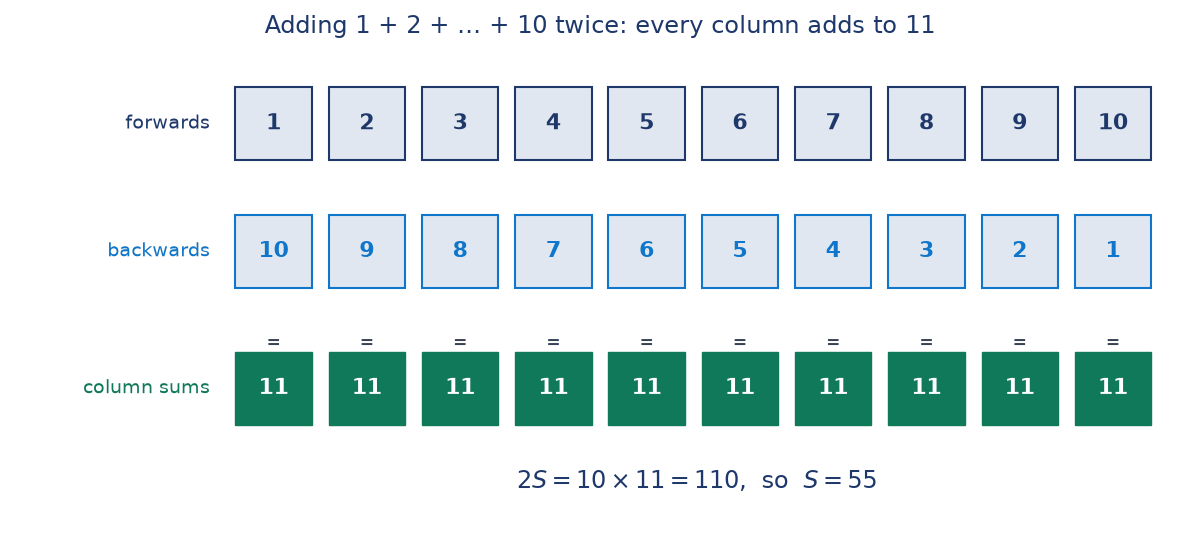
A well-known story says that the young Carl Friedrich Gauss found the sum 1+2+⋯+100 almost instantly by pairing numbers from the two ends. The same idea works for any AP. Take a smaller case, S=1+2+⋯+10, and write it twice, once forwards and once backwards:
SS=1+2+3+⋯+10=10+9+8+⋯+1
Add the two lines column by column. Every column adds up to 11, and there are 10 columns, so 2S=10×11=110 and S=55. In the same way, 1+2+⋯+100 has 100 columns each adding to 101, giving 2S=10100 and S=5050.
Writing the sum forwards and backwards makes every column add up to the same number.
Add the two lines term by term. In each column, one term has k lots of d and the term beneath it has n−1−k lots, so each column adds up to
2a+(n−1)d
There are n columns, so
2Sn=n[2a+(n−1)d]⇒Sn=2n[2a+(n−1)d]
Since 2a+(n−1)d=a+[a+(n−1)d]=a+l, this is the same as Sn=2n(a+l). In words: the sum is the number of terms times the average of the first and last terms.
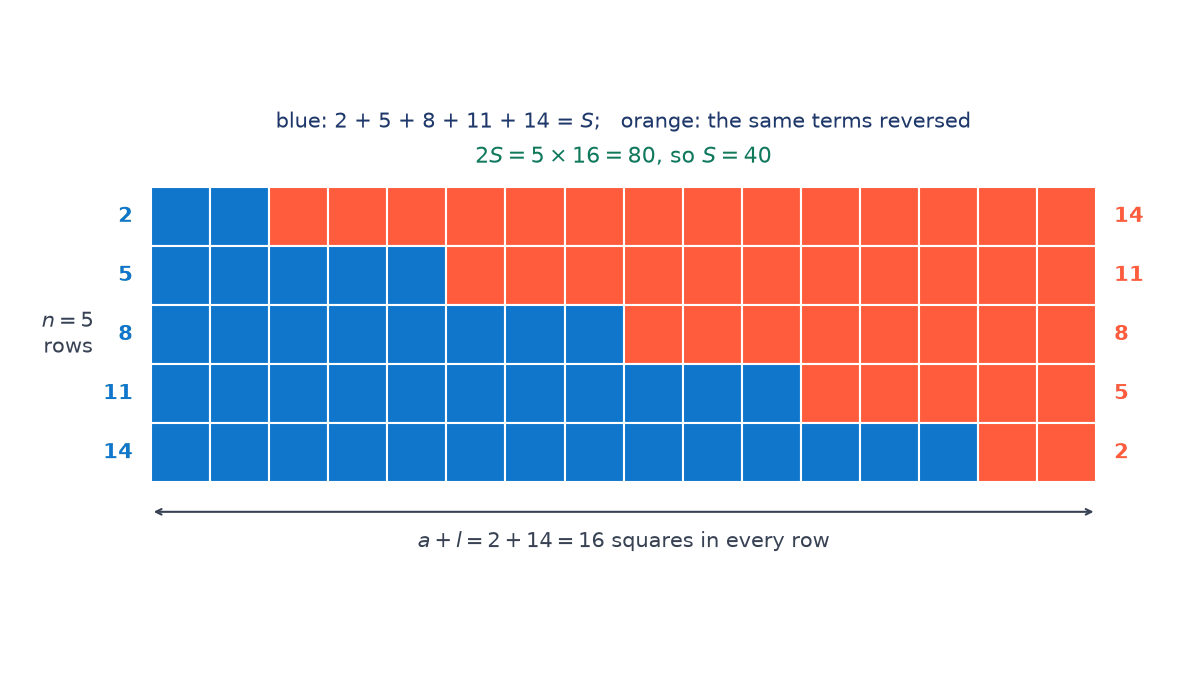
Two copies of the staircase 2, 5, 8, 11, 14 fit together into a 5 by 16 rectangle, so the sum is half of 80.
So n=6 or n=15. Both are positive whole numbers, so both are valid. Why? The nth term is an=30−3(n−1)=33−3n, so the terms from the 7th to the 15th are
12,9,6,3,0,−3,−6,−9,−12
These nine terms add up to 0, so adding them to the first six terms does not change the total.
Answer: Either 6 terms or 15 terms give a sum of 135.
(a) Pipes are stacked with 24 pipes in the bottom row, 23 in the next, 22 in the next, and so on, with 9 pipes in the top row. How many pipes are there?
The rows form the AP 24, 23, …, 9 with d=−1. From 24−(n−1)=9 we get n=16 rows. So the total is
S16=216(24+9)=8×33=264
(b) A loan is repaid in monthly instalments of ₹1000, ₹1100, ₹1200, and so on. How much is paid in the first 12 months?
Yes. When d is negative the later terms become negative, and the total can fall to zero or below, as in the AP 12, 9, …, −12, whose terms add up to 0.
Why can two different values of n give the same sum?#
If a block of consecutive terms adds up to zero, including or leaving out that block does not change the total. This can happen only when the terms change sign, so d and a have opposite signs.
Does the pairing method need an even number of terms?#
No. Writing the sum twice avoids the problem of a middle term, because every column pairs a term with a different copy. That is why the formula works for odd n too.