Class 10 Arithmetic Progressions Practice Questions and Solutions
Eighteen original Class 10 practice questions on arithmetic progressions, from spotting an AP to nth terms, sums and exam-level word problems, each with a complete step-by-step solution.
This set of 18 original questions practises the whole Class 10 chapter on arithmetic progressions: recognising an AP, finding its nth term, adding up its terms, and turning word problems into AP calculations. The questions start with short checks and build up to exam-level problems worth 3 to 5 marks. Try each one before reading the solution.
Quick recap
Idea
Formula or method
Common difference
d=ak+1−ak, the same for every k
Three numbers in AP
a,b,c are in AP when 2b=a+c
nth term
an=a+(n−1)d
mth term from the end
l−(m−1)d
Sum of n terms
Sn=2n[2a+(n−1)d]=2n(a+l)
Term from sums
an=Sn−Sn−1 for n≥2, and a1=S1
Solving for n
n must be a positive whole number; reject other roots
Identifying APs
Question 1
Is 4, 10, 16, 22, … an AP? If it is, write its next term.
The consecutive differences are 10−4=6, 16−10=6 and 22−16=6. They are all equal, so the list is an AP with d=6. The next term is 22+6=28.
Answer: Yes, d=6; the next term is 28.
Question 2
Is 1, −1, 1, −1, … an AP?
The differences are −1−1=−2 and 1−(−1)=2. These are not equal.
Answer: No. The list alternates, so it has no common difference.
Question 3
Find p if 2p, p+10 and 3p+2 are consecutive terms of an AP. Write the three terms.
For three numbers in AP, twice the middle one equals the sum of the other two:
2(p+10)2p+2018p=2p+(3p+2)=5p+2=3p=6
The terms are 2×6=12, 6+10=16 and 3×6+2=20, which have a common difference of 4.
Answer:p=6; the terms are 12, 16, 20.
Why this works:b−a=c−b rearranges to 2b=a+c.
The nth term
Question 4
Find the 25th term of the AP −8,−5,−2,…
Here a=−8 and d=−5−(−8)=3.
a25=−8+24×3=−8+72=64
Answer: 64.
Question 5
Which term of the AP 4, 9, 14, … is 249?
Here a=4 and d=5.
4+(n−1)×5(n−1)×5n−1n=249=245=49=50
Answer: The 50th term.
Question 6
Is 302 a term of the AP 6, 13, 20, … ? Give a reason.
Here a=6 and d=7. If an=302, then (n−1)×7=296, so n−1=7296, which is not a whole number.
You can also see this directly: a43=6+42×7=300 and a44=307, and 302 lies strictly between them.
Answer: No, 302 is not a term, because n would not be a whole number.
Question 7
The 7th term of an AP is −4 and the 13th term is −16. Find the AP and its 20th term.
Write the two facts as equations:
a+6d=−4anda+12d=−16
Subtracting the first from the second gives 6d=−12, so d=−2. Then a=−4−6×(−2)=8.
a20=8+19×(−2)=8−38=−30
Answer: The AP is 8, 6, 4, 2, …, and its 20th term is −30.
Question 8
How many terms are there in the AP 20,17.5,15,…,−45?
Here a=20, d=−2.5 and l=−45.
20+(n−1)(−2.5)(n−1)(−2.5)n−1n=−45=−65=26=27
Answer: 27 terms.
Sums of APs
Question 9
Find the sum of the first 22 terms of the AP 21,1,23,…
Here a=21, d=21 and n=22.
S22=222[2×21+21×21]=11[1+221]=11×223=2253
Answer:2253, that is, 126.5.
Question 10
Find the sum 46+43+40+⋯+10.
Here a=46, d=−3 and l=10. The number of terms comes from 46−3(n−1)=10, so n−1=12 and n=13.
S13=213(46+10)=213×56=364
Answer: 364.
Question 11
Find the sum of all two-digit numbers that are divisible by 7.
These numbers are 14, 21, …, 98, an AP with a=14, d=7 and l=98. From 14+7(n−1)=98 we get n−1=12, so n=13.
S13=213(14+98)=13×56=728
Answer: 728.
Question 12
The sum of the first n terms of an AP is Sn=6n−n2. Find the first term, the second term, the nth term and the 10th term.
This also gives a1=5, so the formula works for every n. Then a2=3 and a10=7−20=−13.
Answer:a1=5, a2=3, an=7−2n, a10=−13.
Question 13
The first and last terms of an AP are 4 and 52, and the sum of all its terms is 364. Find the number of terms and the common difference.
Using Sn=2n(a+l):
364=2n(4+52)=28n⇒n=13
Then 52=4+12d, so 12d=48 and d=4.
Answer: 13 terms; d=4.
Word problems and exam-level questions
Question 14
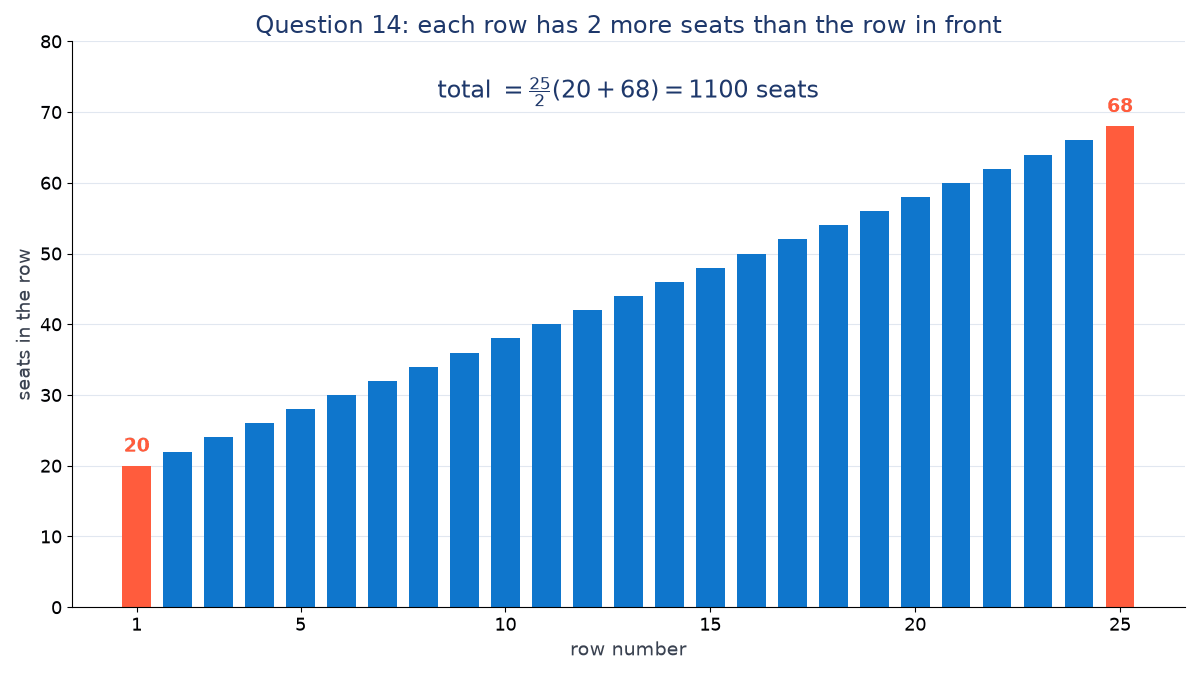
A hall has 25 rows of seats. The first row has 20 seats and each row has 2 more seats than the row in front of it. How many seats are in the last row, and how many seats are there in the hall?
The seats per row form an AP with a=20, d=2 and n=25.
a25=20+24×2=68
S25=225(20+68)=225×88=1100
Seats per row rise steadily from 20 to 68, so the total is the number of rows times the average of the first and last rows.
Answer: 68 seats in the last row; 1100 seats in all.
Question 15
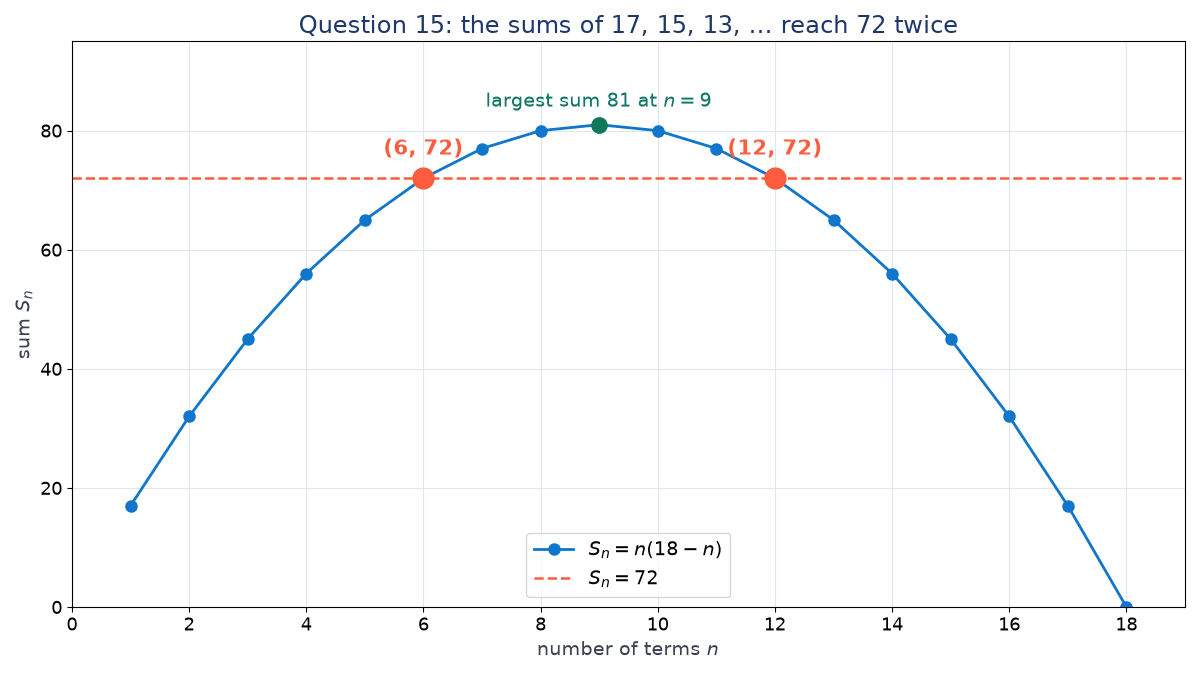
How many terms of the AP 17, 15, 13, … must be taken so that their sum is 72? Explain the double answer.
So n=6 or n=12. Both are positive whole numbers. The 7th to 12th terms are 5,3,1,−1,−3,−5, which add up to 0, so the sum of 12 terms equals the sum of 6 terms.
The running total of 17, 15, 13, … rises to 81 and then falls, so it passes 72 once on the way up and once on the way down.
Answer: 6 terms or 12 terms.
Question 16
For the AP 7, 13, 19, …, 241, find (a) the number of terms, (b) the two middle terms, and (c) the sum of the last 10 terms.
(a) With a=7 and d=6: 7+6(n−1)=241 gives n−1=39, so n=40.
(b) Since 40 is even, the middle terms are the 20th and 21st:
a20=7+19×6=121,a21=7+20×6=127
(c) The last 10 terms are the 31st to the 40th. Here a31=7+30×6=187 and a40=241, so
Sum=210(187+241)=5×428=2140
Answer: (a) 40; (b) 121 and 127; (c) 2140.
Why this works: the last 10 terms are themselves an AP, so the first-and-last form applies to them directly.
Question 17
A club gives 6 prizes with a total value of ₹1200. Each prize is ₹30 less than the prize just above it. Find the value of each prize.
Let the top prize be ₹a. The prizes form an AP with d=−30 and n=6:
26[2a+5×(−30)]2a−150a=1200=400=275
The prizes are ₹275, ₹245, ₹215, ₹185, ₹155 and ₹125. Check: these add up to ₹1200.
Answer: ₹275, ₹245, ₹215, ₹185, ₹155 and ₹125.
Question 18
The second and third terms of an AP are 11 and 17. Find the sum of its first 30 terms.
The common difference is d=17−11=6, so the first term is a=11−6=5.
S30=230[2×5+29×6]=15×184=2760
Answer: 2760.
Key terms
Arithmetic progression
A sequence in which every term after the first is the previous term plus a fixed number d.
Common difference
The fixed number d; any term minus the term before it.
nth term
an=a+(n−1)d.
Last term
The final term l of a finite AP.
Sum of n terms
Sn=2n[2a+(n−1)d]=2n(a+l).
Middle term
For an odd number of terms n, the 2n+1th term; for even n there are two middle terms.
Common questions
How much working should I show in a 3-mark AP question?
Write a and d, the formula you are using, the substitution, and the final answer with units. Examiners give marks for each of these steps.
What if solving for n gives a fraction?
If the question asks which term has a value, a fractional n means the value is not a term. If it asks how many terms give a sum, reject the fractional root.
When are both roots of the quadratic in n acceptable?
When both are positive whole numbers. This happens when the terms change sign and a block of terms adds up to zero, as in Question 15.
Can I use either sum formula?
Yes. Use 2n(a+l) when the last term is known, and 2n[2a+(n−1)d] otherwise. Both give the same value.
References
National Council of Educational Research and Training. Mathematics: Textbook for Class X. NCERT, New Delhi.
Aggarwal, R. S. Secondary School Mathematics for Class 10. Bharati Bhawan.
Sharma, R. D. Mathematics for Class 10. Dhanpat Rai Publications.