How income and wealth inequality differ from poverty, how the Lorenz curve and Gini coefficient measure inequality, and the main causes of unequal incomes.
Income inequality is closely linked to poverty, but it is not the same thing.
Inequality can be looked at in two different ways: income inequality and wealth inequality.
Income is a flow of earnings received at a certain rate in a given period, such as a salary or rental earnings.
Wealth is the stock or monetary value of a person's marketable assets.
Difference between poverty and income inequality#
Income inequality is the degree to which income is distributed unequally throughout a population. Wealth inequality is how unequal the distribution of wealth is throughout a population.
A population can be divided up in many different ways to study and understand how income and wealth are distributed.
The population can be divided up by age to see how income is distributed between the old and the young.
Poverty, on the other hand, as described in the previous section, is when people are unable to afford the sufficient necessities to sustain themselves.
Let's discuss some of the measurements of income inequality. Economists measure income inequality using a variety of criteria. The most generally used measures - the Lorenz curve, the Gini coefficient, decile ratios, the Palma ratio, and the Theil index - all have merits and limits.
The choice of what to measure is also crucial: pre-tax and after-tax income, consumption, and wealth are helpful indicators, as are various sources of income such as wages, capital gains, taxes, and perks.
Understanding the dimensions of economic inequality is a critical first step in determining the best solutions to combat it.
Measurements of income inequality: The Lorenz curve#
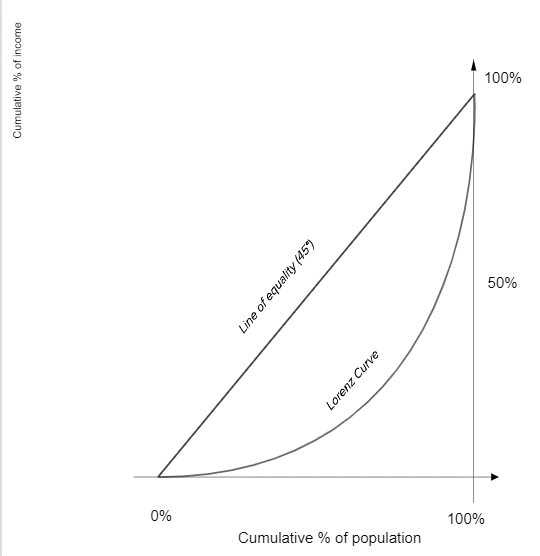
The Lorenz curve is one measure of income inequality. It graphically depicts how income is distributed throughout a population.
As the figure shows, the cumulative percentage of the population is plotted against the cumulative percentage of the income of a population. The straight line of equality shows a perfectly equal society. The Lorenz curve is below the line of equality. The further away it is, the greater the income inequality.
Measurements of income inequality: The Gini coefficient#
The Gini Coefficient is related to the Lorenz curve. It is the ratio of the area between the 45-degree line of equality and the Lorenz curve to the whole area under the line of equality.
Its values range from 0 to 1. A value of 0 means that income is perfectly shared equally across society. A value of 1 would mean that one single person has access to all the income in a country.
The closer the Gini coefficient is to 1, the more unequal the distribution of income.
There are many causes of both poverty and income inequality. Some causes are:
Wages. Unequal distribution of wages on grounds of higher educational achievements or longer working hours causes a disparity among the higher income earners and lower-income earners. A higher-income earner can save more, which build up more wealth compared to a lower-income earner whose basic needs take precedence.
Wealth levels. A higher level of wealth eventually leads to more wealth. With more wealth, people can take on riskier investments with higher returns, which raise their income further.
Chance. This is based on good decision making and luck of the people who either choose the right sort of job that increases their income or they invest in assets that increase their wealth.
Age. Working adults at the peak of their careers usually earn more than people just starting out, and older people have had time to build up wealth and assets.
Position in the world economy. This helps explain differences in income and wealth between countries. Developing countries may be at a disadvantage in international trade and negotiations, which tend to favour developed countries.
What is the difference between poverty and inequality?#
Poverty is when people cannot afford the sufficient necessities to sustain themselves. Inequality refers to the unequal distribution of income or wealth which results in some people having more than others.
What is the relationship between economic growth, poverty and inequality?#
Economic growth positively affects absolute poverty by raising the levels of income. However, it may not reduce relative poverty, because the benefits of growth may not be shared equally.