Distance Formula in Coordinate Geometry: Class 10 Guide
Learn the distance formula from Pythagoras, then use it to test collinearity, classify triangles and quadrilaterals, find unknown coordinates and locate equidistant points, with six worked examples.
Coordinate geometry joins algebra and geometry. Once every point of a plane has a pair of numbers attached to it, we can measure lengths, test shapes and locate points with plain arithmetic instead of a ruler. The distance formula is the first and most-used tool of this chapter. With it you can find how far apart two points are, check whether three points lie on one line, and decide whether four points make a square, a rhombus, a rectangle or just a parallelogram. The same idea is used in maps, in computer graphics and wherever positions are stored as coordinates.
Two perpendicular number lines, the horizontal x-axis and the vertical y-axis, meet at the originO(0,0). Every point P is described by an ordered pair (x,y). The first number, the abscissa, is the signed distance of P from the y-axis. The second number, the ordinate, is the signed distance of P from the x-axis.
Take A(x1,y1) and B(x2,y2) with AB neither horizontal nor vertical. Through A draw a line parallel to the x-axis, and through B a line parallel to the y-axis. They meet at C(x2,y1), and the angle at C is a right angle because the axes are perpendicular.
A and C have the same y-coordinate, so AC=∣x2−x1∣.
B and C have the same x-coordinate, so BC=∣y2−y1∣.
By the Pythagoras theorem in right triangle ACB,
A square of a number equals the square of its absolute value, so the modulus signs can be dropped. Since a distance is never negative, we take the positive square root. If AB is horizontal, then y2=y1 and the formula gives ∣x2−x1∣, which is correct. The vertical case works in the same way. So the formula holds for every pair of points.
Putting A=O(0,0) gives the distance from the origin, x2+y2.
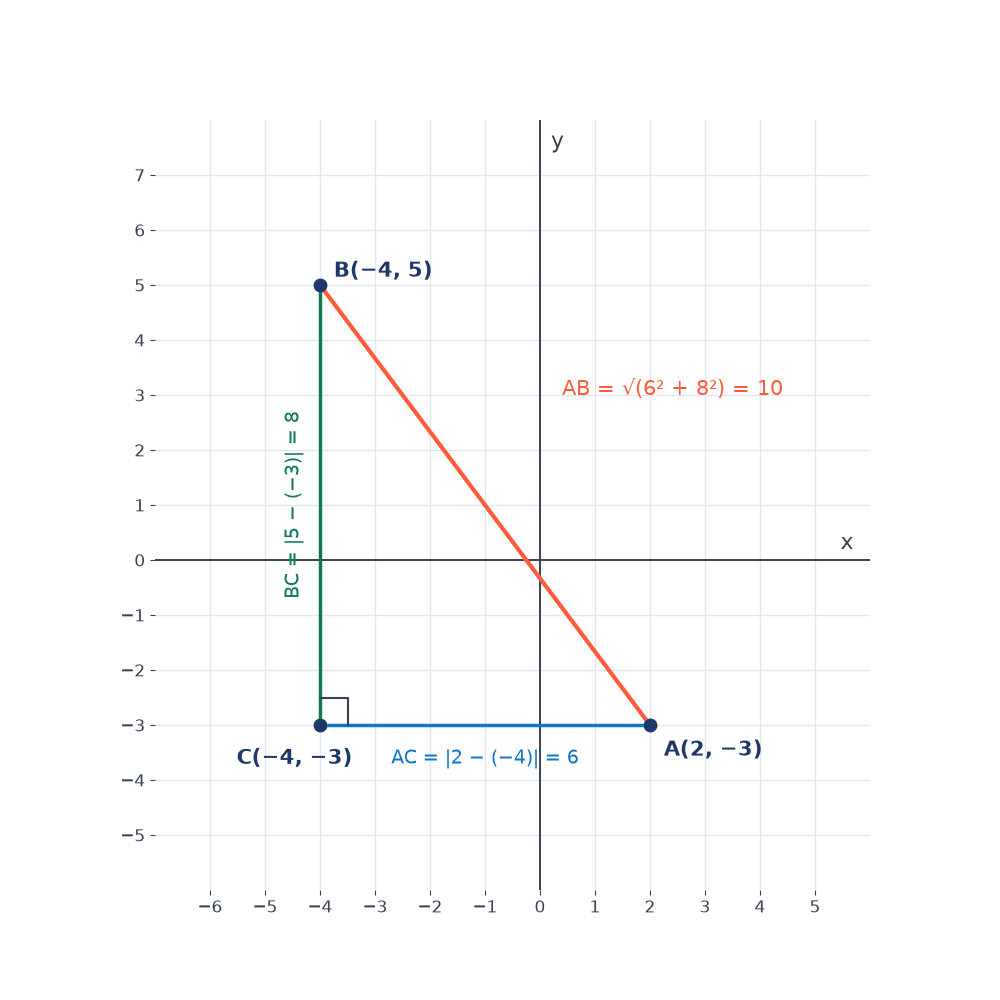
The distance formula is Pythagoras on a grid: AC = 6, BC = 8, so AB = 10.
The order of the points does not matter: (x2−x1)2=(x1−x2)2. So AB=BA, as it should.
Three points A, B, C lie on one straight line exactly when the largest of the three distances equals the sum of the other two, for example AB+BC=AC. If the largest distance is less than the sum of the other two, the points form a triangle.
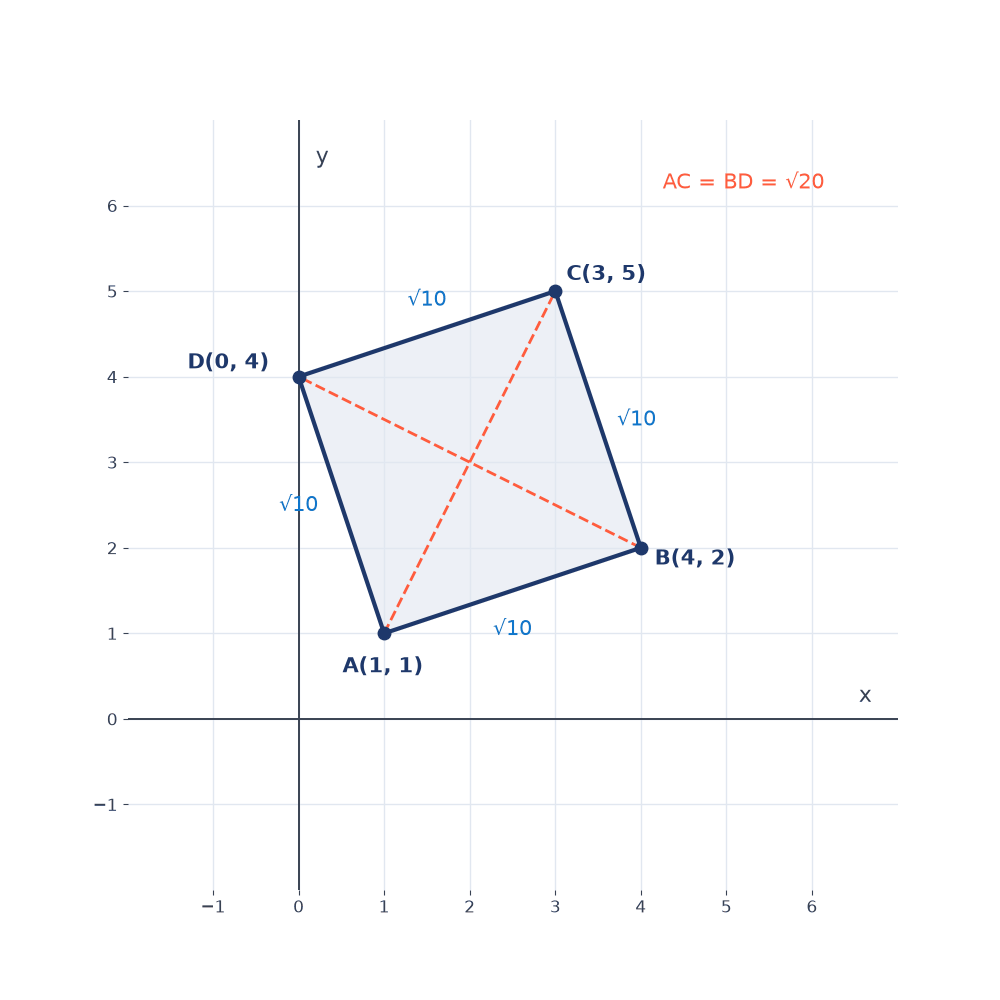
Take the vertices A,B,C,D in order. Find the four sides AB,BC,CD,DA and the two diagonals AC,BD.
Sides
Diagonals
Quadrilateral
All four equal
Equal
Square
All four equal
Not equal
Rhombus (not a square)
Opposite sides equal
Equal
Rectangle
Opposite sides equal
Not equal
Parallelogram (not a rectangle)
These tests rest on standard facts. A quadrilateral with both pairs of opposite sides equal is a parallelogram. A parallelogram with equal diagonals is a rectangle. A rhombus with equal diagonals is a square.
Show that A(2,1), B(5,5) and C(9,2) are the vertices of an isosceles right-angled triangle.
ABBCAC=32+42=25=5=42+(−3)2=25=5=72+12=50
Two sides are equal, so the triangle is isosceles. Also AB2+BC2=25+25=50=AC2, so by the converse of Pythagoras the angle at B is 90∘. The triangle is an isosceles right-angled triangle with the right angle at B.
Writing a2+b2=a+b. The square root of a sum is not the sum of the square roots.
Mixing an x-coordinate with a y-coordinate inside one difference. The order of subtraction does not matter, because each difference is squared, but both numbers in a difference must be x-coordinates, or both y-coordinates.
Deciding a quadrilateral is a square from four equal sides alone. A rhombus also has four equal sides, so you must compare the diagonals too.
For collinearity, adding the wrong pair. The largest distance must equal the sum of the other two.
Throwing away one of the two answers in an unknown-coordinate question without checking. Often both are valid.
Leaving answers such as 50 when the question asks for the simplest form, which is 52.
Both have four equal sides. Compare the diagonals: equal diagonals mean a square, unequal diagonals mean a rhombus that is not a square.
Why can an unknown-coordinate question have two answers?#
Squaring leads to a quadratic equation. Geometrically, a circle around the fixed point usually cuts the given line in two places, so two positions can be at the required distance.