nth Term of an AP: Formula and Worked Examples, Class 10
Derive the nth term formula of an AP and use it to find any term, decide whether a number is a term, build an AP from two terms, count from the end and solve savings and multiples problems.
Once you know that a list is an arithmetic progression, you rarely want to write out every term to reach the one you need. The 100th term of 5, 9, 13, … would take a long time to find by adding 4 again and again. The nth term formula gives any term directly from the first term and the common difference. It also answers the reverse questions: which term has a given value, whether a number belongs to the list at all, and how many terms a list has. These questions come up in savings plans, instalment schedules and counting problems such as "how many three-digit numbers are multiples of 9?".
The nth term formula
Notation
For an AP we write a for the first term, d for the common difference and an for the term in position n. When the AP is finite, its last term is written l and the number of terms is n. The nth term an is also called the general term.
The result
The nth term of the AP a,a+d,a+2d,… is
an=a+(n−1)d
For a finite AP whose last term is the nth term, l=a+(n−1)d.
Why the formula is true
Each step from one term to the next adds one d. Write the first few terms and count the ds:
To travel from the 1st term to the nth term you take n−1 steps, because positions 1 to n have n−1 gaps between them. Each step adds d, so altogether (n−1)d has been added to a. Therefore an=a+(n−1)d.
A useful consequence: for any two positions p and q, ap−aq=(p−q)d. The gap between two terms is the number of steps between them times d.
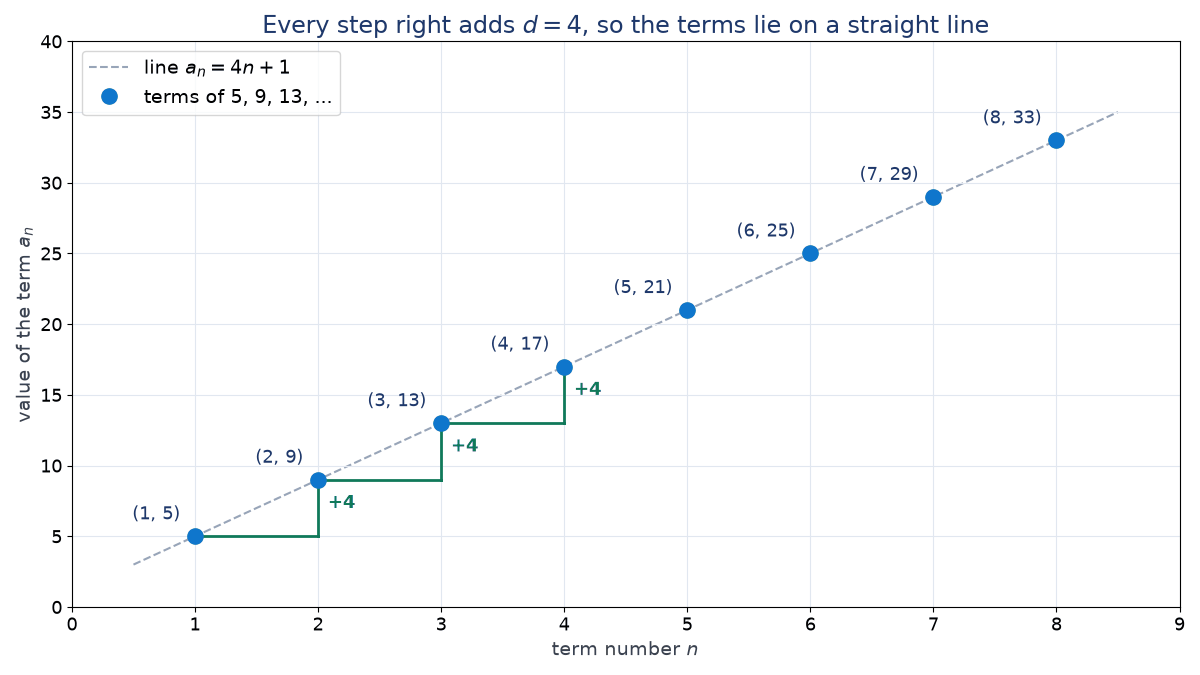
Plotting term number against term value for 5, 9, 13, … gives points on the line an=4n+1; each step right raises the value by d=4.
The graph shows another way to see the formula. For 5, 9, 13, …, an=5+(n−1)×4=4n+1. The nth term of any AP is a linear expression in n, and the coefficient of n is the common difference.
Method: using the formula
Read off a (the first term) and find d (second term minus first term).
Write the formula an=a+(n−1)d and decide which quantity is unknown: an, n, a or d.
Substitute the known values and solve the equation for the unknown.
If you solved for n, check that it is a positive whole number. If it is not, the given value is not a term of the AP.
Check your answer by substituting back, and state it in words.
Worked examples
Example 1: finding a term
Find the 20th term of the AP 5, 9, 13, … .
Here a=5 and d=9−5=4. With n=20:
a20=5+(20−1)×4=5+76=81
Answer: The 20th term is 81.
Example 2: which term has a given value
Which term of the AP 7, 13, 19, … is 205?
Here a=7 and d=6. Put an=205:
7+(n−1)×6(n−1)×6n−1n=205=198=33=34
Answer: 205 is the 34th term.
Example 3: is a number a term?
Is 150 a term of the AP 11, 17, 23, … ?
Here a=11 and d=6. Suppose an=150:
11+(n−1)×6(n−1)×6n−1=150=139=6139
Since 6139 is not a whole number, n is not a whole number, and a term position must be a positive whole number.
Answer: No, 150 is not a term of this AP.
Why this works: every term is 11 more than a multiple of 6, and 150−11=139 is not a multiple of 6.
Example 4: finding the AP from two terms
The 4th term of an AP is 17 and its 11th term is 45. Find the AP.
Write both facts using the formula:
a+3d=17anda+10d=45
Subtract the first equation from the second:
7d=28⇒d=4
Substitute into a+3d=17: a+12=17, so a=5.
Check: a11=5+10×4=45.
Answer: The AP is 5, 9, 13, 17, … .
Example 5: a term counted from the end
Find the 8th term from the end of the AP 4, 9, 14, …, 254.
Counting backwards from the last term is an AP too, with first term l and common difference −d. So the mth term from the end is
l−(m−1)d
Here l=254, d=5 and m=8:
254−(8−1)×5=254−35=219
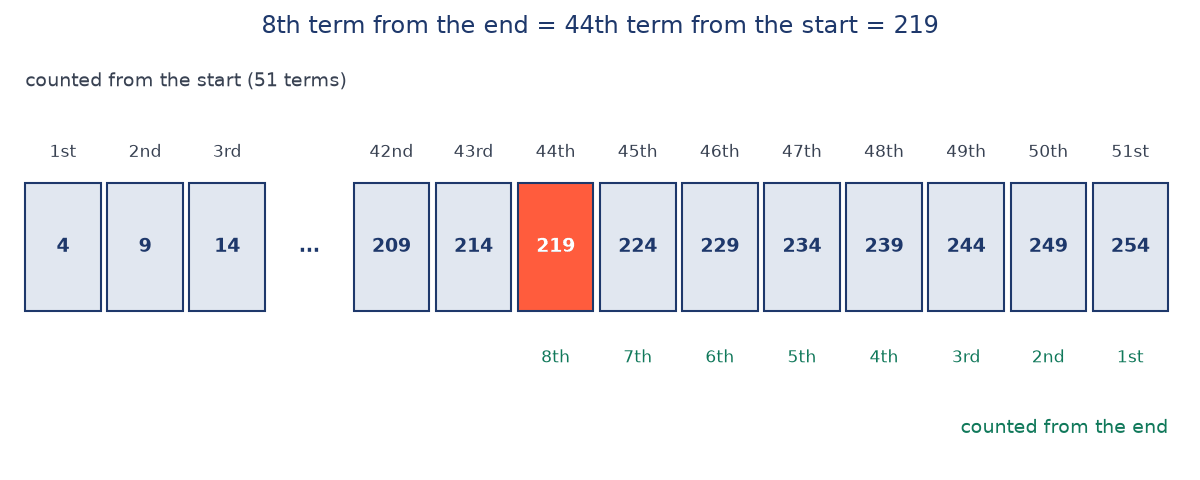
Check by counting from the front. The number of terms is found from 4+(n−1)×5=254, giving n−1=50, so n=51. The 8th term from the end is the (51−8+1)th = 44th term from the start, and a44=4+43×5=219.
Answer: 219.
In a list of 51 terms, the 8th term from the end is the 44th from the start.
Example 6: counting multiples in a range
How many three-digit numbers are divisible by 9?
The smallest three-digit multiple of 9 is 108 (since 9×11=99 has only two digits and 9×12=108), and the largest is 999 (since 9×111=999). The multiples form the AP 108, 117, …, 999 with d=9.
108+(n−1)×9(n−1)×9n−1n=999=891=99=100
Answer: 100 three-digit numbers are divisible by 9.
Example 7: a savings word problem
Meera saves ₹150 in the first month and increases her saving by ₹25 every month after that. How much does she save in the 12th month, and in which month does she first save ₹600?
The monthly savings form an AP with a=150 and d=25.
For the 12th month:
a12=150+11×25=150+275=425
For a saving of ₹600:
150+(n−1)×25(n−1)×25n−1n=600=450=18=19
Answer: She saves ₹425 in the 12th month, and she saves ₹600 in the 19th month.
Common mistakes
Writing an=a+nd. The first term already sits in position 1, so only n−1 steps are needed.
Taking d as first term minus second term. For 26, 22, 18 the common difference is −4, not 4.
Accepting a fractional or negative value of n. A term number must be a positive whole number; otherwise the value is not a term.
Using l+(m−1)d for the mth term from the end. Going backwards subtracts d.
Counting multiples by dividing the range, such as 9999−100. Find the first and last multiples and use the formula instead.
Stopping at d when the question asks for the AP. Always find a too and write out the first few terms.
Try these
Find the 15th term of the AP 3, −1, −5, … . Answer:−53.
Which term of the AP 26, 22, 18, … is −82? Answer: The 28th term.
How many two-digit numbers are divisible by 4? Answer: 22.
Find the 10th term from the end of the AP 7, 10, 13, …, 184. Answer: 157.
The 3rd term of an AP is 12 and the 9th term is 30. Find its 20th term. Answer: 63 (the AP is 6, 9, 12, …).
Key terms
nth term (general term)
The term in position n, given by an=a+(n−1)d.
First term
The term in position 1, written a.
Common difference
The constant d=ak+1−ak between consecutive terms.
Last term
The final term l of a finite AP; l=a+(n−1)d.
Number of terms
The value of n for which an=l; it must be a positive whole number.
Term from the end
The mth term counting backwards from l, equal to l−(m−1)d.
Common questions
Why is it n minus 1 and not n?
Between position 1 and position n there are n−1 gaps. Only the gaps add a d, so the nth term is a plus n−1 lots of d.
How can I tell quickly that a number is not a term?
Subtract the first term from the number. If the result is not an exact multiple of d (with the right sign), the number is not a term.
Is the nth term always a linear expression?
Yes. a+(n−1)d=dn+(a−d), which is of the form pn+q with p=d. Conversely, any sequence with an=pn+q is an AP with common difference p.
How do I find the middle term of a finite AP?
If the number of terms n is odd, the middle term is the 2n+1th term. If n is even, there are two middle terms, the 2nth and the (2n+1)th.
Can two different terms of an AP be equal?
Only when d=0. If d=0, then ap−aq=(p−q)d is non-zero whenever p=q.
References
National Council of Educational Research and Training. Mathematics: Textbook for Class X. NCERT, New Delhi.
Sharma, R. D. Mathematics for Class 10. Dhanpat Rai Publications.
Hall, H. S. and Knight, S. R. Higher Algebra. Macmillan.