What is an Arithmetic Progression? Class 10 Maths Guide
Learn what an arithmetic progression is: first term, common difference, the general form a, a + d, a + 2d, finite and infinite APs, and a sure method to test whether any list of numbers is an AP.
Many lists of numbers grow or shrink by the same amount at every step. Suppose you put ₹200 in a piggy bank and then add ₹50 every week: the amounts in the bank are ₹200, ₹250, ₹300, ₹350 and so on. A hall where each row has 3 more chairs than the row in front might have 20, 23, 26, 29 chairs in its first four rows. Lists like these are called arithmetic progressions, or APs for short. They are the simplest kind of pattern in algebra, and they appear in savings plans, instalment payments, seating plans, stacking problems and timetables. This lesson explains exactly what an AP is, how to describe one with just two numbers, and how to test whether a given list is an AP or not.
A sequence is a list of numbers written in a definite order. Each number in the list is called a term. We write the first term as a1, the second as a2, the third as a3, and in general the term in position n as an. For the piggy bank list, a1=200, a2=250 and a3=300.
Order matters. The lists 2, 5, 8 and 8, 5, 2 contain the same numbers but are different sequences, because their first terms are different.
The definition of an arithmetic progression#
An arithmetic progression is a sequence in which each term, except the first, is obtained by adding a fixed number to the term just before it. That fixed number is called the common difference and is written d. The first term is usually written a.
In symbols, a list a1,a2,a3,… is an AP when
ak+1−ak=dfor every k=1,2,3,…
The common difference can be positive, negative or zero, and it does not have to be a whole number.
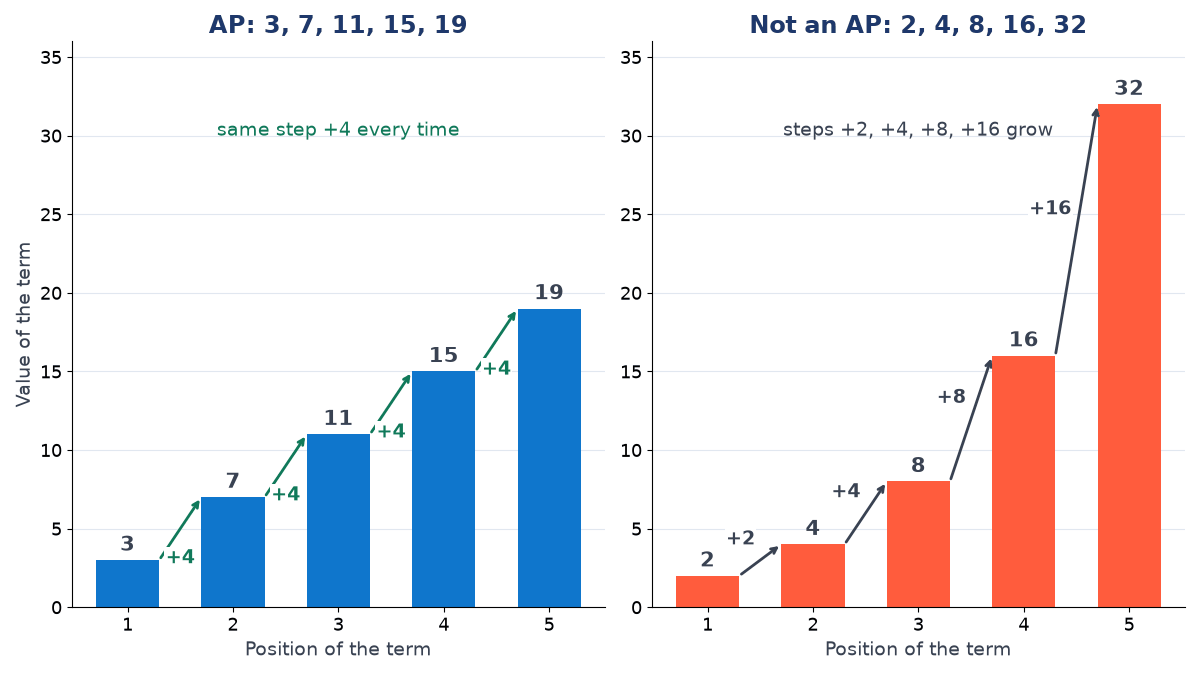
If d>0, the terms increase: 3, 7, 11, 15, … has d=4.
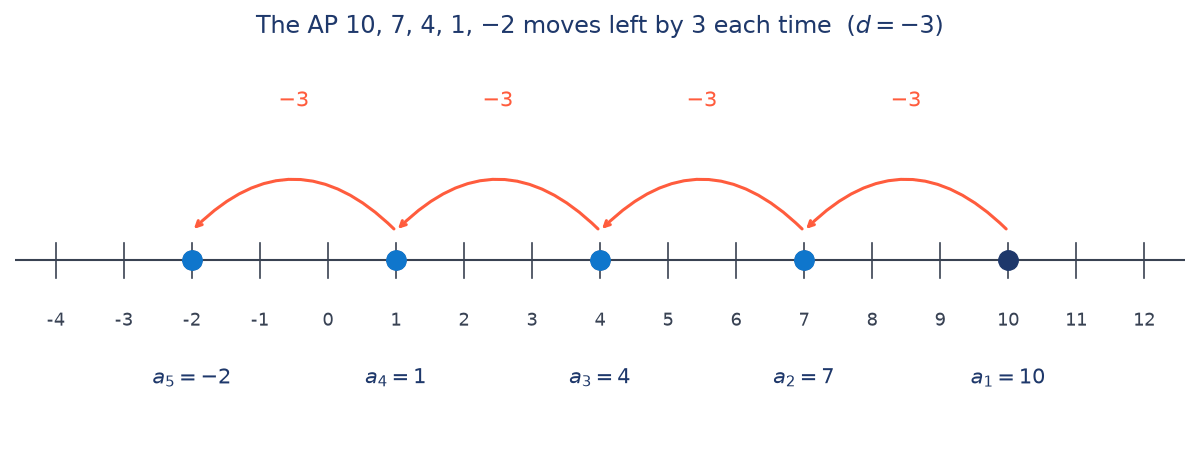
If d<0, the terms decrease: 10, 7, 4, 1, … has d=−3.
If d=0, every term is the same: 6, 6, 6, 6, … is an AP with d=0.
In an AP every step is the same size (left). When the steps change size, as in 2, 4, 8, 16, 32 (right), the list is not an AP.
If you know the first term a and the common difference d, you can write down every term. Start at a and keep adding d:
a,a+d,a+2d,a+3d,…
This is called the general form of an AP. Notice the pattern: the second term has one d added, the third term has two, the fourth has three. Each term has one fewer d than its position number. This observation leads straight to the formula for the nth term, an=a+(n−1)d, which is the subject of the next lesson in this chapter.
The definition says each term is the previous term plus d. Subtracting the previous term from both sides gives ak+1−ak=d. So a list is an AP exactly when all of its consecutive differences are equal. If even one difference is different from the others, the list is not an AP. This is the whole reason the test below works, and it is why checking only the first two terms is never enough.
A finite AP has a last term. The two-digit multiples of 5, namely 10, 15, 20, …, 95, form a finite AP with 18 terms. An infinite AP goes on for ever, such as the list of odd numbers 1, 3, 5, 7, … . We show that a list continues by writing three dots at the end. For a finite AP, the last term is often written l.
An AP with a negative common difference moves the same distance to the left at every step.
Work out every consecutive difference: a2−a1, a3−a2, a4−a3, and so on. Always subtract a term from the term after it.
If all the differences are equal, the list is an AP and that common value is d.
If any two differences are unequal, the list is not an AP. Say which differences disagree.
If the list is an AP and the question asks for more terms, keep adding d to the last term.
Here are some quick checks.
List
Differences
AP?
3, 7, 11, 15
4, 4, 4
Yes, d=4
10, 7, 4, 1, −2
−3, −3, −3, −3
Yes, d=−3
21,65,67,23
31,31,31
Yes, d=31
2, 4, 8, 16
2, 4, 8
No
1, 4, 9, 16
3, 5, 7
No
The last two rows are important non-examples. In 2, 4, 8, 16 each term is multiplied by 2, so the steps keep growing. In 1, 4, 9, 16 (the square numbers) the differences increase by 2 each time, so again they are not equal.
The differences are 3−1=2, 6−3=3 and 10−6=4. Since 2=3, the differences are not all equal.
Answer: No. The gaps grow by one each time, so there is no common difference.
Example 5: finding an unknown so that three terms form an AP#
For what value of k are k+1, 2k+1 and 4k−1 consecutive terms of an AP?
Three numbers are in AP when the middle difference equals the first difference:
(2k+1)−(k+1)=(4k−1)−(2k+1)
Simplify each side:
kk=2k−2=2
Check: with k=2 the terms are 3, 5, 7, whose differences are 2 and 2.
Answer:k=2.
Why this works: the condition b−a=c−b can be rearranged to 2b=a+c, so the middle term of three numbers in AP is always the average of the other two.
Subtracting the wrong way round. The common difference is a later term minus the earlier one, so for 10, 7, 4 it is −3, not 3.
Checking only the first two terms. A list such as 1, 3, 6, 10 starts with a difference of 2 but is not an AP. Check every difference you are given.
Thinking d must be a positive whole number. Negative, zero and fractional differences are all allowed.
Comparing surds without simplifying them first. 12−3 is not 9; write 12=23 and then subtract.
Confusing an AP with a list that multiplies by a fixed number, such as 2, 4, 8, 16. Multiplying gives growing gaps, so it is not an AP.
Forgetting the sign when adding a negative fraction, for example writing 41−21=41 instead of −41.
Any two numbers can be treated as the first two terms of an AP, since there is only one difference to compare. Questions on testing an AP therefore always give at least three terms.
How do I know whether to write d as a fraction or a decimal?#
Match the form of the question. If the terms are fractions, keep d as a fraction; if they are decimals, a decimal is fine. Both are correct if they are equal in value.
Why is the middle of three AP terms their average?#
If a, b and c are in AP, then b−a=c−b, which rearranges to b=2a+c. This is a quick way to find an unknown middle term.