Derive the section formula using similar triangles, then use it for midpoints, ratios in k to 1 form, division by an axis, points of trisection, the missing vertex of a parallelogram and the centroid.
The distance formula tells you how far apart two points are. The section formula answers a different question: where exactly is the point that cuts a segment in a given ratio? It is used to find midpoints, points of trisection, a missing vertex of a parallelogram and the centroid of a triangle. It is also the idea behind dividing a straight road or pipeline into equal stretches when the ends are known on a map.
What "dividing in a ratio" means
Internal division
Let A and B be two points. A point P on the segment ABdivides AB internally in the ratio m1:m2 if
PBAP=m2m1
where m1 and m2 are positive. The ratio is always read from the first-named point: AP:PB. If P divides AB in 2:3, then P divides BA in 3:2.
Special cases
Midpoint: the ratio is 1:1.
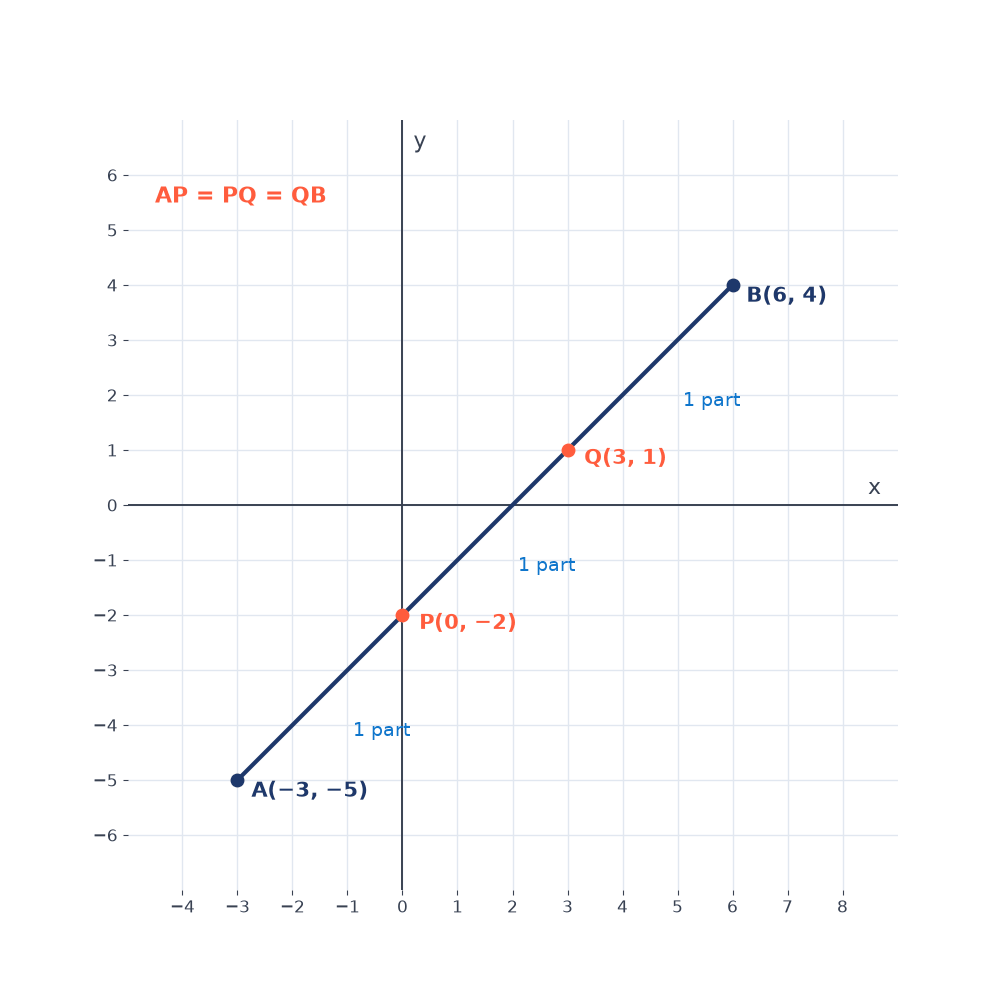
Points of trisection: the two points that divide AB into three equal parts. They divide AB in the ratios 1:2 and 2:1.
Ratio k:1: any ratio m1:m2 can be written as k:1 with k=m2m1. This form uses one unknown instead of two.
The section formula
Statement
The point P(x,y) that divides the segment joining A(x1,y1) and B(x2,y2) internally in the ratio m1:m2 is
A useful way to remember it: each end point is multiplied by the part of the ratio next to the other end. So x2 (from B) goes with m1, and x1 (from A) goes with m2.
Why the formula is true
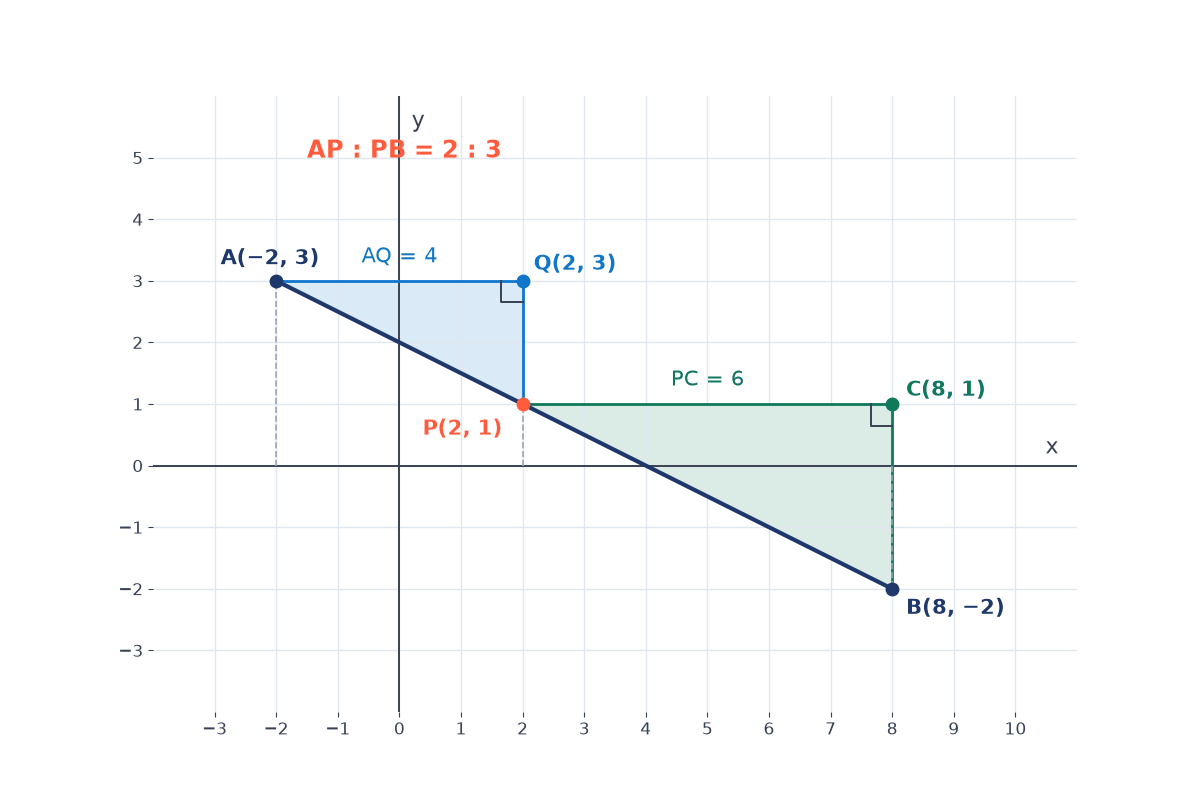
Take the case where x1<x<x2 and the segment is not parallel to an axis. Draw perpendiculars from A, P and B to the x-axis. Through A draw a line parallel to the x-axis meeting the perpendicular from P at Q. Through P draw a line parallel to the x-axis meeting the perpendicular from B at C. Then Q=(x,y1) and C=(x2,y).
In triangles AQP and PCB:
∠AQP=∠PCB=90∘, since each is made by a horizontal line and a vertical line;
∠PAQ=∠BPC, since AQ∥PC and AB is a transversal (corresponding angles).
So △AQP∼△PCB by the AA criterion. Corresponding sides of similar triangles are proportional:
The vertical sides give the y-coordinate in the same way. If y increases from A to B, then QP=y−y1 and CB=y2−y. If y decreases, as in the figure below, then QP=y1−y and CB=y−y2. In both cases the ratio equals y2−yy−y1, which gives y=m1+m2m1y2+m2y1. The other arrangements of the points give the same result.
Triangles AQP and PCB are similar, so AP : PB = AQ : PC = 4 : 6 = 2 : 3.
The midpoint formula
Put m1=m2 in the section formula. The midpoint of the segment joining A(x1,y1) and B(x2,y2) is
M=(2x1+x2,2y1+y2)
Each coordinate of the midpoint is the average of the corresponding coordinates of the end points.
The centroid of a triangle
A median joins a vertex of a triangle to the midpoint of the opposite side. The three medians meet at the centroidG, which divides each median in the ratio 2:1 from the vertex. For A(x1,y1), B(x2,y2) and C(x3,y3), let D be the midpoint of BC:
D=(2x2+x3,2y2+y3)
Dividing AD in the ratio 2:1:
x=2+12⋅2x2+x3+1⋅x1=3x1+x2+x3
and similarly for y. The same point comes out from any of the three medians, so
G=(3x1+x2+x3,3y1+y2+y3)
Method in steps
Finding the point when the ratio is known
Label the end points A(x1,y1) and B(x2,y2) in the order the ratio is given.
Write m1 (next to A) and m2 (next to B).
Substitute into the section formula, crossing the ratio: m1 with B and m2 with A.
Simplify each coordinate separately.
Finding the ratio when the point is known
Let the ratio be k:1.
Write one coordinate of the point using the section formula with m1=k and m2=1.
Equate it to the known coordinate and solve for k.
Write the ratio as k:1 and clear any fractions. If k is negative, the division is external, which is outside this syllabus.
Use k in the other coordinate to find the missing value, or to check the point.
When a segment is cut by the x-axis, the point has y=0. When it is cut by the y-axis, the point has x=0.
Worked examples
Example 1: point of division and midpoint
(a) Find the point that divides the segment joining A(−2,3) and B(8,−2) internally in the ratio 2:3.
By the formula: G=(3−1+5+2,34+2−3)=(2,1). Both methods give G(2,1).
Common mistakes
Pairing the ratio the wrong way: writing m1x1+m2x2 instead of m1x2+m2x1.
Reading the ratio from the wrong end. "P divides AB in 1:2" means P is nearer to A.
Giving only one point of trisection when the question asks for both.
Using y=0 for division by the y-axis. On the y-axis it is x=0 that holds.
Leaving the ratio as 32:1 instead of writing 2:3.
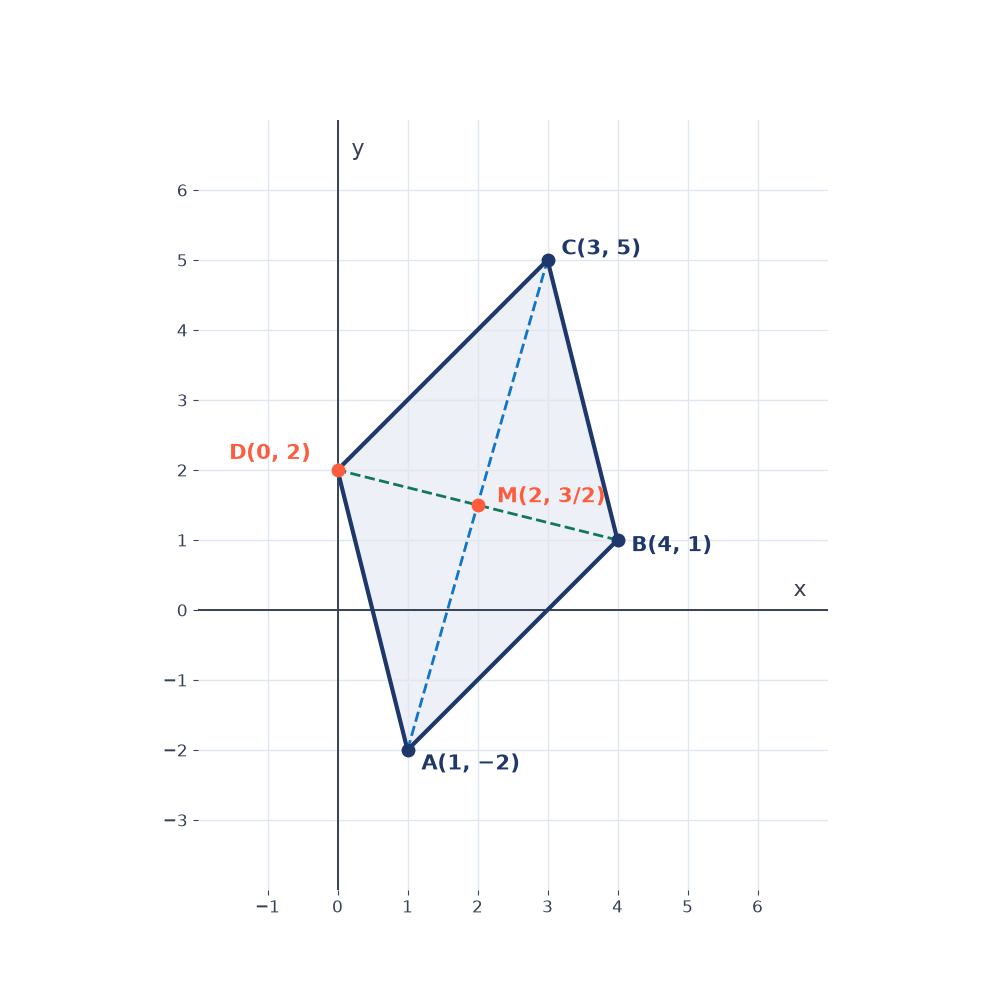
For a parallelogram, equating the midpoints of adjacent vertices, such as AB and CD. It is the diagonals, AC and BD, that bisect each other.
Dividing by 2 instead of 3 in the centroid formula.
Try these
Find the point that divides the segment joining (4,−3) and (−6,7) internally in the ratio 3:2. Answer:(−2,3).
In what ratio does the y-axis divide the segment joining (−4,2) and (6,−3)? Find the point. Answer:2:3, at (0,0).
The midpoint of AB is (2,−1) and A=(−3,4). Find B. Answer:B(7,−6).
Find the points of trisection of the segment joining (2,−2) and (−7,4). Answer:(−1,0) and (−4,2).
A(−2,1), B(3,2) and C(5,6) are three vertices of parallelogram ABCD in order. Find D. Answer:D(0,5).
Find the centroid of the triangle with vertices (0,6), (8,0) and (−2,−3). Answer:(2,1).
Key terms
Section formula
The coordinates of the point dividing a segment internally in the ratio m1:m2.
Internal division
Division of a segment by a point lying between its end points.
Midpoint
The point dividing a segment in the ratio 1:1.
Points of trisection
The two points that divide a segment into three equal parts.
Median
A segment joining a vertex of a triangle to the midpoint of the opposite side.
Centroid
The common point of the three medians of a triangle; it divides each median in the ratio 2:1 from the vertex.
Ratio k : 1
A way of writing an unknown ratio with a single unknown k.
Common questions
Why is the k : 1 form so useful?
An unknown ratio m1:m2 has two unknowns but only its quotient matters. Writing it as k:1 leaves one unknown, which a single equation can find.
How do I know which coordinate to use when finding a ratio?
Use the coordinate you are given. If the point lies on the x-axis, use y=0. If it lies on the y-axis, use x=0. Then use the other coordinate to find the full point.
What if k comes out negative?
A negative k means the point lies outside the segment, so the division is external. For a question about internal division, recheck your working.
Is the midpoint formula a separate result?
No. It is the section formula with m1=m2, so the two parts of each coordinate are simply averaged.
Can I find the fourth vertex without the midpoint method?
The shortcut D=A+C−B gives the same answer, but it comes from the diagonals bisecting each other. In an exam, show the midpoint working.
References
National Council of Educational Research and Training. Mathematics: Textbook for Class X. NCERT, New Delhi.
Aggarwal, R. S. Secondary School Mathematics for Class 10. Bharati Bhawan.
Sharma, R. D. Mathematics for Class 10. Dhanpat Rai Publications.
Coxeter, H. S. M. and Greitzer, S. L. Geometry Revisited. Mathematical Association of America.