Class 10 Coordinate Geometry Practice Questions with Solutions
Seventeen original Class 10 coordinate geometry questions with full solutions on distance, collinearity, identifying shapes, the section formula, midpoints, ratios, trisection and the centroid.
This set gives you practice in both halves of the Class 10 coordinate geometry chapter: the distance formula and the section formula. It starts with one-step questions and builds up to 3-mark and 5-mark problems on collinearity, shapes, ratios, midpoints, parallelograms and centroids. Try each question before reading the solution.
Quick recap
Idea
Formula or method
Distance between A(x1,y1) and B(x2,y2)
(x2−x1)2+(y2−y1)2
Distance from the origin
x2+y2
Section formula, ratio m1:m2
(m1+m2m1x2+m2x1,m1+m2m1y2+m2y1)
Midpoint
(2x1+x2,2y1+y2)
Centroid
(3x1+x2+x3,3y1+y2+y3)
Collinearity
Largest distance = sum of the other two
Unknown ratio
Take it as k:1; on the x-axis y=0, on the y-axis x=0
Parallelogram
Diagonals bisect each other: midpoint of AC = midpoint of BD
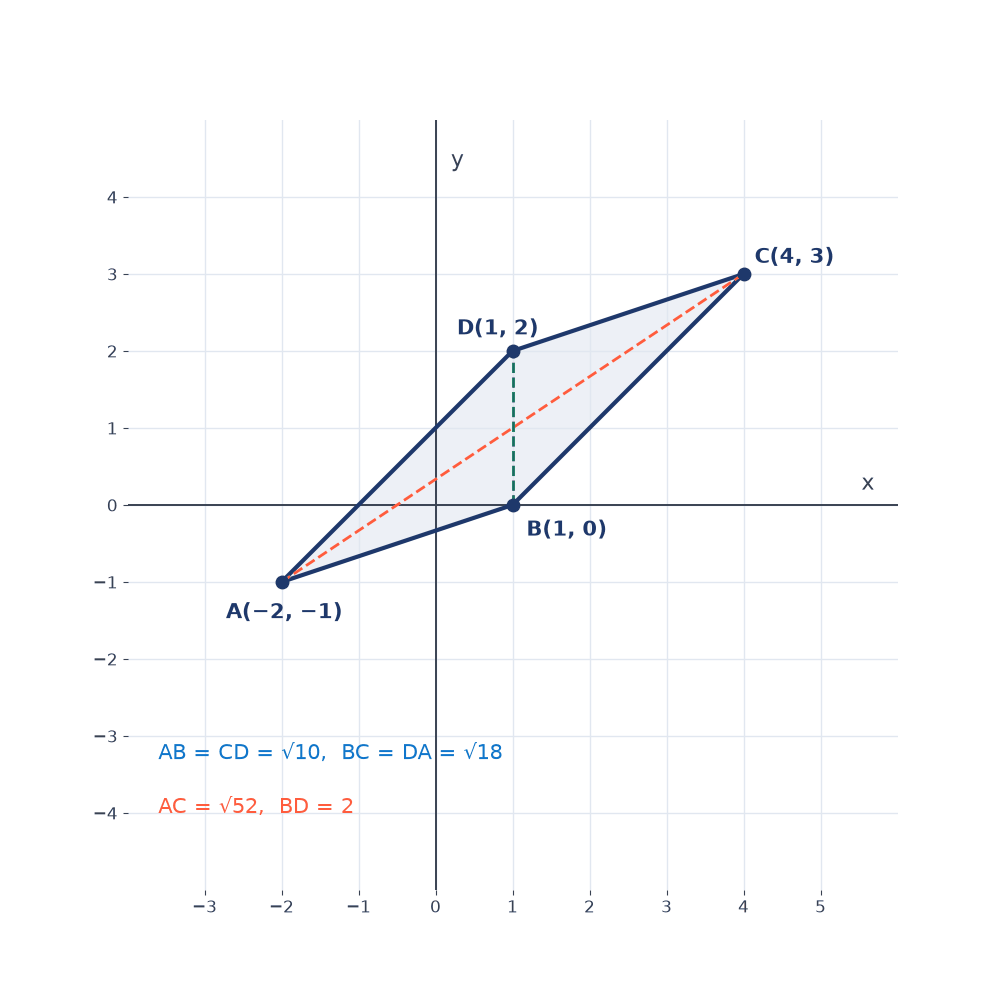
Shapes from distances (vertices in order): four equal sides with equal diagonals is a square; four equal sides with unequal diagonals is a rhombus; equal opposite sides with equal diagonals is a rectangle; equal opposite sides with unequal diagonals is a parallelogram that is not a rectangle.
Very short answer (1 mark)
Question 1
Find the distance between (−6,−1) and (6,4).
(6+6)2+(4+1)2=144+25=169=13
Answer: 13 units.
Question 2
How far is the point (7,−24) from the origin?
72+(−24)2=49+576=625=25
Answer: 25 units.
Question 3
Find the midpoint of the segment joining (−5,8) and (9,−2).
(2−5+9,28+(−2))=(2,3)
Answer:(2,3).
Question 4
The point (2a,3) is the midpoint of the segment joining (−7,1) and (3,5). Find a.
The midpoint is (2−7+3,21+5)=(−2,3). The y-coordinates agree. Equating the x-coordinates:
2a=−2⇒a=−4
Answer:a=−4.
Short answer (2 marks)
Question 5
Find the ratio in which the x-axis divides the segment joining (−3,−6) and (5,3). Also find the point of division.
Let the ratio be k:1. On the x-axis, y=0:
k+13k+(−6)=0⇒3k=6⇒k=2
So the ratio is 2:1. Then
x=32×5+1×(−3)=37
Answer:2:1, at the point (37,0).
Question 6
Show that A(0,−2), B(3,2) and C(9,10) are collinear.
ABBCAC=32+42=5=62+82=10=92+122=225=15
Since AB+BC=15=AC, the three points lie on one line.
Answer: The points are collinear, with B between A and C.
Why this works: if B were off the line, A, B, C would form a triangle and AB+BC would be greater than AC.
Question 7
Find x if P(x,2) is equidistant from A(3,−4) and B(−1,6).
Why this works: the middle point is simply the midpoint of AB, and the other two are the midpoints of AP2 and P2B.
Question 17
Find the centroid of the triangle with vertices (3,−5), (−7,4) and (10,−2).
G=(33+(−7)+10,3−5+4+(−2))=(36,3−3)=(2,−1)
Answer:(2,−1).
Why this works: the centroid divides each median in the ratio 2:1 from the vertex, and applying the section formula to any median gives the average of the three vertices.
Key terms
Distance formula
(x2−x1)2+(y2−y1)2, the length of the segment joining two points.
Collinear
Lying on a single straight line.
Section formula
Gives the point dividing a segment internally in a given ratio.
Midpoint
The point that divides a segment in the ratio 1:1.
Points of trisection
The two points that split a segment into three equal parts.
Centroid
The point where the medians of a triangle meet.
Rhombus
A quadrilateral with four equal sides; its area is half the product of its diagonals.
Converse of Pythagoras
If the square of one side equals the sum of the squares of the other two, the angle opposite that side is a right angle.
Common questions
How much working should I show in a shape question?
Show all four sides and both diagonals, then state the property you are using, such as "opposite sides are equal and the diagonals are unequal". The conclusion earns marks only with its reason.
Which is quicker for collinearity, distances or the section formula?
Distances always work. If one point looks like a midpoint or a trisection point, checking it with the section formula can be quicker.
Why do we use the diagonals, not the sides, to find a missing vertex?
The diagonals of a parallelogram bisect each other, which gives two simple linear equations. Equating side lengths would give squared equations that are harder to solve.
Should I simplify surds in the final answer?
Yes. Write 52 as 213 and 125 as 55, unless the answer is only needed for a comparison.
Can I leave a ratio as a fraction?
Write the final ratio in whole numbers. A value k=32 means the ratio 2:3.
References
National Council of Educational Research and Training. Mathematics: Textbook for Class X. NCERT, New Delhi.
Aggarwal, R. S. Secondary School Mathematics for Class 10. Bharati Bhawan.
Sharma, R. D. Mathematics for Class 10. Dhanpat Rai Publications.