What are Linear Polynomials? Class 9 Terms, Degree and Uses
Learn terms, variables, coefficients and degree, see why a linear polynomial changes by equal steps, turn it into a linear equation, and read it as an input-output machine.
Algebra lets us write one short expression that works for every possible case: any number of boxes, any size of garden, any number of matches played. This lesson looks closely at such expressions. We sort them by the highest power of the variable they contain, and then study the simplest non-constant kind, the linear polynomial. Linear polynomials describe situations where every extra step adds or removes the same fixed amount. They also lead straight to linear equations, and they can be pictured as an input-output machine.
Algebraic expressions: a quick review
Terms, variables, coefficients and constants
Suppose a stationery shop sells packets of 6 erasers and packets of 10 sharpeners, and Meera buys p packets of erasers and q packets of sharpeners, and the shopkeeper adds 2 loose erasers as a gift. She gets 6p erasers, 10q sharpeners and 2 more erasers, so the total count of items is
6p+10q+2.
The parts joined by + or − signs are the terms: here 6p, 10q and 2. The letters p and q stand for numbers that can change, so we call them variables (earlier you may have called them letter-numbers). The number multiplying a variable is its coefficient: 6 is the coefficient of p and 10 is the coefficient of q. A term with no variable, such as 2, is a constant.
The textbook's first two situations work the same way. Buying x boxes of 4 pens and y boxes of 5 pencils, with 3 free pens, gives 4x+5y+3. Fencing a garden of length l metres and width w metres, with wire at ₹100 per metre along the two lengths, wood at ₹80 per metre along the two widths, and seeds at ₹50 per square metre, costs
2l×100+2w×80+50×l×w=200l+160w+50lw rupees.
Think and Reflect: comparing the expressions
In 200l+160w+50lw the terms are 200l, 160w and 50lw; the variables are l and w; the coefficients are 200, 160 and 50. It differs from 4x+5y+3 in two ways. It has no constant term, and its last term 50lw is a product of two variables, because the seed cost depends on the area. In 4x+5y+3 every term has at most one variable, to the first power.
Now bend a 20 cm wire into rectangles. Length and width together make half the perimeter, so they add to 10 cm. Lengths such as 7 and 3, 5.5 and 4.5, or 6 and 4 all work. If the length is x cm the width is (10−x) cm, and the area is
x(10−x)=10x−x2 square cm.
Its terms are 10x and −x2, the only variable is x, and the coefficients are 10 and −1. Like the first two expressions it has several terms, but it uses only one variable, and that variable appears squared.
Polynomials in one variable
What a univariate polynomial is
From here on we keep to expressions with a single variable, such as 4x, x2+1, 2y−5 or 3z+7. An expression built from one variable and its whole-number powers, each multiplied by a number and added together, is called a polynomial in one variable, or a univariate polynomial ("univariate" means having one variable). When the context is clear we simply say polynomial.
In 5y3+y2+2y−1 the coefficient of y3 is 5, the coefficient of y2 is 1 (because y2 means 1×y2), the coefficient of y is 2, and the constant term is −1. Notice that the sign travels with the term.
Degree and the names of polynomials
The highest power of the variable that appears in a polynomial is its degree. The degree gives the polynomial its family name:
Degree 3: cubic, for example 5y3+y2+2y−1.
Degree 2: quadratic, for example x2+5x+1.
Degree 1: linear, for example 3z+7.
Degree 0: constant, for example 8.
Why does a plain number like 8 have degree 0? Any non-zero number raised to the power 0 equals 1, so 8=8×1=8x0. The variable is present with power 0, so the degree is 0.
Worked example 1: reading a polynomial
Find the degree of 6−2p+4p3, the coefficients of p, p2 and p3, and its constant term.
First arrange the terms from the highest power down: 4p3+0p2−2p+6. The highest power is 3, so the degree is 3 and the polynomial is cubic. The coefficient of p3 is 4. There is no p2 term, so the coefficient of p2 is 0. The coefficient of p is −2, not 2, because the minus sign belongs to the term. The constant term is 6.
Linear polynomials
The general form
A linear polynomial in x is a polynomial of degree 1. It can always be written as ax+b, where a and b are numbers and a=0. If a were 0 the x term would vanish and we would be left with a constant.
A simple example is the perimeter of a square of side x, which is 4x. For sides 1, 1.5, 2, 2.5 and 3 cm, the perimeters are 4, 6, 8, 10 and 12 cm. Each time the side grows by 0.5 cm, the perimeter grows by the same amount, 4×0.5=2 cm. This answers the Think and Reflect question about the squares.
Equal steps: the signature of a linear polynomial
The textbook describes a chess club that charges ₹200 to join plus ₹50 per match. After m matches the total is 200+50m rupees: 250, 300, 350, 400, … Every extra match adds exactly ₹50. If a player paid ₹750, then 200+50m=750, so 50m=550 and m=11 matches.
This is the key feature of every linear polynomial. Take ax+b and increase x by 1:
(a(x+1)+b)−(ax+b)=ax+a+b−ax−b=a.
The change is always a, whatever x was. So when the inputs go up in equal steps, the values go up (or down) in equal steps too. Lists of numbers with a constant difference like this are called linear patterns. A quadratic does not behave this way: for 10x−x2 the values at x=1,2,3,4 are 9, 16, 21, 24, and the differences 7, 5, 3 keep changing.
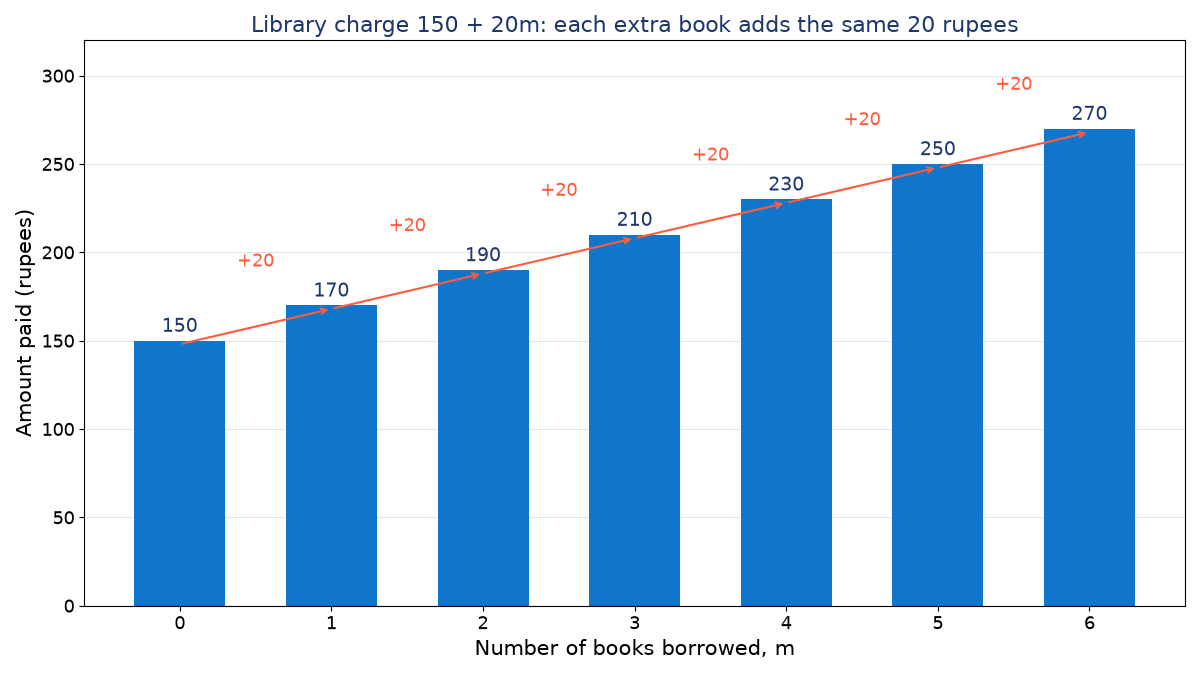
A linear polynomial 150+20m grows by the same 20 at every step.
Worked example 2: a library fee
A reading library charges a membership fee of ₹150 and ₹20 for every book borrowed in a month. (a) Write the monthly charge for m books. (b) Find the charge for 4 books. (c) Riya paid ₹290. How many books did she borrow?
(a) The charge is 150+20m rupees, a linear polynomial in m.
(b) For m=4: 150+20×4=150+80=230, so ₹230.
(c) Set the polynomial equal to 290 and solve:
150+20m20mm=290=140=7
Riya borrowed 7 books. Check: 150+140=290.
From linear polynomials to linear equations
Setting a polynomial equal to a number
When we put a linear polynomial equal to a constant, we get a linear equation. The book's example asks for two numbers that add to 64, one being 10 more than the other. Calling the smaller number x gives x+(x+10)=64, that is 2x+10=64, so 2x=54 and x=27. The numbers are 27 and 37.
The method is always the same: name the unknown, write the other quantities in terms of it, build one equation from the stated fact, solve it, and check the answer against the original words.
Worked example 3: two numbers
Two numbers add up to 90, and one of them is 14 more than the other. Find them.
Let the smaller number be n. Then the larger is n+14, and
n+(n+14)2n+142nn=90=90=76=38
The numbers are 38 and 52. Check: 38+52=90 and 52−38=14.
Worked example 4: cutting a rope
A 48 m rope is cut into two pieces so that the longer piece is three times the shorter. How long is each piece?
Let the shorter piece be s metres. The longer is 3s metres. Together they make the whole rope, so s+3s=48, giving 4s=48 and s=12. The pieces are 12 m and 36 m. Check: 36=3×12 and 12+36=48.
A polynomial as an input-output machine
Feeding in values
A polynomial can be read as a rule: put in a value of the variable and get back exactly one value of the expression. For 2x+3, the input 4 gives 2×4+3=11 and the input −6 gives 2×(−6)+3=−9. A rule that gives exactly one output for each input is called a function. We say 2x+3 is a function of x. You will study functions in detail in later classes.
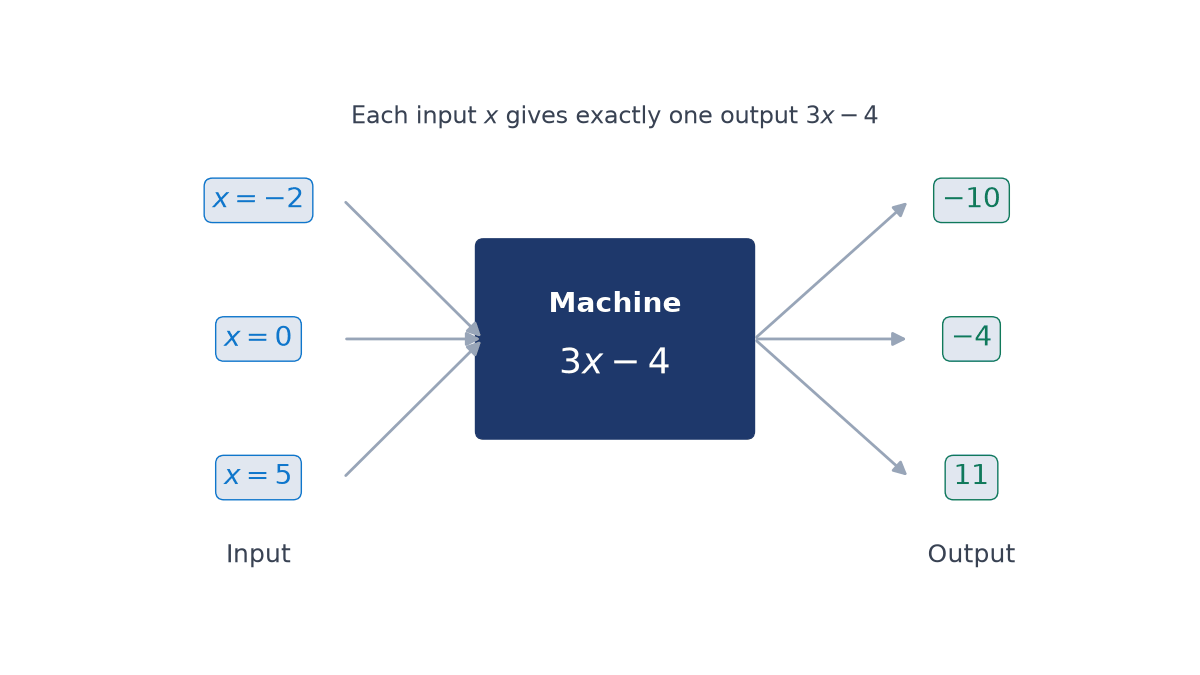
The machine 3x−4 turns each input into exactly one output.
Worked example 5: running the machine backwards
For the machine 3x−4, find the outputs for x=−2, 0 and 5. Which input gives the output 17?
For the output 17 we solve 3x−4=17: 3x=21, so x=7. Check: 3×7−4=17.
Think and Reflect: the wire rectangle as a machine
The area 10x−x2 of the wire rectangle is also a function of x: put in a length and the machine returns the area. For x=6 cm the output is 10×6−62=60−36=24 square cm, which matches a 6 cm by 4 cm rectangle. The difference is the type of function: 2x+3 is a linear function (degree 1), while 10x−x2 is a quadratic function (degree 2).
Common mistakes
Dropping the sign of a coefficient. In 9−4x the coefficient of x is −4, not 4.
Saying a term with no visible number has no coefficient. In x2+3x the coefficient of x2 is 1.
Reading the degree from the first term written instead of the highest power. The degree of 2+5x−x3 is 3.
Calling ax+b linear when a=0. Then it is a constant polynomial, of degree 0.
Forgetting brackets when substituting a negative number: 2x+3 at x=−6 is 2×(−6)+3=−9, not 2−6+3.
Stopping after finding x in a word problem. Answer the question asked, for example give both numbers, and check them in the original words.
Try these
What is the degree of 7−3y+y2? Answer: 2 (quadratic).
What is the coefficient of x in 2x3−x+9? Answer:−1.
Find the value of 4x−7 when x=−3. Answer:−19.
A taxi charges ₹60 plus ₹12 per km. A ride cost ₹204. How long was it? Answer: 12 km.
Two numbers add up to 75 and one is four times the other. Find them. Answer: 15 and 60.
Key terms
Variable
A letter that stands for a number that can change, such as x in 4x+1.
Coefficient
The number that multiplies a variable or a power of it, including its sign.
Constant term
A term with no variable in it.
Univariate polynomial
An expression made of one variable and its whole-number powers, each multiplied by a number and added together.
Degree
The highest power of the variable that appears in a polynomial.
Linear polynomial
A polynomial of degree 1, of the form ax+b with a=0.
Linear equation
An equation formed by setting a linear polynomial equal to a constant.
Function
A rule that gives exactly one output for each input.
Common questions
Is 5 a polynomial?
Yes. It is a constant polynomial of degree 0, because it can be written as 5x0.
Is 4x+5y+3 a linear polynomial in one variable?
No. Each term has degree at most 1, but it has two variables. This chapter keeps to polynomials in a single variable.
How can I tell a linear pattern from a table of values?
Look at the differences between consecutive values when the input goes up in equal steps. If the difference is always the same, the pattern is linear.
Why is the coefficient of x in ax+b not allowed to be zero?
If a=0 the expression becomes just b, which has degree 0, so it is a constant polynomial, not a linear one.
What is the difference between a linear polynomial and a linear equation?
A linear polynomial such as 2x+10 is an expression whose value changes with x. A linear equation such as 2x+10=64 is a statement that is true only for particular values of x, here x=27.
References
National Council of Educational Research and Training. Ganita Manjari: Textbook of Mathematics, Grade 9 (Part I). NCERT, New Delhi.
Sharma, R. D. Mathematics for Class 9. Dhanpat Rai Publications.