Exploring Linear Patterns, Class 9: Growth and Decay
Spot linear patterns in tiles, money and fares, write the nth term as a linear expression, work backwards to find a stage, and tell linear growth from linear decay.
Many everyday situations change by the same amount at every step: pocket money shrinking by a fixed sum each day, a fare rising by a fixed sum per kilometre, water in a tank falling by a fixed height each month. In this lesson we learn to spot these linear patterns, to describe the nth term with a linear expression, and to use that expression to predict values far ahead or to work backwards. We finish with the names for the two directions such a pattern can take: linear growth and linear decay.
Linear patterns
A growing pattern of tiles
The textbook shows square tiles arranged in stages, where each stage has two more tiles than the one before. Counting gives the list 1, 3, 5, 7, … so the next three stages have 9, 11 and 13 tiles, and the first seven stages give
1,3,5,7,9,11,13.
To write a rule, compare each count with its stage number. Stage 2 has 2×2−1=3 tiles and stage 5 has 2×5−1=9. In every case the count is one less than twice the stage number, so stage n has
2n−1 tiles.
This is a linear polynomial in n. The counts go up by the constant amount 2, which is the coefficient of n. We call the link between the stage number and the number of tiles a linear relationship.
Think and Reflect: using the rule
Stage 15 has 2×15−1=29 tiles and stage 26 has 2×26−1=51 tiles. To find the stage with 21 tiles, solve 2n−1=21: 2n=22, so n=11. For 47 tiles, 2n−1=47 gives 2n=48 and n=24. The rule saves us from drawing every stage.
What makes a pattern linear
A linear pattern is a list of numbers in which the difference between any two consecutive terms is the same. If the first term is f and the common difference is d, then each step adds another d:
term n=f+(n−1)d=dn+(f−d).
This is always a linear expression in n, with coefficient d. For the tiles, f=1 and d=2, which gives 2n+(1−2)=2n−1, the same rule as before. You will meet these lists again in the chapter on sequences and progressions.
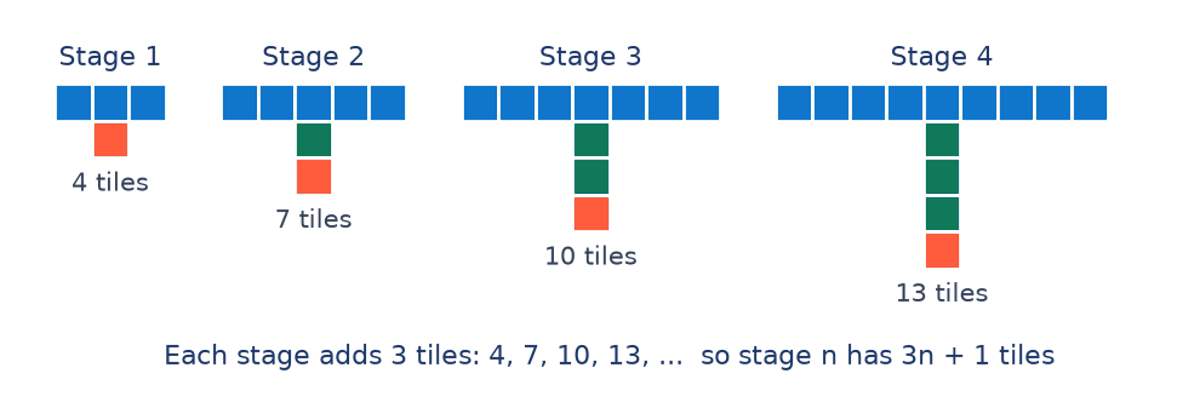
Each stage adds two tiles to the top row and one to the stem, so stage n has 3n+1 tiles.
Worked example 1: a T-shaped pattern
In the pattern above, stage n has a top row of 2n+1 tiles and a stem of n tiles. (a) Find a rule for the number of tiles. (b) How many tiles are in stage 10? (c) Which stage uses 64 tiles? (d) Can any stage use exactly 50 tiles?
(a) Total =(2n+1)+n=3n+1. The counts 4, 7, 10, 13 rise by 3 each time, which agrees with the coefficient 3.
(b) Stage 10 has 3×10+1=31 tiles.
(c) 3n+1=64 gives 3n=63, so n=21.
(d) 3n+1=50 gives 3n=49, and 49 is not a multiple of 3, so n would not be a whole number. No stage has exactly 50 tiles.
Worked example 2: finding the rule from a list
Find the nth term of 7, 12, 17, 22, … and use it to find the 20th term.
The differences are 12−7=5, 17−12=5 and 22−17=5, so the pattern is linear with d=5. The rule is 5n+(7−5)=5n+2. Check: n=1 gives 7 and n=4 gives 22. The 20th term is 5×20+2=102.
Linear patterns in daily life
Spending a fixed amount each day
In the book, Bela starts with ₹100 and spends ₹5 a day. After n days she has 100−5n rupees left: 95, 90, 85, 80, … She is left with ₹40 when 100−5n=40, which gives 5n=60, so on day 12. On day 15 she has 100−75=25 rupees. The money runs out when 100−5n=0, that is after n=20 days. Here the pattern goes down by 5 each day: the common difference is −5.
A fare with a fixed starting part
The book's auto-rickshaw charges ₹25 for anything up to 2 km, then ₹15 for each further kilometre. So 10 km costs 25+15×8=145 rupees. For n≥2 km, the fare is
25+15(n−2)=25+15n−30=15n−5 rupees.
The rule only applies from 2 km onwards. For 1 km the fare is still ₹25, and 15×1−5=10 would be wrong. A fare of ₹130 needs 15n−5=130, so 15n=135 and n=9 km.
Worked example 3: parking charges
A parking lot charges ₹30 for up to 3 hours and ₹10 for each hour after that. (a) Find the charge for n hours when n≥3. (b) Find the charge for 7 hours. (c) A driver paid ₹110. How long did she park?
(a) The extra hours number n−3, so the charge is 30+10(n−3)=30+10n−30=10n rupees.
(b) For 7 hours: 10×7=70 rupees. Check: 30+10×4=70.
(c) 10n=110 gives n=11 hours.
Linear growth and linear decay
Linear growth
A quantity shows linear growth when it increases by the same amount over equal intervals. The book's journey cost C(d)=100+60d rupees for d km is an example. The values for d=0,1,2,3,4,5 are 100, 160, 220, 280, 340 and 400, rising by ₹60 each kilometre. The notation C(d) is read "C of d" and means the value of the cost rule when the distance is d.
Think and Reflect: for 15 km, C(15)=100+60×15=1000 rupees. A cost of ₹700 needs 100+60d=700, so 60d=600 and d=10 km.
Linear decay
A quantity shows linear decay when it decreases by the same amount over equal intervals. In the book, water in a tank stands 3 m high at the start of summer, and after t months its height is h(t)=3−0.5t metres. The values for t=0 to 4 are 3, 2.5, 2, 1.5 and 1, falling by 0.5 m each month. Think and Reflect: after 5 months, h(5)=3−2.5=0.5 m.
In the form b+at, growth means a is positive and decay means a is negative. The size of a tells you how much changes in each interval.
Linear growth rises by equal amounts; linear decay falls by equal amounts.
Worked example 4: savings that grow
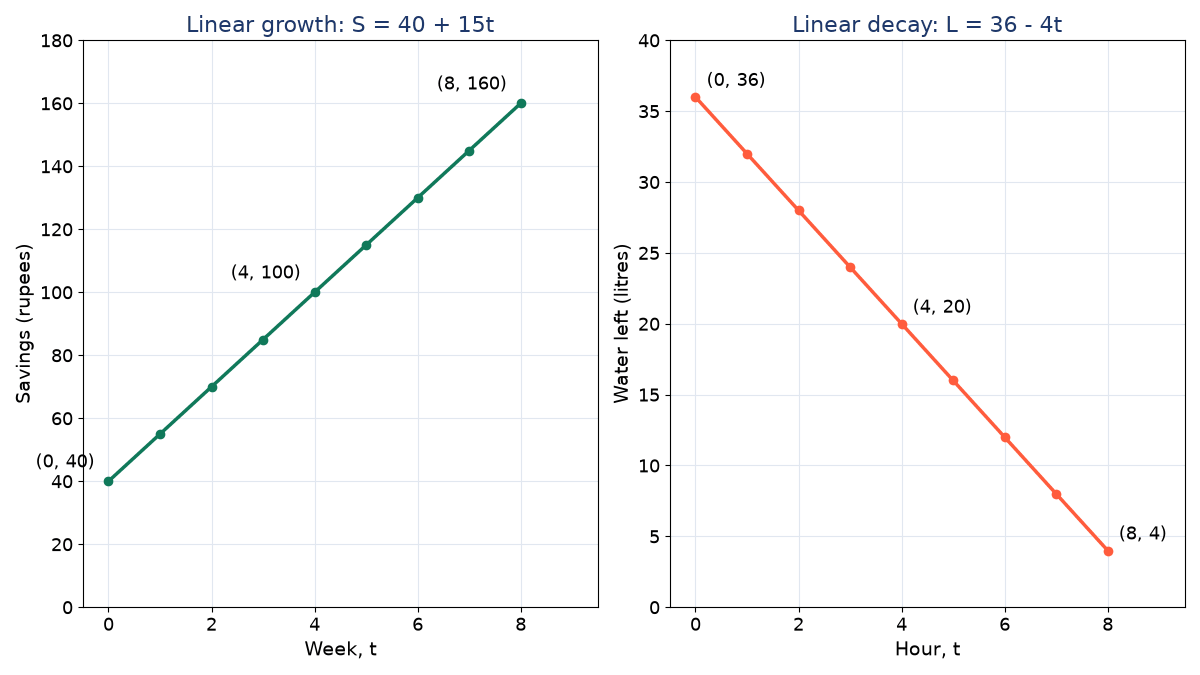
Arjun has ₹40 in his piggy bank and adds ₹15 every week. (a) Write his savings S after t weeks. (b) Make a table for t=0 to 4. (c) Find his savings after 8 weeks. (d) When will he have ₹250?
(a) S=40+15t.
(b) For t=0,1,2,3,4, the values of S are 40, 55, 70, 85 and 100.
(c) S=40+15×8=160 rupees.
(d) 40+15t=250 gives 15t=210, so t=14 weeks.
This is linear growth, because each week adds the same ₹15.
Worked example 5: a leaking can
A can holds 36 litres of water and leaks 4 litres every hour. (a) Write the amount L left after t hours. (b) How much is left after 5 hours? (c) When is the can empty?
(a) L=36−4t.
(b) L=36−20=16 litres.
(c) 36−4t=0 gives 4t=36, so t=9 hours. The rule makes sense only for 0≤t≤9, because the amount of water cannot be negative.
This is linear decay: each hour removes the same 4 litres.
Common mistakes
Writing the nth term as dn+f instead of dn+(f−d). Always check the rule against the first term.
Calling any increasing list linear. The list 3, 6, 10, 15 increases, but its differences 3, 4, 5 are not equal, so it is not linear.
Using a rule outside the range where it holds, for example using 15n−5 for a 1 km auto ride.
Accepting a fractional stage number. If solving gives n=16.33, no stage has that many objects.
Letting a decay rule run past zero. Money or water cannot go below zero, so the rule stops there.
Counting steps wrongly. If the list starts at stage 1, the nth term has n−1 differences added to it; if it starts at day 0, as with Bela's money, day n has n differences added.
Try these
Find the nth term of 4, 9, 14, 19, … and its 30th term. Answer:5n−1; 149.
A 30 cm candle burns down 2.5 cm every hour. How tall is it after 6 hours, and when does it burn out? Answer: 15 cm; after 12 hours.
A savings box starts with ₹120 and gains ₹35 each week. After how many weeks will it hold ₹400? Answer: 8 weeks.
Is 3, 6, 10, 15, … a linear pattern? Answer: No, the differences 3, 4, 5 are not constant.
A taxi charges ₹50 for the first kilometre and ₹18 for every further kilometre. Write the fare for n km (n≥1) and find the fare for 11 km. Answer:18n+32 rupees; ₹230.
Key terms
Linear pattern
A list of numbers in which consecutive terms always differ by the same amount.
Common difference
The fixed amount added to each term to get the next; it is negative when the list decreases.
nth term
An expression in n that gives the term at position n; for a linear pattern it is linear in n.
Linear relationship
A link between two quantities in which equal changes in one always cause equal changes in the other.
Linear growth
An increase by a constant amount over equal intervals.
Linear decay
A decrease by a constant amount over equal intervals.
Function notation
Writing C(d) for the value of a rule C at the input d.
Common questions
How do I find the rule for a linear pattern quickly?
Find the common difference d; the rule is dn+c. Choose c so that n=1 gives the first term, that is c=first term−d.
Can a linear pattern have a negative common difference?
Yes. Such a pattern decreases, like 100, 95, 90, … with difference −5. In real situations this is linear decay.
Why does the auto fare rule start only from 2 km?
The first 2 km cost a flat ₹25 whatever the distance, so the fare does not change by ₹15 per km there. The linear rule 15n−5 describes only the part where every kilometre adds ₹15.
How do I know if a number belongs to a pattern?
Set the nth term equal to the number and solve. If n is a positive whole number, the number is in the pattern; otherwise it is not.
Is every growth linear?
No. If the amount added keeps changing, for example when a sum doubles each year, the growth is not linear. Linear growth adds the same amount every time.
References
National Council of Educational Research and Training. Ganita Manjari: Textbook of Mathematics, Grade 9 (Part I). NCERT, New Delhi.
Sharma, R. D. Mathematics for Class 9. Dhanpat Rai Publications.
Stewart, J., Redlin, L. and Watson, S. Precalculus: Mathematics for Calculus. Cengage Learning.