Linear Relationships and Their Graphs, Class 9 Explained
Find y = ax + b from two known values, draw the line from two points, and see how the slope a sets steepness and direction while the y-intercept b shifts the line.
A linear pattern links two quantities: a stage number and a tile count, the data used and a phone bill, the hours worked and a plumber's charge. In this lesson we write such links as equations of the form y=ax+b, find a and b from two known facts, and then draw the equations as straight lines. Along the way we discover what the two numbers a and b do to a line: a sets its steepness and direction, and b sets where it crosses the y-axis.
Linear relationships
The form y = ax + b
A linear relationship between two variables x and y is one that can be written as
y=ax+b,
where a and b are fixed numbers. For the growing tile pattern of the previous lesson, with x the stage number and y the number of tiles, the relationship is y=2x−1, so a=2 and b=−1.
Finding a and b from two facts
Often we know that a relationship is linear but not the numbers in it. Two pairs of values are enough to find both. The book's telecom bill has a fixed monthly fee plus a charge for each GB. A bill of ₹350 for 10 GB and ₹550 for 20 GB give
350=10a+band550=20a+b.
From the first, b=350−10a. Putting this in the second gives 550=20a+350−10a, so 10a=200 and a=20. Then b=350−200=150, and the relationship is y=20x+150.
Think and Reflect: the 20 is the charge in rupees for each GB, because every extra GB adds ₹20 to the bill. The 150 is the fixed monthly fee, the bill when x=0.
A quick way to see a at once: the extra 10 GB added ₹200 to the bill, so each GB costs 200÷10=20 rupees. In general, a is the change in y divided by the change in x.
Worked example 1: a plumber's bill
A plumber charges a fixed visit fee plus a fee per hour. A 2-hour job costs ₹700 and a 5-hour job costs ₹1450. Write the bill y for x hours as y=ax+b and explain the numbers.
7001450=2a+b=5a+b
Subtracting the first equation from the second removes b: 750=3a, so a=250. Then b=700−2×250=200. So y=250x+200: the plumber charges ₹250 per hour and a visit fee of ₹200. Check: 250×5+200=1450.
The two known bills fix the line; it meets the y-axis at the visit fee of 200.
Drawing a linear relationship
Two points are enough
The graph of y=ax+b is a straight line, and a straight line is fixed by any two of its points. To draw y=2x+1: when x=0, y=1, giving the point A(0,1); when x=3, y=7, giving B(3,7). In A(0,1) the first number is the x-coordinate and the second is the y-coordinate. Plot A and B on the coordinate plane, join them with a ruler, and extend the line both ways.
Think and Reflect: more points on y = 2x + 1
Substituting each x into y=2x+1 completes the book's table:
x
1
2
5
7
9
12
20
y
3
5
11
15
19
25
41
A point lies on a line exactly when its coordinates make the equation true. For (7,15): 2×7+1=15, so it lies on the line.
Worked example 2: testing points
Do the points (4,11) and (−2,−6) lie on y=3x−1?
For (4,11): 3×4−1=11, which equals the y-coordinate, so yes. For (−2,−6): 3×(−2)−1=−7, which is not −6, so no. That point sits just above the line.
Guessing the equation from plotted points
The book plots (−1,−3), (0,0), (1,3), (3,9) and (4,12). They lie on one straight line, and each y is three times its x, so the line is y=3x. Its second set of points, (−3,6), (−2,4), (0,0), (1,−2), (2,−4) and (3,−6), has each y equal to −2 times its x, so that line is y=−2x.
Worked example 3: finding the rule
The points (−2,1), (0,0), (2,−1) and (4,−2) lie on a line. Find its equation.
The line passes through (0,0), so b=0. In every point y is −21 of x: for example −21×4=−2. So the line is y=−21x.
The role of a: slope
Lines through the origin
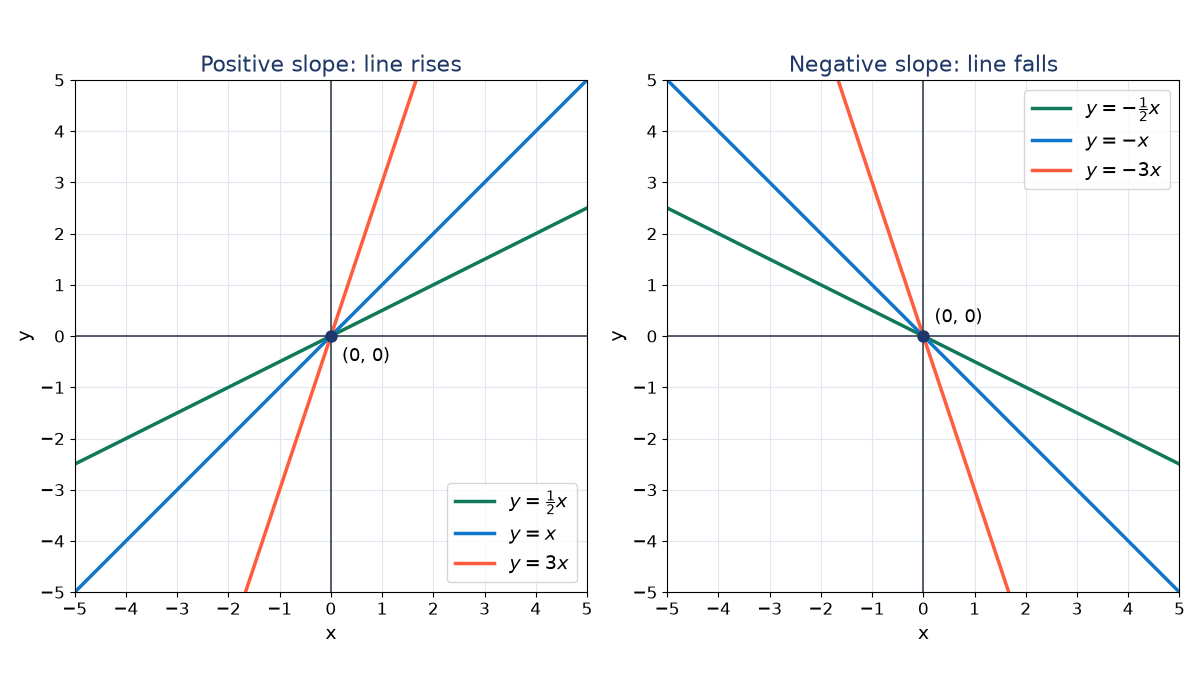
Every line y=ax passes through (0,0), because x=0 gives y=0. Drawing y=21x, y=x and y=2x (the book suggests the points (0,0) and (4,2) for the first, and indeed 21×4=2) on the same axes shows the following, for a>0:
y=x is equally inclined to both axes.
When a>1, the line is steeper than y=x, and the larger a is, the steeper it gets (y=3x is steeper than y=2x).
When a<1, the line is less steep than y=x (y=31x is flatter than y=21x).
The number a is called the slope of the line. It tells how much y changes when x goes up by 1.
All lines y=ax pass through (0,0); the sign of a decides rise or fall, and its size decides steepness.
Negative slopes
For y=−31x, y=−x and y=−3x, the lines still pass through the origin but fall from left to right. For y=−ax with a>0: when a>1 the line is steeper than y=−x, and when a<1 it is less steep. So the size of the slope controls steepness, and its sign controls direction.
This links back to the previous lesson. Linear growth is a line with positive slope, and linear decay is a line with negative slope. For the tile pattern y=2x−1, the slope 2 is exactly the common difference of 1, 3, 5, 7, … The slope of the line is the constant difference of the pattern.
Think and Reflect: y = 3x + 1 and y = −3x + 1
Both lines cross the y-axis at (0,1), and both are equally steep, since their slopes are 3 and −3. But y=3x+1 rises from left to right, while y=−3x+1 falls. Each is the mirror image of the other in the y-axis: the point (1,4) is on the first and (−1,4) is on the second.
The role of b: the y-intercept
Same slope, different b
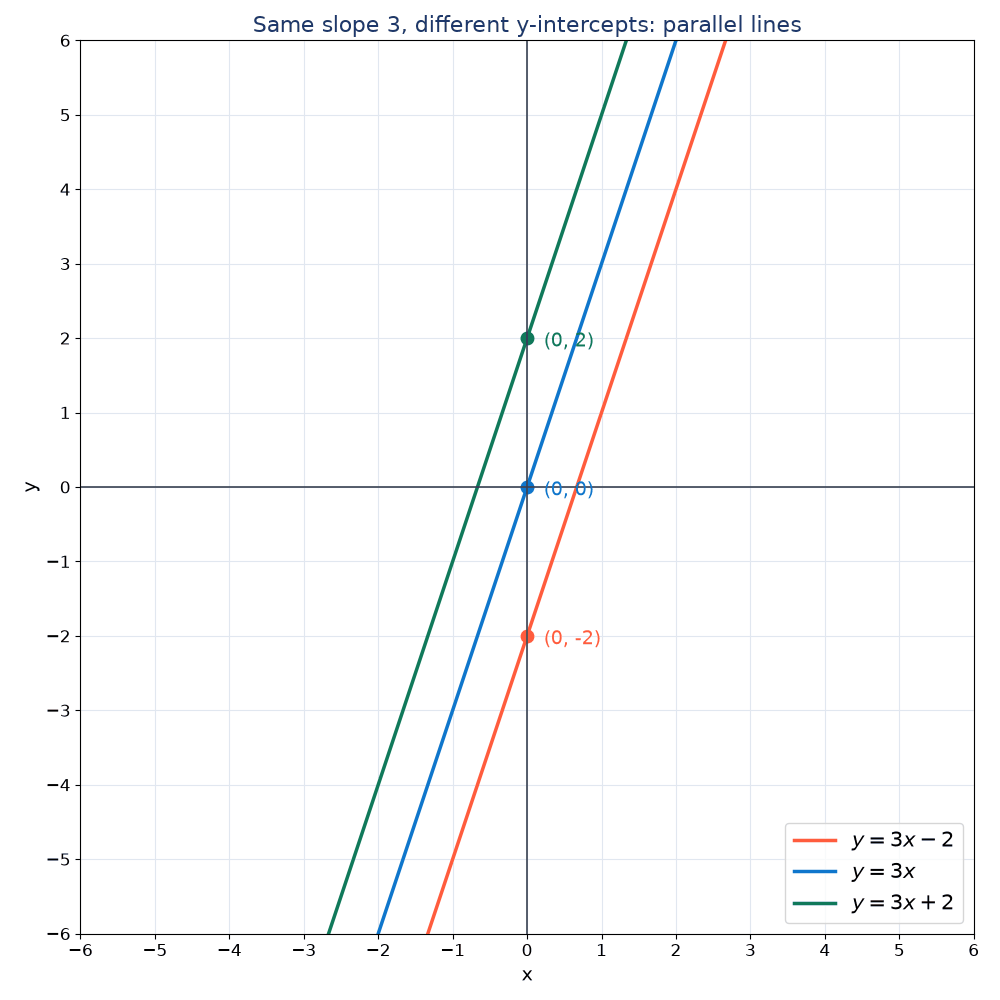
The book draws y=2x−1, y=2x+1 and y=2x+5 on the same axes. Here a=2 stays fixed while b takes the values −1, 1 and 5. The three lines have the same steepness, so they never meet: they are parallel. Changing b just slides the line up or down.
Why can they never meet? If 2x−1 and 2x+1 were equal for some x, subtracting 2x from both would give −1=1, which is false. The same argument works for any two lines y=ax+b and y=ax+c with b=c.
Equal slopes with different b give parallel lines, each crossing the y-axis at (0,b).
Where a line cuts the y-axis
Every point on the y-axis has x=0. Putting x=0 in y=ax+b gives y=b, so the line cuts the y-axis at (0,b). The number b is called the y-intercept. For example, y=2x+5 cuts the y-axis at (0,5), y=x+3 at (0,3) and y=3x−2 at (0,−2). An intercept of −2 means the crossing is 2 units below the origin.
Summary of what a and b do
In y=ax+b, a is the slope and b is the y-intercept.
Changing a with b fixed turns the line about the point (0,b): the slope changes but the y-intercept does not.
Changing b with a fixed shifts the line up or down; lines with equal slopes and different y-intercepts are parallel.
Worked example 4: reading and drawing a line
For y=−2x+3, state the slope and y-intercept, find two points, and say whether it shows growth or decay. Is it parallel to y=−2x−5 or to y=2x+3?
The slope is −2 and the y-intercept is 3, so the line cuts the y-axis at (0,3). For x=2, y=−4+3=−1, giving (2,−1). Join (0,3) and (2,−1). The slope is negative, so the line falls: linear decay. It is parallel to y=−2x−5 (same slope, different intercept). It is not parallel to y=2x+3; those two lines meet at (0,3).
Common mistakes
Swapping the coordinates. In (3,7) the 3 is the x-value and the 7 is the y-value.
Reading the slope before making y the subject. In 2y=4x+7 the slope is 2, not 4; divide by 2 first.
Thinking a bigger b makes a line steeper. b only moves the line up or down.
Believing y=−3x is less steep than y=x because −3<1. Steepness depends on the size of the slope, 3 here.
Plotting only two points and making an arithmetic slip. A third point is a free check that all three lie in a straight line.
Forgetting the sign of the y-intercept: y=3x−2 cuts the y-axis at (0,−2), below the origin.
Try these
A line y=ax+b passes through (1,9) and (4,18). Find a and b. Answer:a=3, b=6.
Does (3,10) lie on y=4x−2? Answer: Yes.
State the slope of y=−5x+8 and the point where it cuts the y-axis. Answer: slope −5; (0,8).
Which is steeper, y=41x or y=4x? Answer:y=4x.
Write the line parallel to y=6x−1 that cuts the y-axis at (0,4). Answer:y=6x+4.
A cab charges ₹110 for 3 km and ₹235 for 8 km, following y=ax+b. Find a and b. Answer:a=25, b=35.
Key terms
Linear relationship
A relationship between x and y of the form y=ax+b.
Coordinates
The pair (x,y) that fixes a point: first the x-value, then the y-value.
Origin
The point (0,0) where the axes cross.
Slope
The number a in y=ax+b; the change in y when x increases by 1.
y-intercept
The number b in y=ax+b; the line cuts the y-axis at (0,b).
Parallel lines
Lines that never meet; in the form y=ax+b they have the same slope and different intercepts.
Positive and negative slope
A positive slope gives a rising line (linear growth); a negative slope gives a falling line (linear decay).
Common questions
Why are two points enough to draw a linear graph?
Through two different points there is exactly one straight line, and the graph of y=ax+b is a straight line. Plotting a third point is a useful check.
What does the slope mean in a real situation?
It is the rate of change: the extra rupees per GB, per hour or per km. In y=20x+150 the slope 20 means each GB adds ₹20.
Does every line of the form y = ax pass through the origin?
Yes. Putting x=0 gives y=0, so (0,0) is always on the line.
How can I tell from equations whether two lines are parallel?
Rewrite each as y=ax+b. If the values of a are equal and the values of b are different, the lines are parallel.
Is the y-intercept a length or a number with a sign?
It is a signed number. A y-intercept of −2 means the line crosses the y-axis 2 units below the origin.
References
National Council of Educational Research and Training. Ganita Manjari: Textbook of Mathematics, Grade 9 (Part I). NCERT, New Delhi.
Sharma, R. D. Mathematics for Class 9. Dhanpat Rai Publications.
Stewart, J., Redlin, L. and Watson, S. Precalculus: Mathematics for Calculus. Cengage Learning.