How to Prove √2 and √3 Are Irrational, Class 10 Maths
Step-by-step proofs by contradiction that root 2 and root 3 are irrational, the prime-divides-square theorem they rest on, and how to show numbers like 5 minus root 3 and 3 root 2 are irrational.
In Class IX you met the irrational numbers: numbers that sit on the number line alongside the fractions but can never be written as a fraction themselves. You were told that numbers such as 2, 3 and 15 are irrational and took it on trust. In Class 10 we finally prove it, using the Fundamental Theorem of Arithmetic and a style of argument called proof by contradiction. The same method then shows that numbers such as 5−3 and 32 are irrational too. These proofs are standard board-exam questions, so this lesson sets out every step in the order you should write it.
A number s is rational if it can be written as qp, where p and q are integers and q=0. A number s is irrational if it cannot be written in this form.
Examples of irrational numbers include 2, 3, 15, π, and non-terminating, non-repeating decimals such as 0.10110111011110…
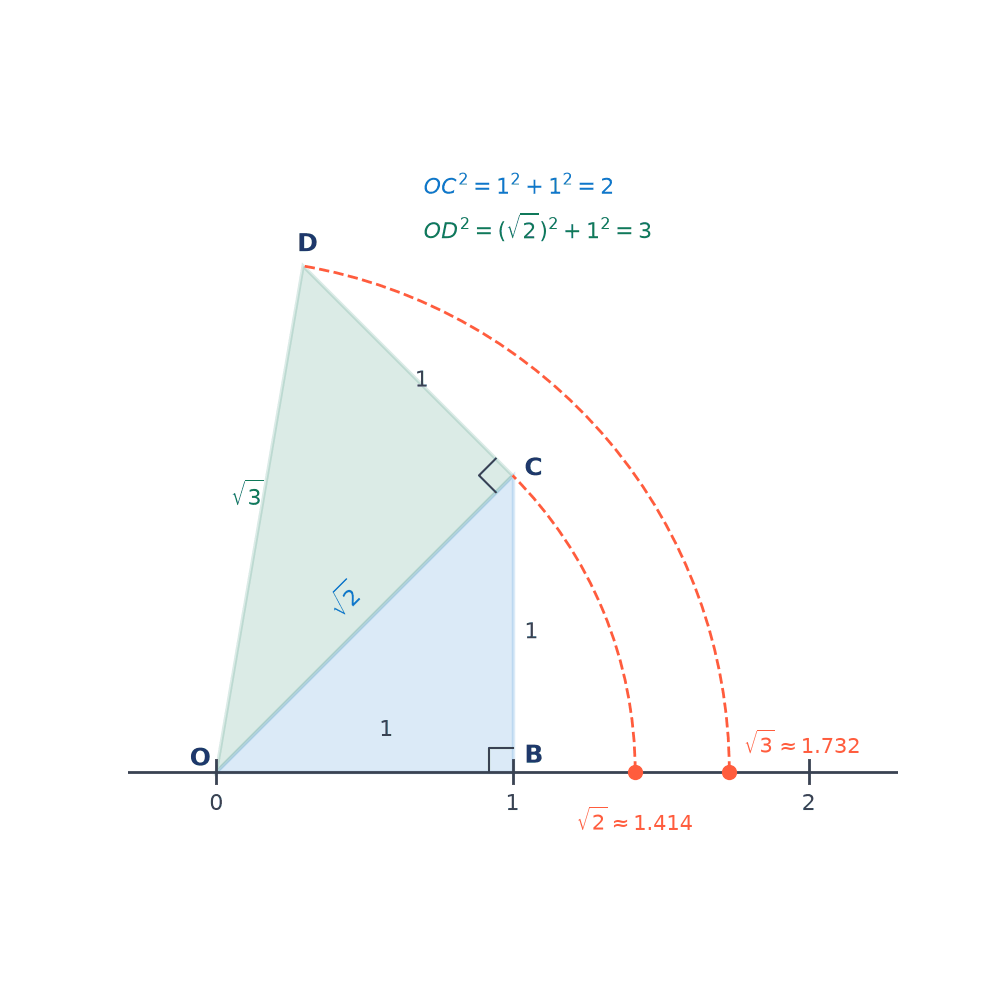
Irrational numbers are real points on the number line, not vague ideas. A right-angled triangle with legs 1 and 1 has hypotenuse 12+12=2, and swinging that length down with a compass marks 2 exactly. Building a second right triangle on it, with legs 2 and 1, gives a hypotenuse of 3.
Locating 2≈1.414 and 3≈1.732 on the number line with right-angled triangles, drawn to scale.
By the Fundamental Theorem of Arithmetic, write a as a product of primes: a=p1p2⋯pn, where the primes need not be different. Then
a2=(p1p2⋯pn)(p1p2⋯pn)=p12p22⋯pn2.
Now suppose the prime p divides a2. Then p appears in the prime factorisation of a2. Because this factorisation is unique, the only primes in it are p1,p2,…,pn, so p must be one of them. But p1,p2,…,pn are exactly the primes that make up a, so p divides a.
In short: squaring a number never brings in a new prime factor; it only doubles the powers of the primes already there.
To prove a statement by contradiction, you assume that it is false and then reason correctly until you reach something impossible. Since correct reasoning cannot lead from a true assumption to an impossibility, the assumption must be wrong, and the original statement is true.
Method for proving that p is irrational (p prime)#
Assume, to the contrary, that p is rational, so p=ba with a, b coprime integers and b=0.
Square and rearrange to get pb2=a2.
Conclude that p divides a2, hence p divides a; write a=pc.
Substitute to get b2=pc2, so p divides b2, hence p divides b.
State the contradiction: p is a common factor of a and b, yet they are coprime.
This is one of the most famous proofs in mathematics.
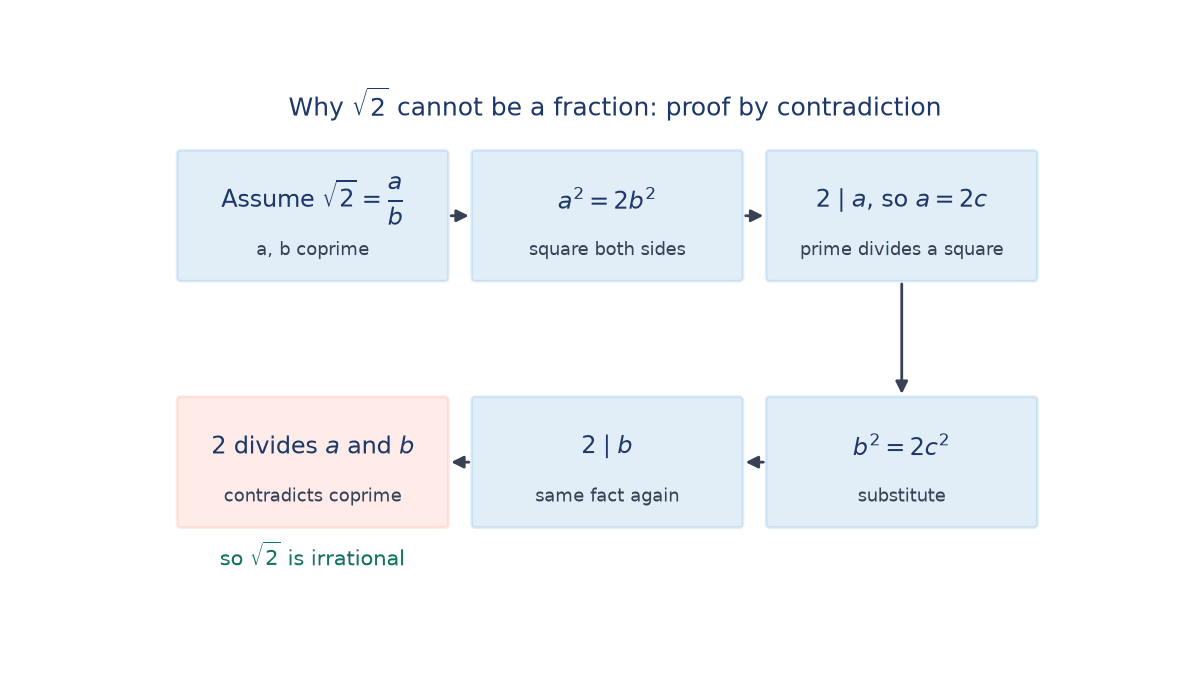
Assume, to the contrary, that 2 is rational. Then there are integers r and s, with s=0, such that 2=sr. If r and s have a common factor other than 1, divide it out. So we may write
2=ba,
where a and b are coprime (their only common factor is 1) and b=0.
Multiplying both sides by b gives b2=a. Squaring both sides:
2b2=a2.
So 2 divides a2. Since 2 is prime, the stepping-stone theorem tells us that 2 divides a. Write a=2c for some integer c and substitute:
2b2b2=(2c)2=4c2=2c2
So 2 divides b2, and by the same theorem 2 divides b.
Now both a and b have the factor 2. This contradicts the fact that a and b are coprime. The contradiction arose from the assumption that 2 is rational, so that assumption is false.
Hence 2 is irrational.
The chain of the proof for 2: every arrow is a correct step, so the starting assumption must be what fails.
Assume, to the contrary, that 3 is rational. Then 3=ba for some coprime integers a and b with b=0. So b3=a, and squaring gives
3b2=a2.
Therefore 3 divides a2, and since 3 is prime, 3 divides a. Write a=3c for some integer c. Substituting:
3b2b2=9c2=3c2
So 3 divides b2, and hence 3 divides b. Now 3 is a common factor of a and b, which contradicts their being coprime. So the assumption is false, and 3 is irrational.
Nothing in this argument used any property of 3 except that it is prime. The same steps prove that p is irrational for every prime p.
the sum or difference of a rational number and an irrational number is irrational;
the product or quotient of a non-zero rational number and an irrational number is irrational.
The key tool behind both is that rational numbers are closed under addition, subtraction, multiplication and division by a non-zero number. The examples below prove particular cases by contradiction.
Assume, to the contrary, that 5−3 is rational. Then there are coprime integers a and b, with b=0, such that
5−3=ba.
Rearranging,
3=5−ba=b5b−a.
Since a and b are integers, 5b−a is an integer and b=0, so b5b−a is rational. This says 3 is rational, which contradicts Example 2. Hence 5−3 is irrational.
Every proof in this lesson has the same shape: assume the opposite, carry out correct algebra, and arrive at something impossible. For p, the impossibility is that two numbers chosen with no common factor turn out to share the factor p. For combinations such as 5−3, the impossibility is that a number already proved irrational turns out to be rational. Learn to recognise this pattern; it appears again and again in mathematics.
Forgetting to say that a and b are coprime. Without it there is no contradiction at the end.
Writing "2 divides a2, so 2 divides a" without giving the reason: 2 is prime, so the stepping-stone theorem applies.
Trying the same proof for a non-prime such as 4. Since 4 divides 36 but not 6, the key step fails, and in fact 4=2 is rational.
In proofs such as Example 3, not explaining why the rearranged expression is rational. Say that it is a quotient of integers with a non-zero denominator.
Assuming that the sum of two irrationals is irrational. It need not be: 2+(−2)=0.
Using the decimal 1.414 as if it were exactly 2. It is only an approximation, and a proof cannot rely on it.
Any fraction can be reduced to lowest terms by cancelling common factors, so this costs nothing. It is what makes the ending a contradiction: finding a common factor 2 is impossible for a fraction already in lowest terms.
Both are irrational, but the argument needs a prime. For 6, from 6b2=a2 use the prime 2: it divides a2, so it divides a. Writing a=2c gives 3b2=2c2, so 3b2 is even; if b were odd, 3b2 would be odd, so b is even, and 2 divides both a and b. For 8=22, use the result for 2 and the rule for products.
Five things: the assumption that the number is rational, the condition that a and b are coprime with b=0, the use of the prime-divides-square theorem with its reason, the contradiction, and the final conclusion.