How firms in monopolistic competition set price and output: short-run profit or loss where MR = MC, and why entry drives long-run economic profit to zero.
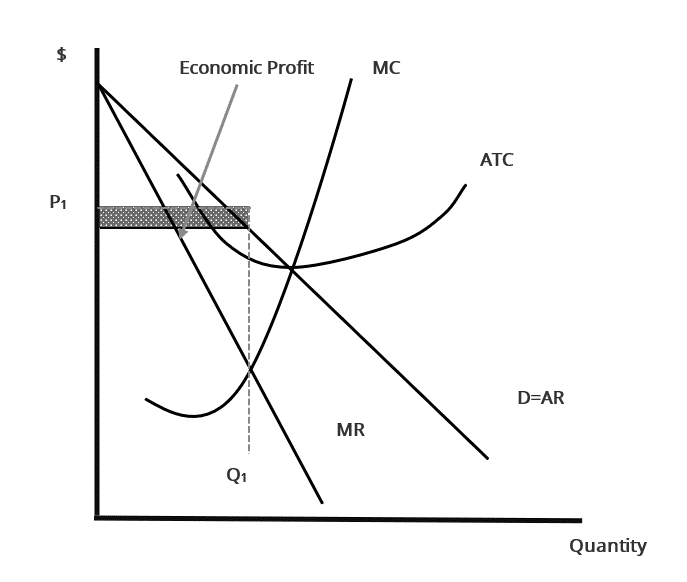
The short-run equilibrium under monopolistic competition is illustrated in the diagram below:
Profits are maximized where marginal revenue (MR) is equal to marginal cost (MC). The point determines the company’s equilibrium output. The price is found by drawing a vertical line up from this output, through the point where MR and MC intersect, to the average revenue (AR) curve, which is also the demand curve.
Total profit is represented by the rectangle in the diagram above. It is determined by the equilibrium output multiplied by the difference between AR and the average total cost (ATC). In the short run, firms in monopolistic competition make their price and output decisions just as a monopolist does.
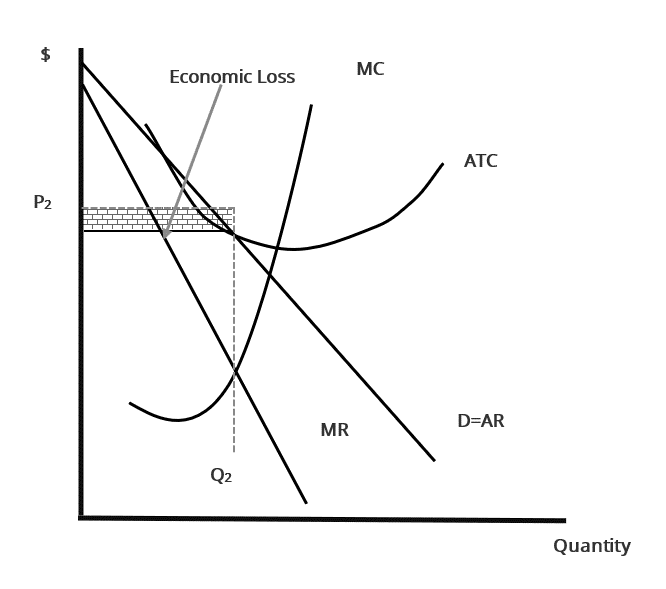
Companies in monopolistic competition can also incur economic losses in the short run, as illustrated below. They still produce where MR equals MC, which is where losses are smallest.
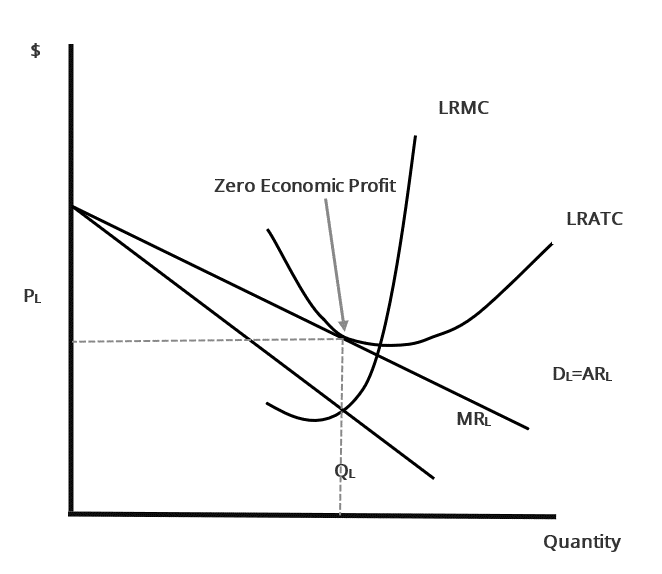
In the long run, companies in monopolistic competition still produce at a level where marginal cost and marginal revenue are equal. However, the demand curve will have shifted to the left due to other companies entering the market. The shift in the demand curve is a result of reduced demand for an individual company’s products due to increased competition.
Such action reduces economic profits, depending on the magnitude of the entry of new players. Eventually individual companies can no longer sell at a price above average cost.
Companies in monopolistic competition will earn zero economic profit in the long run. At this stage, there is no incentive for new entrants in the industry.