NCERT Class 10 Exercise 1.2 Solutions: Irrational Numbers
Step-by-step NCERT Class 10 Exercise 1.2 solutions proving that root 5, 3 + 2 root 5, 1 over root 2, 7 root 5 and 6 + root 2 are irrational, using proof by contradiction and the prime divisor theorem.
Exercise 1.2 of the NCERT Class 10 textbook (Chapter 1, Real Numbers) asks you to prove that certain numbers are irrational. There are three questions: 5 on its own, then 3+25, and then three more numbers built from 2 and 5. All of them use proof by contradiction, and all of them lean on one fact from the Fundamental Theorem of Arithmetic. Each proof below is written the way an examiner expects to read it.
Theorem. Let p be a prime number. If p divides a2, where a is a positive integer, then p divides a.
Why it is true: write a=p1p2⋯pn as a product of primes. Then a2=p1p1p2p2⋯pnpn. If p divides a2, then by the uniqueness of prime factorisation p must be one of p1,p2,…,pn, and so p divides a.
Assume the opposite of what you want: the number is rational.
Write it as ba with integers a and b=0 (for a square root, also take a and b coprime, which is always possible by cancelling common factors).
Rearrange or square, and follow the algebra.
Reach something impossible: a common factor of coprime numbers, or a known irrational number equal to a rational one.
Conclude that the assumption was false, so the number is irrational.
For Questions 2 and 3 you also use the fact that the sum, difference, product and quotient (with non-zero divisor) of rational numbers are rational.
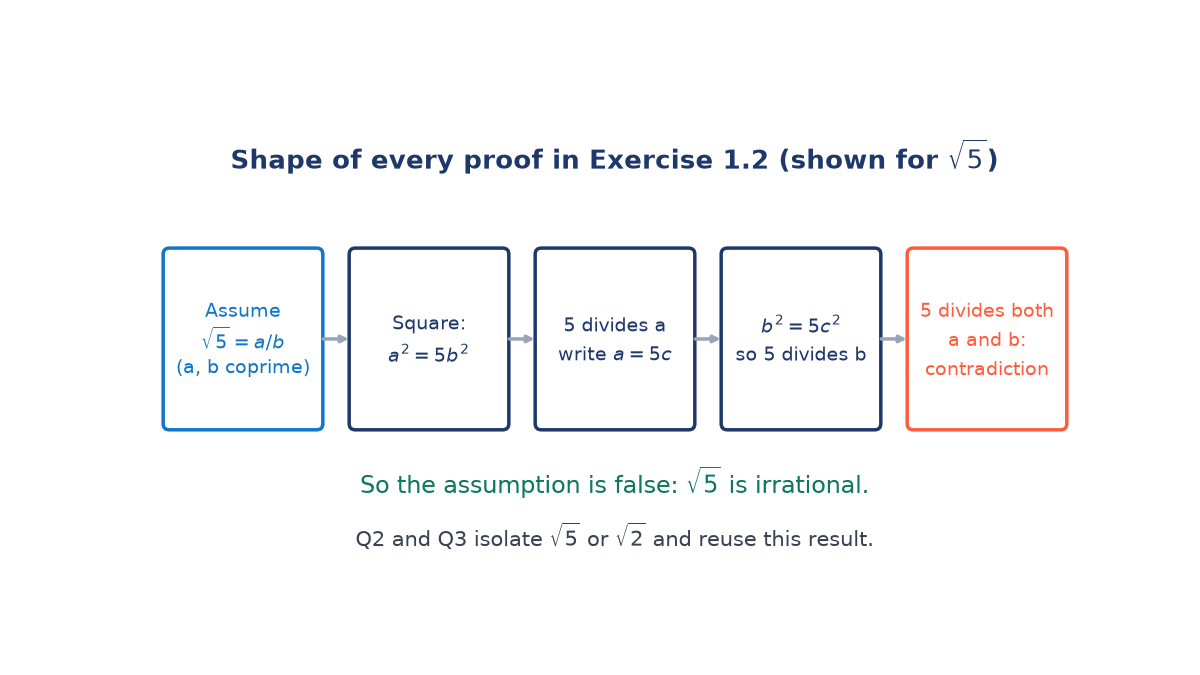
The chain of steps in the proof that 5 is irrational. Questions 2 and 3 reduce to this result or to the same result for 2.
Assume, to the contrary, that 5 is rational. Then there are integers a and b (b=0) such that
5=ba
Suppose a and b have a common factor other than 1. Dividing both by it, we may assume that a and b are coprime.
Then b5=a. Squaring both sides,
5b2=a2(1)
So 5 divides a2. Since 5 is prime, by the theorem above 5 divides a. So we can write a=5c for some integer c. Substituting in (1),
5b2b2=25c2=5c2
So 5 divides b2, and again by the theorem, 5 divides b.
Therefore a and b both have 5 as a common factor. This contradicts the fact that a and b are coprime.
The contradiction arose from assuming that 5 is rational. So that assumption is false.
Answer:5 is irrational.
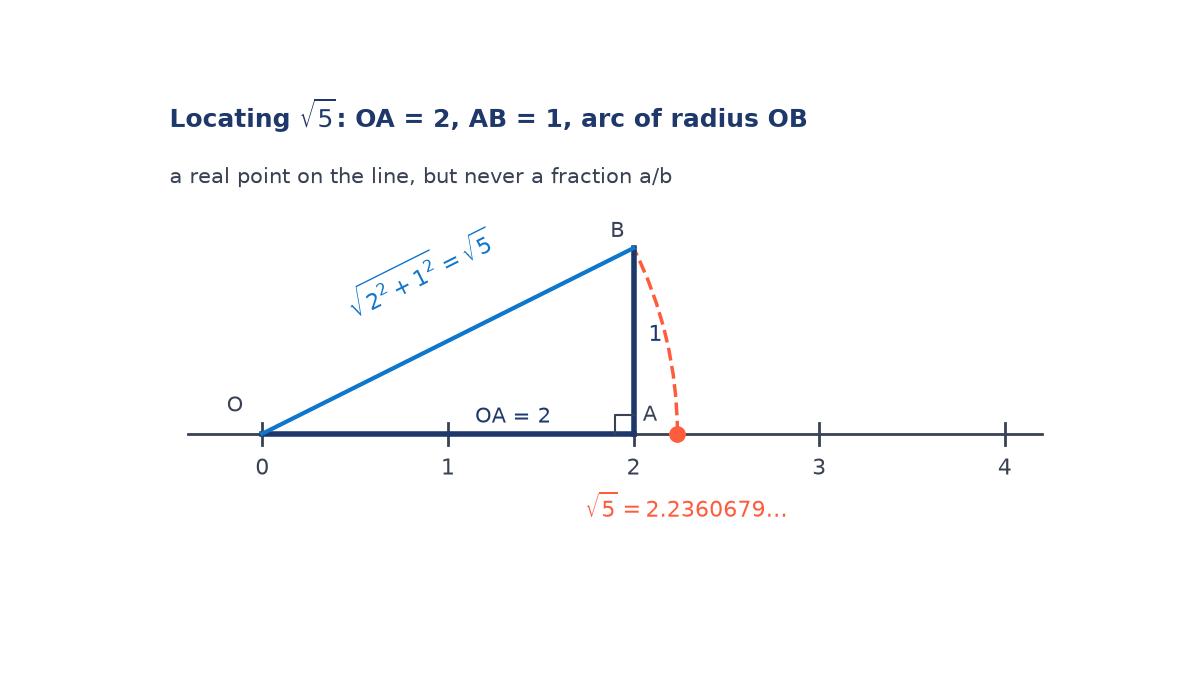
5 is a genuine point on the number line (the hypotenuse of a 2 by 1 right triangle), yet Question 1 shows it is not a fraction.
Why this works: in lowest terms, a and b cannot both be multiples of 5, but the equation a2=5b2 forces both to be. As a numerical check, 5=2.2360679…, a decimal that neither terminates nor repeats.
Assume, to the contrary, that 3+25 is rational. Then there are integers a and b (b=0) such that
3+25=ba
Rearranging,
255=ba−3=ba−3b=2ba−3b
Since a and b are integers, a−3b is an integer and 2b is a non-zero integer. So 2ba−3b is rational, and therefore 5 would be rational.
This contradicts the fact, proved in Question 1, that 5 is irrational. So our assumption is false.
Answer:3+25 is irrational.
Check of the algebra: multiplying 5=2ba−3b by 2b gives 2b5=a−3b, so a=b(3+25), which is the starting equation. Numerically, 3+25=7.4721359…
Prove that the following are irrational: (i) 21
Assume, to the contrary, that 21 is rational. Then there are integers a and b (b=0) with
21=ba
Since 21=0, also a=0. Taking reciprocals,
2=ab
Here b and a are integers with a=0, so ab is rational, which would make 2 rational.
But 2 is irrational (proved in the textbook by exactly the method of Question 1, with 2 in place of 5). This contradiction shows the assumption is false.
Answer:21 is irrational.
Another way to see it: 21=22, so if it were rational, twice it, which is 2, would be rational too. Numerically, 21=0.7071067…
Assume, to the contrary, that 6+2 is rational. Then there are integers a and b (b=0) with
6+2=ba
Rearranging,
2=ba−6=ba−6b
Since a−6b and b are integers with b=0, the right-hand side is rational, which would make 2 rational.
But 2 is irrational. This contradiction shows that the assumption is false.
Answer:6+2 is irrational.
Check of the algebra: b2=a−6b gives a=b(6+2), the starting equation. Numerically, 6+2=7.4142135…
Why Questions 2 and 3 work: in each one we isolate the square root. The other side is then built from integers using only addition, subtraction, multiplication and division by a non-zero number, so it is rational. A known irrational number cannot equal a rational one. This is the general fact that a non-zero rational number added to, subtracted from, multiplied by or divided into an irrational number always gives an irrational number.
Any fraction can be reduced to lowest terms by dividing numerator and denominator by their HCF. So if 5 were a fraction at all, it would also be a fraction in lowest terms.
Why do Questions 2 and 3 not need the coprime condition?#
Their contradiction does not come from a common factor. It comes from showing that 5 or 2 would be rational, which is already known to be false. Adding the coprime condition is harmless but not needed.
Is it enough to say the decimal of 5 never ends?#
No. A calculator shows only finitely many digits, so it cannot prove that the decimal never ends or never repeats. The decimal is a useful check, but the proof must be the algebraic argument.