Exercise 1.1 of the NCERT Class 10 textbook (Chapter 1, Real Numbers) is where the Fundamental Theorem of Arithmetic becomes a working tool. You use it to write numbers as products of primes, to find the HCF and LCM of two or three numbers, and to reason about what a number can or cannot be divisible by. Every one of the seven questions is solved below in the textbook's order, with each step shown and each answer checked.
Methods you need
Prime factorisation
The Fundamental Theorem of Arithmetic says that every composite number can be written as a product of primes, and this factorisation is unique apart from the order of the factors. To find it:
- Divide by the smallest prime that divides the number exactly (try 2, then 3, 5, 7, 11, 13, and so on).
- Repeat with the quotient.
- Stop when the quotient is itself a prime. Collect repeated primes as powers.
You only need to test primes up to the square root of the number you are working on: if none of them divides it, the number is prime.
HCF and LCM from prime factors
- HCF = product of the common prime factors, each taken with its smallest power.
- LCM = product of all prime factors that appear, each taken with its greatest power.
- For any two positive integers and : . This does not hold for three numbers.
Prime factorisation
Question 1 (i)
Express each number as a product of its prime factors: (i) 140.
140 is even, so divide by 2 twice, then by 5.
Check: .
Answer:
Question 1 (ii)
(ii) 156
Check: .
Answer:
Question 1 (iii)
(iii) 3825
3825 is odd, so 2 does not divide it. Its digit sum is , which is divisible by 3 (and by 9), so start with 3.
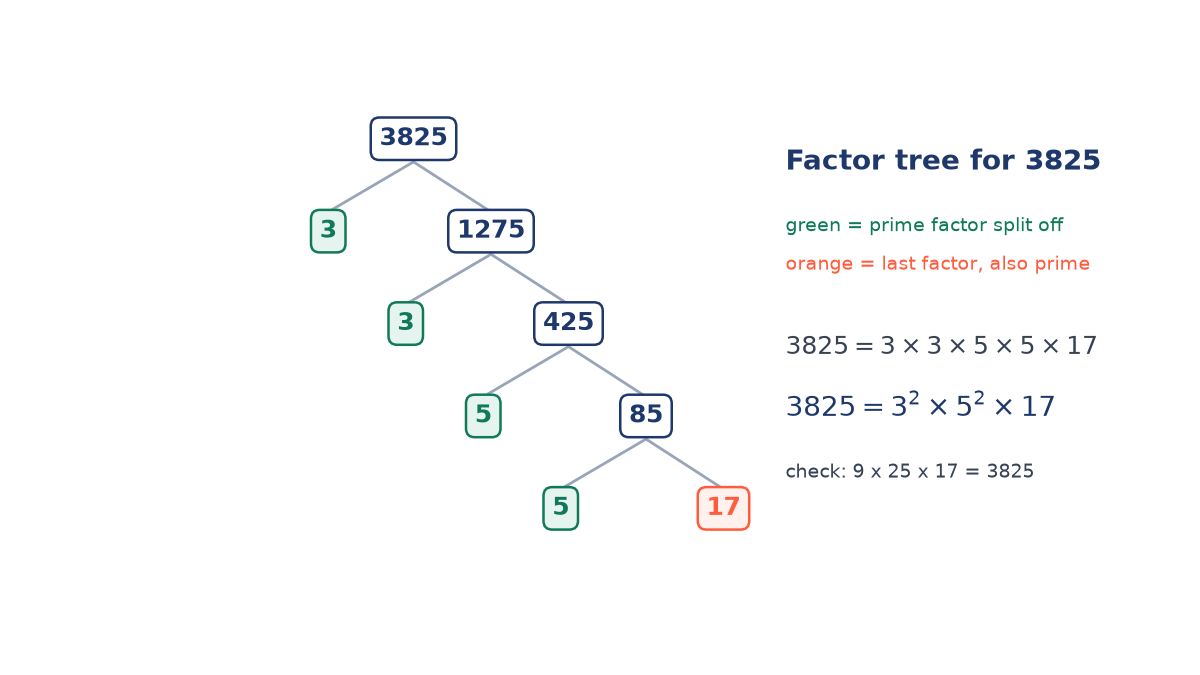
Check: .
Answer:
Question 1 (iv)
(iv) 5005
5005 ends in 5, so start with 5. Then and .
Check: , , .
Answer:
Question 1 (v)
(v) 7429
7429 is not divisible by 2 (odd), 3 (digit sum 22) or 5 (last digit 9). Testing further primes, 7, 11 and 13 all leave remainders, but 17 divides exactly:
Now (since ), and both 19 and 23 are prime.
Check, multiplying in a different order: and .
Answer:
HCF and LCM
Question 2 (i)
Find the LCM and HCF of the following pairs and verify that LCM × HCF = product of the two numbers: (i) 26 and 91.
The only common prime is 13, so . Taking every prime at its highest power, .
Verification: and . The two are equal.
Answer: HCF = 13, LCM = 182, and .
Question 2 (ii)
(ii) 510 and 92
The only common prime is 2; its smaller power is , so .
Verification: and . Equal.
Answer: HCF = 2, LCM = 23460, and .
Question 2 (iii)
(iii) 336 and 54
Common primes are 2 and 3. Smaller powers: and , so .
Greatest powers: .
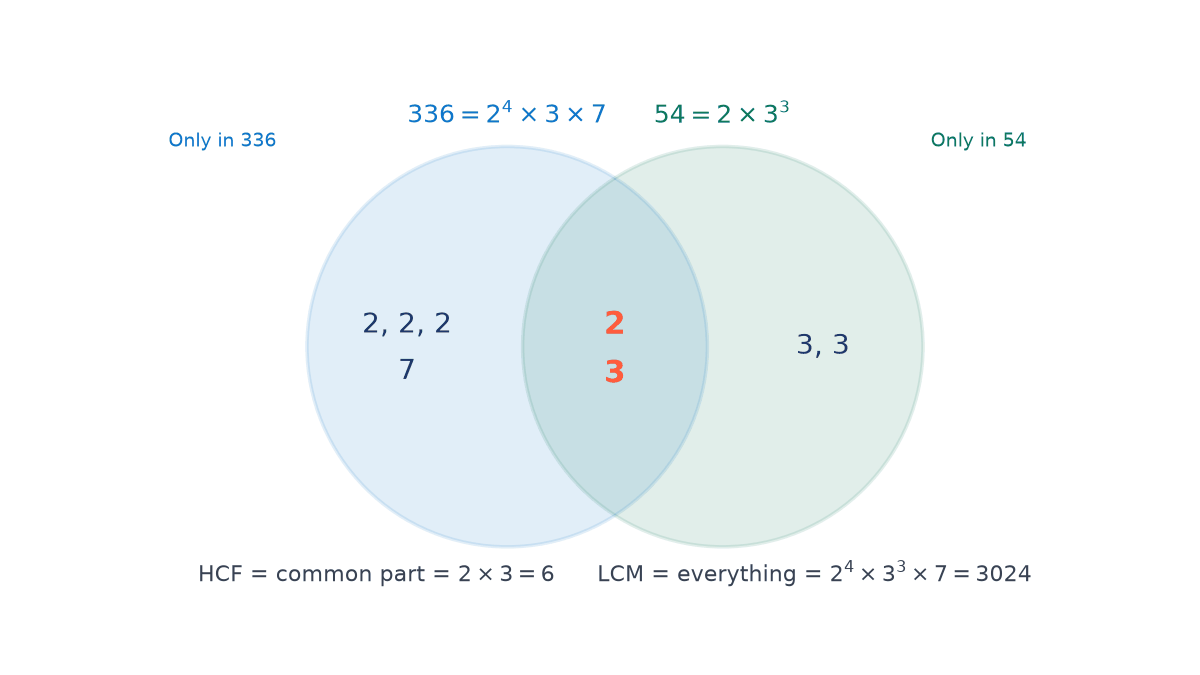
Verification: and . Equal.
Answer: HCF = 6, LCM = 3024, and .
Question 3 (i)
Find the LCM and HCF of the following integers by applying the prime factorisation method: (i) 12, 15 and 21.
With three numbers there is no product shortcut, so use the definitions directly.
The only prime common to all three is 3 (power 1 each time), so . All primes at their greatest powers: .
Check: , , , all whole numbers. Notice that , while : the product rule really does fail for three numbers.
Answer: HCF = 3, LCM = 420
Question 3 (ii)
(ii) 17, 23 and 29
All three are different primes, so they have no common prime factor: . The LCM is their product.
Check another way: and .
Answer: HCF = 1, LCM = 11339
Question 3 (iii)
(iii) 8, 9 and 25
No prime is shared, so (the numbers are pairwise coprime even though none is prime). The LCM is .
Check: and .
Answer: HCF = 1, LCM = 1800
Question 4
Given that HCF(306, 657) = 9, find LCM(306, 657).
For two numbers, product of the numbers, so
A quicker way to compute: , so the LCM is . (Equivalently, and .)
Independent check by factorisation: and . The common part is , which confirms the given HCF, and .
Answer: LCM(306, 657) = 22338
Reasoning with prime factors
Question 5
Check whether can end with the digit 0 for any natural number .
A number ends in 0 exactly when it is divisible by 10. Since , such a number must have 5 in its prime factorisation.
The only primes here are 2 and 3. By the uniqueness part of the Fundamental Theorem of Arithmetic, has no other prime factorisation, so 5 can never be a factor of . Hence is never divisible by 10.
Sanity check: , , , , all ending in 6.
Answer: No. cannot end with the digit 0 for any natural number , because 5 is not a prime factor of .
Why this works: uniqueness of prime factorisation means a prime that is missing from one factorisation is missing for good.
Question 6
Explain why and are composite numbers.
A composite number is one that has a factor other than 1 and itself. The trick is to take out the factor common to both terms before multiplying anything.
First number.
So 1014 has the factor 13, which is neither 1 nor 1014. In fact . Check: and .
Second number.
So 5045 has the factor 5, which is neither 1 nor 5045. Check: and . (It does not matter whether 1009 is prime; one factor other than 1 and the number is enough.)
Answer: and ; each has a factor other than 1 and itself, so both are composite.
A word problem
Question 7
There is a circular path around a sports field. Sonia takes 18 minutes to drive one round of the field, while Ravi takes 12 minutes for the same. Suppose they both start at the same point and at the same time, and go in the same direction. After how many minutes will they meet again at the starting point?
Sonia is at the starting point after 18, 36, 54, … minutes (multiples of 18). Ravi is there after 12, 24, 36, … minutes (multiples of 12). They are there together at the first time common to both lists, which is .
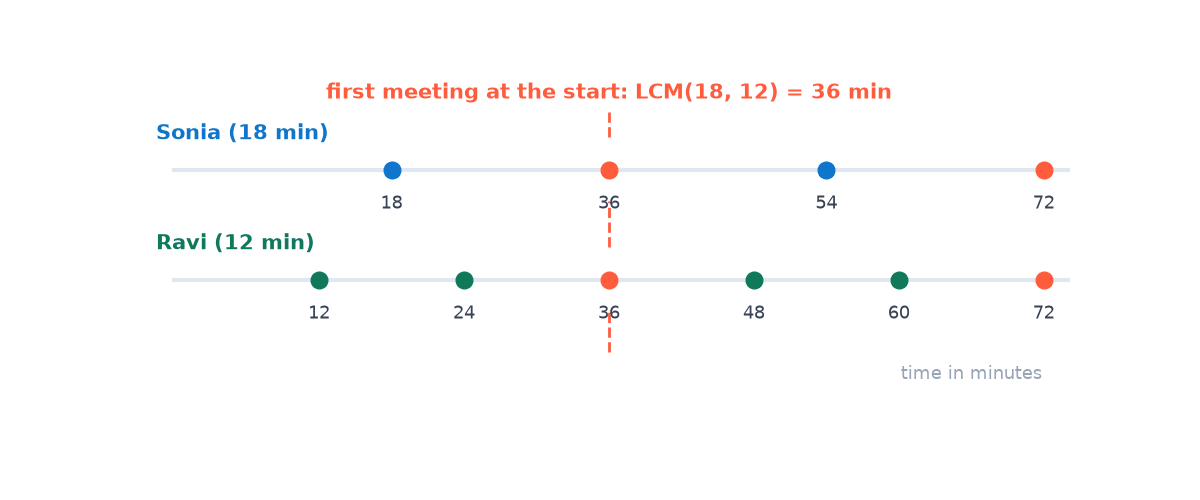
Check: in 36 minutes Sonia completes rounds and Ravi completes rounds, both whole numbers, and no smaller number appears in both lists.
Answer: They meet again at the starting point after 36 minutes.
Why this works: "first time both events happen together" is always a least common multiple question; "largest equal group or piece" is an HCF question.
Key terms
- Prime number
- A natural number greater than 1 whose only factors are 1 and itself, such as 2, 3, 17 and 23.
- Composite number
- A natural number greater than 1 that has at least one factor other than 1 and itself, such as 1014 or 5045.
- Prime factorisation
- Writing a number as a product of primes, for example .
- Fundamental Theorem of Arithmetic
- Every composite number can be expressed as a product of primes, and this factorisation is unique apart from the order of the factors.
- HCF (highest common factor)
- The largest number that divides each of the given numbers; the product of common primes at their smallest powers.
- LCM (lowest common multiple)
- The smallest positive number that is a multiple of each of the given numbers; the product of all primes at their greatest powers.
- Coprime numbers
- Numbers whose HCF is 1, such as 8, 9 and 25.
Common questions
Can I use HCF × LCM = product for three numbers?
No. The identity holds only for two numbers. For 12, 15 and 21 the product is 3780, but HCF × LCM is only .
How do I know when to stop testing primes?
Stop once the prime you are testing is larger than the square root of the number left. For 437, is a little under 21, so testing primes up to 19 is enough, and 19 does divide it.
Is 1 a prime number?
No. A prime has exactly two different factors, and 1 has only one. That is also why 1 never appears in a prime factorisation.
In Question 6, do I have to show that 1009 is prime?
No. To show a number is composite you only need one factor other than 1 and itself. The factor 5 already does that.
How can I tell whether a word problem needs HCF or LCM?
If the answer must be a multiple of the given numbers (a later time, a longer length), it is LCM. If it must divide the given numbers (the biggest equal share or the longest measuring tape), it is HCF.
References
- National Council of Educational Research and Training. Mathematics: Textbook for Class X. NCERT, New Delhi.
- Aggarwal, R. S. Secondary School Mathematics for Class 10. Bharati Bhawan.
- Burton, D. M. Elementary Number Theory. McGraw-Hill Education.