Take the number 30. You can reach it as , or as , or . Keep splitting each piece until nothing splits any further, and every route ends on the same three numbers: 2, 3 and 5. This is not luck. It is the Fundamental Theorem of Arithmetic, one of the most useful facts about whole numbers, and the first big result of the Real Numbers chapter in Class 10. In this lesson you will see what the theorem says, why it is believable, and how it gives a reliable method for the HCF and LCM, for deciding what digit a power can end in, and for the irrationality proofs that come next.
Building numbers up from primes
Primes and composites
A prime number is a natural number greater than 1 whose only factors are 1 and itself, such as 2, 3, 5, 7, 11 and 13. A composite number is a natural number greater than 1 that is not prime, so it can be split into smaller factors. The number 1 is neither prime nor composite.
Multiplying primes together
Pick a few primes, say 2, 3, 7, 11 and 23, and multiply them in different combinations, letting a prime repeat as often as you like:
Each result is a new composite number built entirely from primes. Since there are infinitely many primes, you could build infinitely many composite numbers this way.
Now turn the question round. Given any composite number, can we always break it back down into primes? And could two different sets of primes ever give the same number?
Breaking numbers back down: the factor tree
Why the breaking down always stops
Take any composite number and split it into two smaller factors, each greater than 1. If either factor is composite, split it again. Every split produces strictly smaller numbers, and whole numbers greater than 1 cannot keep getting smaller for ever, so the process must stop. It can only stop when every piece is prime. So every composite number is a product of primes.
Method: prime factorisation by repeated division
- Divide the number by the smallest prime that divides it exactly (try 2, then 3, then 5, and so on).
- Repeat with the quotient, using the same prime as long as it still divides.
- Stop when the quotient is itself a prime.
- Write the number as the product of all the primes used, grouping repeats as powers.
Example 1: factorising 32760
Pull out a 2 to leave 16380, another 2 to leave 8190, and a third 2 to leave 4095, which is odd, so the 2s are finished. Pull out a 3 to leave 1365, another 3 to leave 455, then a 5 to leave 91. Finally , and both are prime.
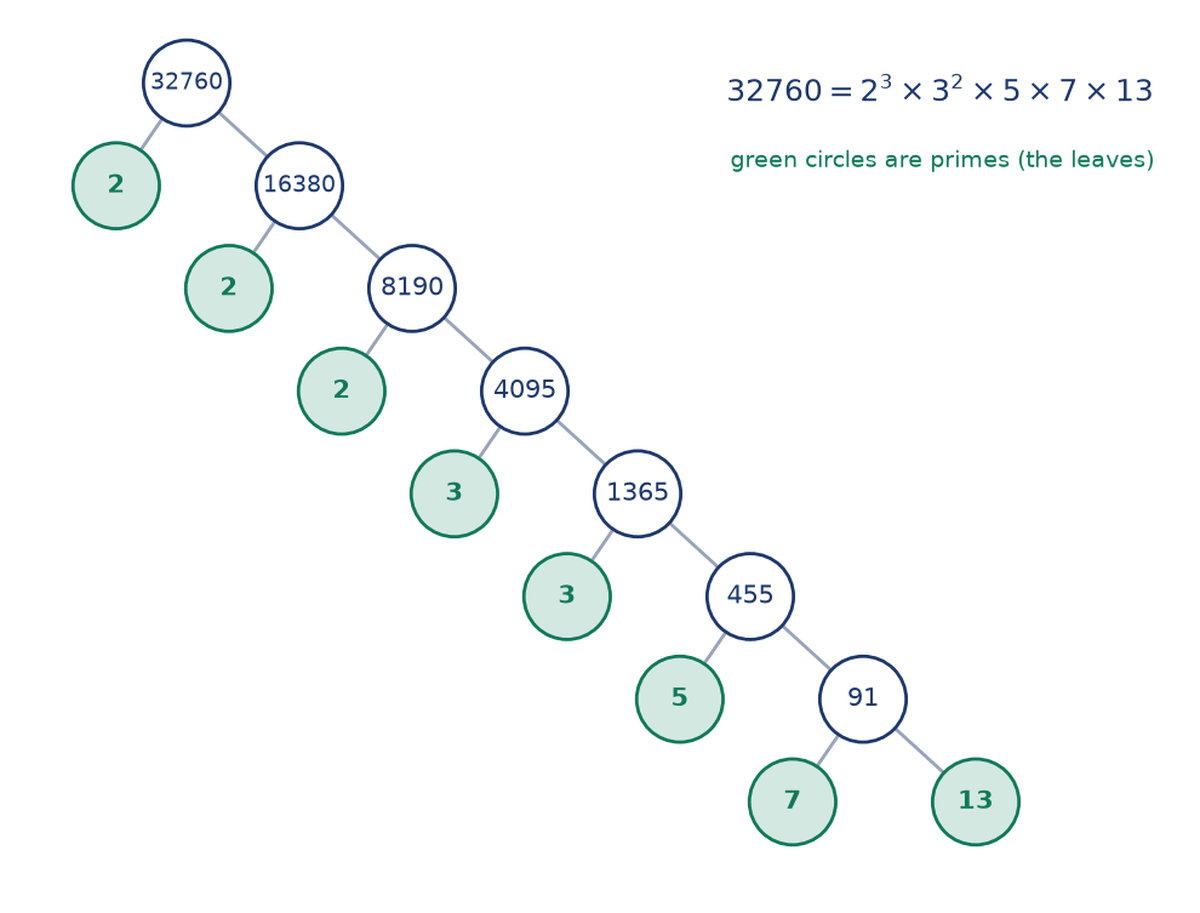
Even a large number such as 123456789 gives way: , and 3607 and 3803 are both prime. However big the number, it comes apart into primes.
A bit of history. An equivalent form of this fact was probably first recorded more than two thousand years ago, as Proposition 14 of Book IX of Euclid's Elements. The first correct proof is credited to Carl Friedrich Gauss (1777–1855), in his Disquisitiones Arithmeticae.
The Fundamental Theorem of Arithmetic
Statement
Theorem (Fundamental Theorem of Arithmetic). Every composite number can be expressed (factorised) as a product of primes, and this factorisation is unique, apart from the order in which the prime factors occur.
The surprising part is the word unique. The theorem does not only say that a composite number can be broken into primes; it says there is exactly one such breakdown. Writing the factors of 32760 as or as counts as the same factorisation, just shuffled. No other collection of primes multiplies to 32760.
In general, a composite number can be written as
where are primes written in ascending order, . Once we agree always to write the primes smallest first, there is exactly one correct answer. In Class 10 the uniqueness part is accepted without proof; the existence part is the splitting argument above.
Example 2: can end in the digit 0?
A number ending in 0 is divisible by 10, so it is divisible by 5, and its prime factorisation must contain the prime 5. But
so the only prime in the factorisation of is 2. By uniqueness, no other prime, 5 included, can appear. Therefore can never end in the digit 0 for any natural number . (Check: end in 4 or 6.)
Example 3: showing numbers are composite
Explain why and are composite.
Take out the common factor in each.
Each number has a factor other than 1 and itself (13 and 5 respectively), so both are composite.
Using the theorem to find HCF and LCM
Definitions and the rule
The HCF (highest common factor) of two numbers is the largest number that divides both exactly. The LCM (lowest common multiple) is the smallest number that both divide exactly. The Fundamental Theorem of Arithmetic gives the prime factorisation method:
- HCF = product of the smallest power of each prime common to the numbers.
- LCM = product of the greatest power of each prime that appears in any of the numbers.
Method
- Write each number as a product of prime powers.
- For the HCF, list the primes found in every number and take the lowest power of each.
- For the LCM, list every prime found in any number and take the highest power of each.
- Multiply out, and check that the HCF divides the LCM.
Example 4: HCF and LCM of 6 and 20
Only 2 is common, with smallest power , so . The greatest powers of 2, 3 and 5 give .
Notice that . This is always true for two positive integers:
Why this works: for each prime, the HCF takes the smaller of the two exponents and the LCM takes the larger. The smaller plus the larger equals the sum of the two exponents, which is exactly the exponent of that prime in .
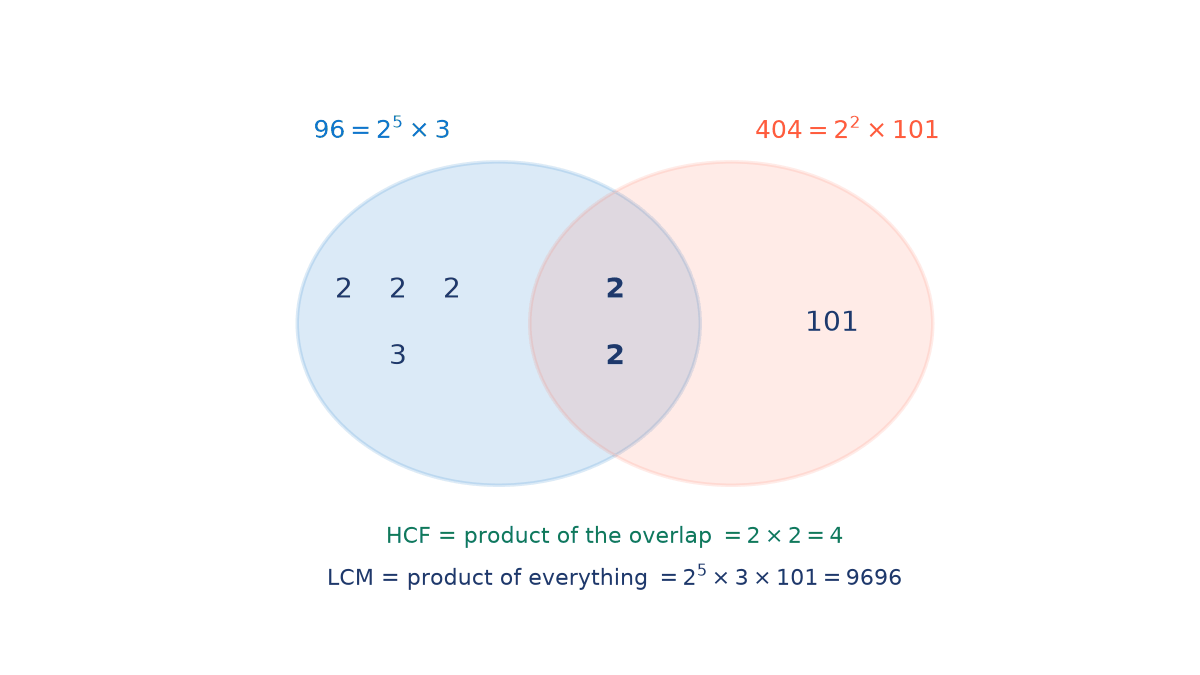
Example 5: HCF of 96 and 404, then the LCM
The only common prime is 2, with smallest power , so . Using the product relationship:
As a check, the greatest powers give .
Example 6: three numbers, and a caution
Find the HCF and LCM of 6, 72 and 120.
The smallest common powers are and , so . The greatest powers are , and , so .
The product relationship does not carry over to three numbers. Here
These are not equal. The rule product works only for two numbers.
Common mistakes
- Leaving a composite number in the "prime" factorisation, for example writing . Keep splitting until every factor is prime.
- Taking the greatest power for the HCF or the smallest for the LCM. HCF uses the smallest powers of common primes; LCM uses the greatest powers of all primes.
- Including in the HCF a prime that appears in only one of the numbers.
- Using product for three or more numbers.
- Treating 1 as a prime. It is neither prime nor composite, and it never appears in a prime factorisation.
- Saying cannot end in 0 "because 4 is even". The real reason is that its only prime factor is 2, so it has no factor 5.
Try these
- Express as a product of prime factors: (i) 140 (ii) 156 (iii) 3825 (iv) 5005 (v) 7429. Answer: (i) (ii) (iii) (iv) (v)
- Find the HCF and LCM of each pair, and check that HCF LCM equals the product of the two numbers: (i) 26 and 91 (ii) 510 and 92 (iii) 336 and 54. Answer: (i) HCF 13, LCM 182 (ii) HCF 2, LCM 23460 (iii) HCF 6, LCM 3024
- Find the HCF and LCM using prime factorisation: (i) 12, 15 and 21 (ii) 17, 23 and 29 (iii) 8, 9 and 25. Answer: (i) HCF 3, LCM 420 (ii) HCF 1, LCM 11339 (iii) HCF 1, LCM 1800
- Given that , find . Answer: 22338
- Check whether can end with the digit 0 for any natural number . Answer: No; has no prime factor 5.
- Sonia takes 18 minutes to drive one round of a circular path around a sports field, while Ravi takes 12 minutes. If they start together from the same point and go in the same direction, after how many minutes will they meet again at the starting point? Answer: 36 minutes (the LCM of 18 and 12)
Key terms
- Prime number
- A natural number greater than 1 whose only factors are 1 and itself.
- Composite number
- A natural number greater than 1 that has at least one factor other than 1 and itself.
- Prime factorisation
- Writing a number as a product of primes, such as .
- Factor tree
- A diagram that splits a number into factors step by step until every branch ends in a prime.
- Fundamental Theorem of Arithmetic
- Every composite number is a product of primes in exactly one way, apart from the order of the factors.
- HCF
- The highest common factor: the largest number that divides each of the given numbers exactly.
- LCM
- The lowest common multiple: the smallest number that each of the given numbers divides exactly.
- Coprime numbers
- Two numbers whose HCF is 1, such as 8 and 9.
Common questions
Why is the theorem called "fundamental"?
Because primes are the building blocks of all whole numbers greater than 1, and uniqueness means each number has one fixed "recipe". Many later results, including the irrationality of , depend on it.
Why is 1 not counted as a prime?
If 1 were prime, factorisations would stop being unique, since . Excluding 1 keeps the theorem true as stated.
Does HCF LCM product work for three numbers?
No. For 6, 72 and 120 the product is 51840, while HCF LCM is only 2160. The relationship is for two numbers only.
Is the prime factorisation method better than listing factors?
For large numbers, yes. Listing all factors of 32760 would be slow and error-prone, while repeated division by primes takes a few lines and gives both the HCF and the LCM.
How do I know when a number such as 101 is prime?
Test division by the primes up to its square root. Since , it is enough to try 2, 3, 5 and 7; none divides 101, so 101 is prime.
References
- National Council of Educational Research and Training. Mathematics: Textbook for Class X. NCERT, New Delhi.
- Hardy, G. H. and Wright, E. M. An Introduction to the Theory of Numbers. Oxford University Press.
- Burton, D. M. Elementary Number Theory. McGraw-Hill Education.
- Heath, T. L. (trans.) The Thirteen Books of Euclid's Elements. Dover Publications.