Angle of Depression Problems with Two Buildings, Class 10
Use alternate angles to turn an angle of depression into an angle of elevation, then find the height of a building, the width of a river and the distance between two cars seen from a height.
So far the observer has mostly stood on the ground and looked up. This lesson turns the view around: the observer is high up, on the roof of a building or on a bridge, and looks down at points below. That brings the angle of depression into play, together with one small fact about parallel lines that makes these problems straightforward. The same set-up is used to find the height of a building from a nearby one, the width of a river from a bridge, or the distance of a ship from a lighthouse, and it follows the NCERT Class 10 examples in Chapter 9.
The angle of depression of a point below the observer is the angle between the horizontal line through the observer's eye and the line of sight to that point.
The horizontal through the observer and the horizontal ground are parallel. The line of sight cuts both of them, so it makes a pair of alternate angles, and alternate angles between parallel lines are equal. Hence:
angle of depression of B from P=angle of elevation of P from B
For example, if the angle of depression from the top of a building to a point on the ground is 30∘, then the angle of elevation of the top of the building from that point is also 30∘.
The angle of depression sits outside the right triangle, between the horizontal and the line of sight. We cannot use it directly in a ratio. The alternate-angle fact moves it to the lower end of the line of sight, where it is an angle inside a right triangle, next to the horizontal side. The angle inside the triangle at the top is 90∘ minus the angle of depression, which is a different angle altogether.
Draw the observer's horizontal as a dashed line and mark each angle of depression below it.
Transfer each angle to the lower end of its line of sight using alternate angles.
If a point of interest is above the ground (the top of a shorter building), draw a horizontal from it to the taller structure. This creates a rectangle whose opposite sides are equal.
Write one tan equation for each right triangle.
Use the rectangle or the shared vertical to connect the equations, then solve.
Check whether the required length is a sum (points on opposite sides) or a difference (points on the same side).
From the top of a tower 60 m high, the angle of depression of a car on the road is 30∘. How far is the car from the foot of the tower?
By alternate angles, the angle of elevation of the top of the tower from the car is 30∘. With the tower (60 m) opposite and the distance d adjacent:
tan30∘=d60⇒d=603≈103.92 m
Answer: the car is 603 m ≈103.92 m from the foot of the tower.
Example 2: two buildings, two angles of depression#
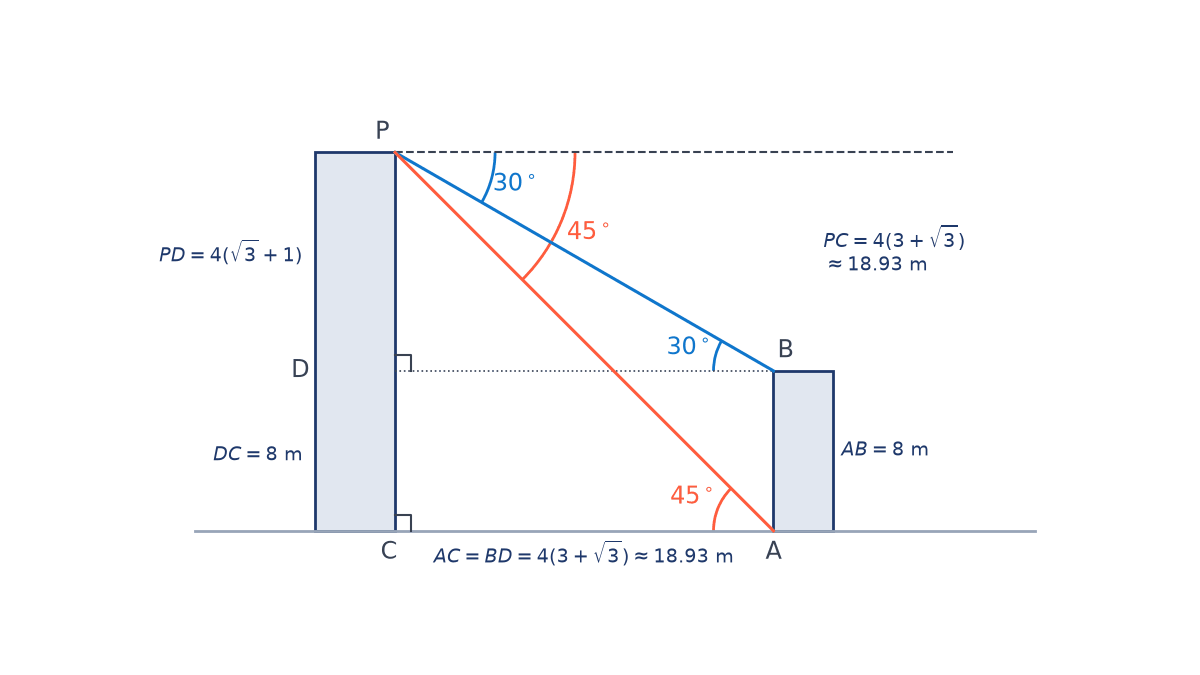
From the top of a multi-storeyed building, the angles of depression of the top and the bottom of an 8 m tall building are 30∘ and 45∘ respectively. Find the height of the multi-storeyed building and the distance between the two buildings.
Naming the points. Let PC be the multi-storeyed building, with top P and foot C. Let AB be the 8 m building, with foot A and top B. Draw a horizontal from B to meet PC at D. Since AB and DC are vertical and AC and BD are horizontal, ABDC is a rectangle, so
DC=AB=8 mandBD=AC
Transferring the angles. The angle of depression of B from P is 30∘, so ∠PBD=30∘. The angle of depression of A from P is 45∘, so ∠PAC=45∘.
Triangle PBD (right-angled at D):
tan30∘=BDPD⇒31=BDPD⇒BD=PD3
Triangle PAC (right-angled at C):
tan45∘=ACPC⇒PC=AC
Connecting them.PC=PD+DC=PD+8, and PC=AC=BD=PD3. Therefore
and since AC=PC, the distance between the buildings is also 4(3+3) m.
Example 2 to scale: the rectangle ABDC gives DC=8 m and BD=AC.
Answer: the building is 4(3+3)≈18.93 m tall, and the buildings are 4(3+3)≈18.93 m apart.
Why this works: the two answers are equal because tan45∘=1 makes the two legs of triangle PAC equal.
Example 3: the width of a river, seen from a bridge#
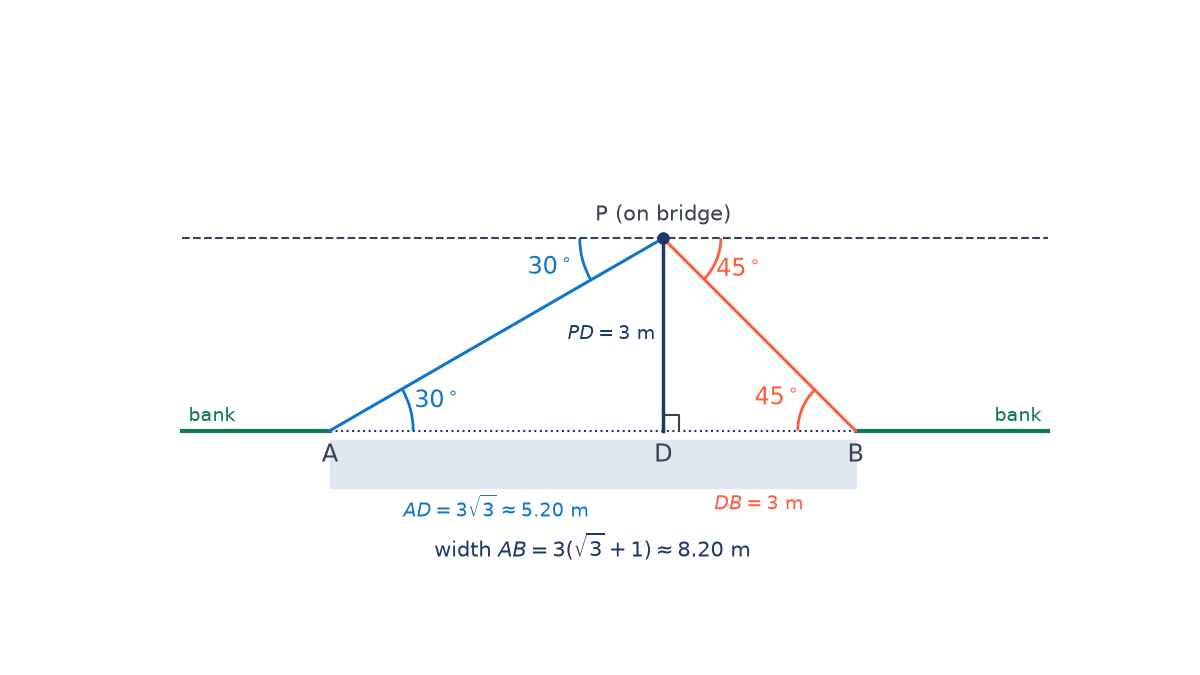
From a point on a bridge across a river, the angles of depression of the banks on opposite sides of the river are 30∘ and 45∘. If the bridge is at a height of 3 m from the banks, find the width of the river.
Let A and B be the points on the two banks, so AB is the width. Let P be the point on the bridge and D the point on AB directly below P, so PD=3 m and PD⊥AB. (The height is measured from the level of the banks, so D lies on the line AB, not on the water surface.)
By alternate angles, ∠PAD=30∘ and ∠PBD=45∘.
Triangle APD:
tan30∘=ADPD⇒31=AD3⇒AD=33 m
Triangle BPD:
tan45∘=BDPD⇒1=BD3⇒BD=3 m
A and B are on opposite sides of D, so the lengths add:
AB=AD+DB=33+3=3(3+1) m≈8.20 m
Example 3 to scale: the banks lie on opposite sides of D, so the two horizontal pieces add.
From the top of a tower 100 m high, a man observes two cars on the same side of the tower, in a straight line with its foot. The angles of depression of the cars are 30∘ and 45∘. Find the distance between the cars.
By alternate angles the angles of elevation from the cars are 30∘ and 45∘. The nearer car (larger angle) is at distance
d1=100cot45∘=100 m
and the farther car is at distance
d2=100cot30∘=1003 m
Both cars are on the same side, so the distances subtract:
d2−d1=1003−100=100(3−1)≈73.2 m
Answer: the cars are 100(3−1) m ≈73.2 m apart.
Example 5: elevation and depression from the same roof#
From the top of a 7 m high building, the angle of elevation of the top of a cable tower is 60∘ and the angle of depression of its foot is 45∘. Find the height of the tower.
Let the building be AB with top A, and the tower CE with foot C and top E. Draw the horizontal AF from A to meet the tower at F, so FC=AB=7 m and AF=BC.
From the angle of depression, ∠ACB=45∘ in triangle ABC:
The same few moves appear in every problem: draw and label the right triangles carefully; convert each angle of depression into an equal angle of elevation using alternate angles; draw a horizontal through any raised point to create a rectangle; identify what the triangles share; and write one equation per triangle before combining them. The trigonometric ratios themselves are the ones you already know. What this chapter adds is the practical eye for turning a tower, a ladder, a flagstaff or a river into the right triangle that solves it.
Marking the angle of depression between the line of sight and the vertical wall of the building.
Using the full height PC in the triangle for the top of the shorter building; that triangle only contains PD=PC−8.
Adding the distances when both points are on the same side of the tower (they should be subtracted), or subtracting when they are on opposite sides.
Assuming the larger angle of depression belongs to the farther point; a larger angle means the point is nearer.
Forgetting that the rectangle gives BD=AC, which is the link between the two triangles.
Stopping at 3−18 without rationalising and simplifying.
From the top of a lighthouse 100 m high, the angle of depression of a boat is 30∘. How far is the boat from the lighthouse? Answer:1003≈173.21 m.
From the top of a 75 m high lighthouse, the angles of depression of two ships on opposite sides of it are 30∘ and 45∘. Find the distance between the ships. Answer:75(3+1)≈204.90 m.
From the top of a 60 m high building, the angles of depression of the top and the bottom of a tower are 30∘ and 60∘. Find the height of the tower. Answer: 40 m.
A bridge is 5 m above the banks of a river. From a point on it, the angles of depression of the two opposite banks are 60∘ and 30∘. Find the width of the river. Answer:3203≈11.55 m.
From the top of a 20 m high building, the angle of elevation of the top of a tower is 60∘ and the angle of depression of its foot is 45∘. Find the height of the tower. Answer:20(3+1)≈54.64 m.
Why can't I use the angle of depression directly in the triangle?#
It lies between the horizontal and the line of sight, outside the right triangle. Alternate angles move it to the lower point, where it lies inside the triangle next to the horizontal side.
How do I tell whether to add or subtract the distances?#
Draw the figure. If the two points lie on opposite sides of the foot of the perpendicular, add; if they are on the same side, subtract the shorter distance from the longer one.
Which point is nearer, the one with the larger or smaller angle of depression?#
The larger angle of depression belongs to the nearer point, because the distance is height ×cotθ and cotθ decreases as θ increases.
Why are the height and distance equal in the two-buildings problem?#
The foot of the shorter building is seen at 45∘, and tan45∘=1, so the vertical and horizontal legs of that triangle are equal.
Only when one of the points is above the ground, such as the top of a shorter building. The rectangle turns the raised point into a right triangle with a known vertical side.