Exer­cise 3.1 of the NCERT Class 10 text­book (Chap­ter 3, Pair of Lin­ear Equa­tions in Two Vari­ables) prac­tises two skills: turn­ing a sit­u­a­tion into a pair of equa­tions and solv­ing it by draw­ing graphs, and using the ratios of the coef­fi­cients to decide whether the lines inter­sect, are par­al­lel or coin­cide. All seven ques­tions are solved below in the text­book's order, with every part included and every answer checked by sub­sti­tu­tion.

Meth­ods you need

The graph­i­cal method

  1. For each equa­tion, find two or three points by choos­ing val­ues of xx and work­ing out yy.
  2. Plot both sets of points on the same axes and draw the two lines.
  3. Read off the com­mon point. Check it in both equa­tions.

The ratio test

For a1x+b1y+c1=0a_1x + b_1y + c_1 = 0 and a2x+b2y+c2=0a_2x + b_2y + c_2 = 0:

  • a1a2b1b2\displaystyle \dfrac{a_1}{a_2} \neq \dfrac{b_1}{b_2}: the lines inter­sect at one point; the pair is con­sis­tent with a unique solu­tion.
  • a1a2=b1b2=c1c2\displaystyle \dfrac{a_1}{a_2} = \dfrac{b_1}{b_2} = \dfrac{c_1}{c_2}: the lines are coin­ci­dent; the pair is con­sis­tent (depen­dent) with infi­nitely many solu­tions.
  • a1a2=b1b2c1c2\displaystyle \dfrac{a_1}{a_2} = \dfrac{b_1}{b_2} \neq \dfrac{c_1}{c_2}: the lines are par­al­lel; the pair is incon­sis­tent, with no solu­tion.

Always move every term to the left-hand side first, so that the signs of c1c_1 and c2c_2 are right.

Form­ing equa­tions and solv­ing graph­i­cally

Ques­tion 1 (i)

Form the pair of lin­ear equa­tions and find the solu­tion graph­i­cally: 10 stu­dents of Class X took part in a Math­e­mat­ics quiz. If the num­ber of girls is 4 more than the num­ber of boys, find the num­ber of boys and girls who took part in the quiz.

Let the num­ber of boys be xx and the num­ber of girls be yy.

x+y=10andyx=4x + y = 10 \qquad \text{and} \qquad y - x = 4

Points on each line
LinePoint 1Point 2Point 3
x+y=10x + y = 10(0,10)(0, 10)(10,0)(10, 0)(3,7)(3, 7)
yx=4y - x = 4(0,4)(0, 4)(4,0)(-4, 0)(3,7)(3, 7)

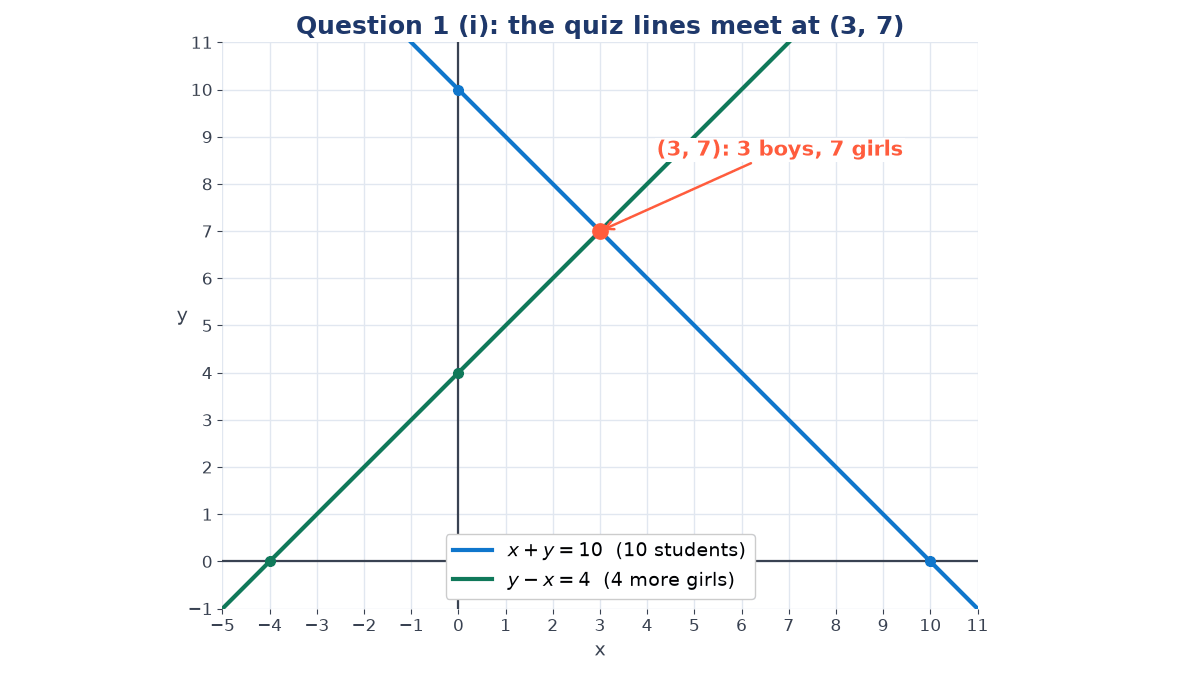
Plot­ting these points and draw­ing the lines, they meet at (3,7)(3, 7).

Graph of x + y = 10 through (0, 10) and (10, 0) and y - x = 4 through (0, 4) and (-4, 0); the lines cross at the marked point (3, 7), labelled 3 boys, 7 girls.
The two quiz con­di­tions meet at (3,7)(3, 7).

Check: 3+7=103 + 7 = 10 and 73=47 - 3 = 4.

Answer: 3 boys and 7 girls took part in the quiz.

Ques­tion 1 (ii)

5 pen­cils and 7 pens together cost ₹50, whereas 7 pen­cils and 5 pens together cost ₹46. Find the cost of one pen­cil and that of one pen.

Let one pen­cil cost ₹xx and one pen cost ₹yy (so xx and yy are num­bers of rupees).

5x+7y=50(1)5x + 7y = 50 \qquad \text{(1)}

7x+5y=46(2)7x + 5y = 46 \qquad \text{(2)}

Points on line (1): (10,0)(10, 0), (3,5)(3, 5) and (4,10)(-4, 10). Points on line (2): (3,5)(3, 5), (8,2)(8, -2) and (2,12)(-2, 12). The xx-inter­cept of line (2) is 4676.57\displaystyle \dfrac{46}{7} \approx 6.57, which is not a whole num­ber, so it is bet­ter to plot points with whole-num­ber coor­di­nates.

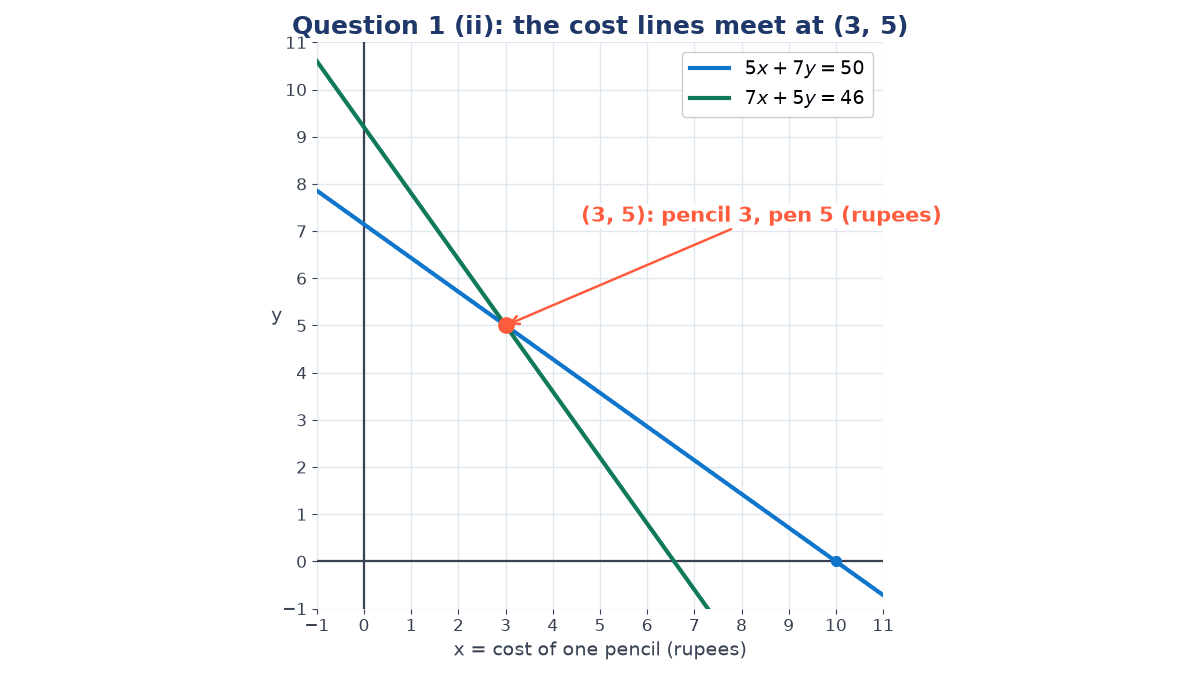
Both lines pass through (3,5)(3, 5), so that is where they meet.

Graph of 5x + 7y = 50 through (10, 0) and 7x + 5y = 46 crossing it at the marked point (3, 5), labelled pencil 3, pen 5 rupees; x-axis is the cost of one pencil.
The two pur­chases as lines. They meet at (3,5)(3, 5).

Alge­braic con­fir­ma­tion: mul­ti­ply (1) by 7 and (2) by 5 to get 35x+49y=35035x + 49y = 350 and 35x+25y=23035x + 25y = 230. Sub­tract­ing, 24y=12024y = 120, so y=5y = 5. Then 5x+35=505x + 35 = 50, so x=3x = 3.

Check: 5(3)+7(5)=15+35=505(3) + 7(5) = 15 + 35 = 50 and 7(3)+5(5)=21+25=467(3) + 5(5) = 21 + 25 = 46.

Answer: one pen­cil costs ₹3 and one pen costs ₹5.

Inter­sect­ing, par­al­lel or coin­ci­dent

Ques­tion 2 (i)

On com­par­ing the ratios a1a2\displaystyle \dfrac{a_1}{a_2}, b1b2\displaystyle \dfrac{b_1}{b_2} and c1c2\displaystyle \dfrac{c_1}{c_2}, find out whether the lines inter­sect at a point, are par­al­lel or coin­ci­dent: (i) 5x4y+8=05x - 4y + 8 = 0 and 7x+6y9=07x + 6y - 9 = 0.

Here a1=5a_1 = 5, b1=4b_1 = -4, c1=8c_1 = 8 and a2=7a_2 = 7, b2=6b_2 = 6, c2=9c_2 = -9.

a1a2=57,b1b2=46=23\displaystyle \frac{a_1}{a_2} = \frac{5}{7}, \qquad \frac{b_1}{b_2} = \frac{-4}{6} = -\frac{2}{3}

Since 5723\displaystyle \dfrac{5}{7} \neq -\dfrac{2}{3}, the lines inter­sect. (One ratio is pos­i­tive and the other neg­a­tive, so they can­not be equal.)

Answer: the lines inter­sect at a point.

Ques­tion 2 (ii)

(ii) 9x+3y+12=09x + 3y + 12 = 0 and 18x+6y+24=018x + 6y + 24 = 0

a1a2=918=12,b1b2=36=12,c1c2=1224=12\displaystyle \frac{a_1}{a_2} = \frac{9}{18} = \frac{1}{2}, \qquad \frac{b_1}{b_2} = \frac{3}{6} = \frac{1}{2}, \qquad \frac{c_1}{c_2} = \frac{12}{24} = \frac{1}{2}

All three ratios are equal. Indeed, 2(9x+3y+12)=18x+6y+242(9x + 3y + 12) = 18x + 6y + 24, so the sec­ond equa­tion is just twice the first.

Answer: the lines are coin­ci­dent.

Ques­tion 2 (iii)

(iii) 6x3y+10=06x - 3y + 10 = 0 and 2xy+9=02x - y + 9 = 0

a1a2=62=3,b1b2=31=3,c1c2=109\displaystyle \frac{a_1}{a_2} = \frac{6}{2} = 3, \qquad \frac{b_1}{b_2} = \frac{-3}{-1} = 3, \qquad \frac{c_1}{c_2} = \frac{10}{9}

The first two ratios are equal but the third is dif­fer­ent. Check: 3(2xy+9)=6x3y+273(2x - y + 9) = 6x - 3y + 27, which has the same xx and yy terms as 6x3y+106x - 3y + 10 but a dif­fer­ent con­stant, so the two can never both be zero.

Answer: the lines are par­al­lel.

Con­sis­tent or incon­sis­tent

Ques­tion 3 (i)

On com­par­ing the ratios, find out whether the fol­low­ing pairs of lin­ear equa­tions are con­sis­tent or incon­sis­tent: (i) 3x+2y=53x + 2y = 5 and 2x3y=72x - 3y = 7.

In gen­eral form: 3x+2y5=03x + 2y - 5 = 0 and 2x3y7=02x - 3y - 7 = 0.

a1a2=32,b1b2=23=23\displaystyle \frac{a_1}{a_2} = \frac{3}{2}, \qquad \frac{b_1}{b_2} = \frac{2}{-3} = -\frac{2}{3}

The ratios dif­fer, so the lines inter­sect at one point.

Con­fir­ma­tion: mul­ti­ply­ing the equa­tions by 3 and 2 gives 9x+6y=159x + 6y = 15 and 4x6y=144x - 6y = 14. Adding, 13x=2913x = 29, so x=2913\displaystyle x = \dfrac{29}{13}, and then y=53x2=1113\displaystyle y = \dfrac{5 - 3x}{2} = -\dfrac{11}{13}. A sin­gle def­i­nite solu­tion exists.

Answer: con­sis­tent (unique solu­tion).

Ques­tion 3 (ii)

(ii) 2x3y=82x - 3y = 8 and 4x6y=94x - 6y = 9

In gen­eral form: 2x3y8=02x - 3y - 8 = 0 and 4x6y9=04x - 6y - 9 = 0.

a1a2=24=12,b1b2=36=12,c1c2=89=89\displaystyle \frac{a_1}{a_2} = \frac{2}{4} = \frac{1}{2}, \qquad \frac{b_1}{b_2} = \frac{-3}{-6} = \frac{1}{2}, \qquad \frac{c_1}{c_2} = \frac{-8}{-9} = \frac{8}{9}

The first two ratios are equal and the third is not. Check: dou­bling the first equa­tion gives 4x6y=164x - 6y = 16, but the sec­ond says 4x6y=94x - 6y = 9; both can­not be true.

Answer: incon­sis­tent (no solu­tion).

Ques­tion 3 (iii)

(iii) 32x+53y=7\displaystyle \dfrac{3}{2}x + \dfrac{5}{3}y = 7 and 9x10y=149x - 10y = 14

In gen­eral form: 32x+53y7=0\displaystyle \dfrac{3}{2}x + \dfrac{5}{3}y - 7 = 0 and 9x10y14=09x - 10y - 14 = 0.

a1a2=3/29=16,b1b2=5/310=16\displaystyle \frac{a_1}{a_2} = \frac{3/2}{9} = \frac{1}{6}, \qquad \frac{b_1}{b_2} = \frac{5/3}{-10} = -\frac{1}{6}

The ratios dif­fer, so the lines inter­sect.

Con­fir­ma­tion: mul­ti­ply the first equa­tion by 6 to get 9x+10y=429x + 10y = 42. Adding this to 9x10y=149x - 10y = 14 gives 18x=5618x = 56, so x=289\displaystyle x = \dfrac{28}{9}; sub­tract­ing gives 20y=2820y = 28, so y=75\displaystyle y = \dfrac{7}{5}. Check in the orig­i­nal first equa­tion: 32289+5375=143+73=7\displaystyle \dfrac{3}{2} \cdot \dfrac{28}{9} + \dfrac{5}{3} \cdot \dfrac{7}{5} = \dfrac{14}{3} + \dfrac{7}{3} = 7.

Answer: con­sis­tent (unique solu­tion).

Ques­tion 3 (iv)

(iv) 5x3y=115x - 3y = 11 and 10x+6y=22-10x + 6y = -22

Watch the signs. In gen­eral form: 5x3y11=05x - 3y - 11 = 0 and 10x+6y+22=0-10x + 6y + 22 = 0. So c1=11c_1 = -11 and c2=+22c_2 = +22.

a1a2=510=12,b1b2=36=12,c1c2=1122=12\displaystyle \frac{a_1}{a_2} = \frac{5}{-10} = -\frac{1}{2}, \qquad \frac{b_1}{b_2} = \frac{-3}{6} = -\frac{1}{2}, \qquad \frac{c_1}{c_2} = \frac{-11}{22} = -\frac{1}{2}

All three ratios are equal. Indeed, 2(5x3y11)=10x+6y+22-2(5x - 3y - 11) = -10x + 6y + 22.

Answer: con­sis­tent, with infi­nitely many solu­tions (coin­ci­dent lines).

Ques­tion 3 (v)

(v) 43x+2y=8\displaystyle \dfrac{4}{3}x + 2y = 8 and 2x+3y=122x + 3y = 12

In gen­eral form: 43x+2y8=0\displaystyle \dfrac{4}{3}x + 2y - 8 = 0 and 2x+3y12=02x + 3y - 12 = 0.

a1a2=4/32=23,b1b2=23,c1c2=812=23\displaystyle \frac{a_1}{a_2} = \frac{4/3}{2} = \frac{2}{3}, \qquad \frac{b_1}{b_2} = \frac{2}{3}, \qquad \frac{c_1}{c_2} = \frac{-8}{-12} = \frac{2}{3}

All three ratios are equal. Indeed, 23(2x+3y12)=43x+2y8\displaystyle \dfrac{2}{3}(2x + 3y - 12) = \dfrac{4}{3}x + 2y - 8.

Answer: con­sis­tent, with infi­nitely many solu­tions (coin­ci­dent lines).

Con­sis­tency and graph­i­cal solu­tions

Ques­tion 4 (i)

Which of the fol­low­ing pairs of lin­ear equa­tions are con­sis­tent or incon­sis­tent? If con­sis­tent, obtain the solu­tion graph­i­cally: (i) x+y=5x + y = 5 and 2x+2y=102x + 2y = 10.

In gen­eral form: x+y5=0x + y - 5 = 0 and 2x+2y10=02x + 2y - 10 = 0.

a1a2=12,b1b2=12,c1c2=510=12\displaystyle \frac{a_1}{a_2} = \frac{1}{2}, \qquad \frac{b_1}{b_2} = \frac{1}{2}, \qquad \frac{c_1}{c_2} = \frac{-5}{-10} = \frac{1}{2}

All equal, so the lines coin­cide and the pair is con­sis­tent. Plot­ting x+y=5x + y = 5 from the points (0,5)(0, 5), (5,0)(5, 0) and (2,3)(2, 3) gives one line, and 2x+2y=102x + 2y = 10 passes through exactly the same points (for exam­ple, 2(2)+2(3)=102(2) + 2(3) = 10). Every point of this line is a solu­tion.

Answer: con­sis­tent, with infi­nitely many solu­tions: y=5xy = 5 - x for any value of xx, such as (0,5)(0, 5), (2,3)(2, 3) and (5,0)(5, 0).

Ques­tion 4 (ii)

(ii) xy=8x - y = 8 and 3x3y=163x - 3y = 16

In gen­eral form: xy8=0x - y - 8 = 0 and 3x3y16=03x - 3y - 16 = 0.

a1a2=13,b1b2=13=13,c1c2=816=12\displaystyle \frac{a_1}{a_2} = \frac{1}{3}, \qquad \frac{b_1}{b_2} = \frac{-1}{-3} = \frac{1}{3}, \qquad \frac{c_1}{c_2} = \frac{-8}{-16} = \frac{1}{2}

The first two ratios are equal and the third is not, so the lines are par­al­lel. Check: tripling the first gives 3x3y=243x - 3y = 24, but the sec­ond says 3x3y=163x - 3y = 16.

Answer: incon­sis­tent; there is no solu­tion to draw.

Ques­tion 4 (iii)

(iii) 2x+y6=02x + y - 6 = 0 and 4x2y4=04x - 2y - 4 = 0

a1a2=24=12,b1b2=12=12\displaystyle \frac{a_1}{a_2} = \frac{2}{4} = \frac{1}{2}, \qquad \frac{b_1}{b_2} = \frac{1}{-2} = -\frac{1}{2}

The ratios dif­fer, so the pair is con­sis­tent with a unique solu­tion.

Points on 2x+y=62x + y = 6: (0,6)(0, 6), (3,0)(3, 0), (2,2)(2, 2). Points on 4x2y=44x - 2y = 4: (0,2)(0, -2), (1,0)(1, 0), (2,2)(2, 2). The lines meet at (2,2)(2, 2).

Alge­braic con­fir­ma­tion: from the first equa­tion y=62xy = 6 - 2x; then 4x2(62x)4=04x - 2(6 - 2x) - 4 = 0 gives 8x=168x = 16, so x=2x = 2 and y=2y = 2.

Check: 2(2)+26=02(2) + 2 - 6 = 0 and 4(2)2(2)4=04(2) - 2(2) - 4 = 0.

Answer: con­sis­tent; the solu­tion is x=2x = 2, y=2y = 2.

Ques­tion 4 (iv)

(iv) 2x2y2=02x - 2y - 2 = 0 and 4x4y5=04x - 4y - 5 = 0

a1a2=24=12,b1b2=24=12,c1c2=25=25\displaystyle \frac{a_1}{a_2} = \frac{2}{4} = \frac{1}{2}, \qquad \frac{b_1}{b_2} = \frac{-2}{-4} = \frac{1}{2}, \qquad \frac{c_1}{c_2} = \frac{-2}{-5} = \frac{2}{5}

The first two ratios are equal but 1225\displaystyle \dfrac{1}{2} \neq \dfrac{2}{5}, so the lines are par­al­lel. Check: dou­bling the first gives 4x4y=44x - 4y = 4, while the sec­ond says 4x4y=54x - 4y = 5.

Answer: incon­sis­tent; there is no solu­tion.

A prob­lem on a rec­tan­gle

Ques­tion 5

Half the perime­ter of a rec­tan­gu­lar gar­den, whose length is 4 m more than its width, is 36 m. Find the dimen­sions of the gar­den.

Let the width be xx m and the length be yy m. Half the perime­ter of a rec­tan­gle is length + width, so

x+y=36andyx=4x + y = 36 \qquad \text{and} \qquad y - x = 4

Adding the two equa­tions: 2y=402y = 40, so y=20y = 20. Then x=3620=16x = 36 - 20 = 16. (On a graph, the line x+y=36x + y = 36 through (0,36)(0, 36) and (36,0)(36, 0) meets the line yx=4y - x = 4 through (0,4)(0, 4) and (10,14)(10, 14) at (16,20)(16, 20).)

Check: 2016=420 - 16 = 4, and half the perime­ter is 20+16=3620 + 16 = 36 m.

Answer: the gar­den is 20 m long and 16 m wide.

Build­ing a sec­ond equa­tion

Ques­tion 6 (i)

Given the lin­ear equa­tion 2x+3y8=02x + 3y - 8 = 0, write another lin­ear equa­tion in two vari­ables such that the geo­met­ri­cal rep­re­sen­ta­tion of the pair so formed is: (i) inter­sect­ing lines.

We need a1a2b1b2\displaystyle \dfrac{a_1}{a_2} \neq \dfrac{b_1}{b_2}, so choose coef­fi­cients not in the ratio 2:32 : 3. Take

xy1=0x - y - 1 = 0

Then a1a2=21=2\displaystyle \dfrac{a_1}{a_2} = \dfrac{2}{1} = 2 and b1b2=31=3\displaystyle \dfrac{b_1}{b_2} = \dfrac{3}{-1} = -3, which are dif­fer­ent.

Answer: xy1=0x - y - 1 = 0 (many other answers are pos­si­ble).

Ques­tion 6 (ii)

(ii) par­al­lel lines

We need a1a2=b1b2c1c2\displaystyle \dfrac{a_1}{a_2} = \dfrac{b_1}{b_2} \neq \dfrac{c_1}{c_2}: keep the xx and yy coef­fi­cients in the ratio 2:32 : 3 and change the con­stant. Take

2x+3y20=02x + 3y - 20 = 0

Then a1a2=1\displaystyle \dfrac{a_1}{a_2} = 1, b1b2=1\displaystyle \dfrac{b_1}{b_2} = 1 and c1c2=820=251\displaystyle \dfrac{c_1}{c_2} = \dfrac{-8}{-20} = \dfrac{2}{5} \neq 1.

Answer: 2x+3y20=02x + 3y - 20 = 0 (any 2x+3y+c=02x + 3y + c = 0 with c8c \neq -8, or a mul­ti­ple of such an equa­tion, also works).

Ques­tion 6 (iii)

(iii) coin­ci­dent lines

We need all three ratios equal, so mul­ti­ply the whole equa­tion by a non-zero con­stant. Tak­ing 2,

4x+6y16=04x + 6y - 16 = 0

Then a1a2=24\displaystyle \dfrac{a_1}{a_2} = \dfrac{2}{4}, b1b2=36\displaystyle \dfrac{b_1}{b_2} = \dfrac{3}{6} and c1c2=816\displaystyle \dfrac{c_1}{c_2} = \dfrac{-8}{-16}, all equal to 12\displaystyle \dfrac{1}{2}.

Answer: 4x+6y16=04x + 6y - 16 = 0 (any non-zero mul­ti­ple of the given equa­tion works).

A tri­an­gle from two lines

Ques­tion 7

Draw the graphs of the equa­tions xy+1=0x - y + 1 = 0 and 3x+2y12=03x + 2y - 12 = 0. Deter­mine the coor­di­nates of the ver­tices of the tri­an­gle formed by these lines and the xx-axis, and shade the tri­an­gu­lar region.

Points on xy+1=0x - y + 1 = 0 (that is, y=x+1y = x + 1): (1,0)(-1, 0), (0,1)(0, 1), (2,3)(2, 3).

Points on 3x+2y12=03x + 2y - 12 = 0: (4,0)(4, 0), (0,6)(0, 6), (2,3)(2, 3).

The three ver­tices of the tri­an­gle are:

  • where xy+1=0x - y + 1 = 0 meets the xx-axis (y=0y = 0): x=1x = -1, giv­ing A(1,0)A(-1, 0);
  • where 3x+2y12=03x + 2y - 12 = 0 meets the xx-axis: 3x=123x = 12, x=4x = 4, giv­ing B(4,0)B(4, 0);
  • where the two lines meet: sub­sti­tut­ing y=x+1y = x + 1 into the sec­ond equa­tion, 3x+2x+212=03x + 2x + 2 - 12 = 0, so 5x=105x = 10, x=2x = 2 and y=3y = 3, giv­ing C(2,3)C(2, 3).
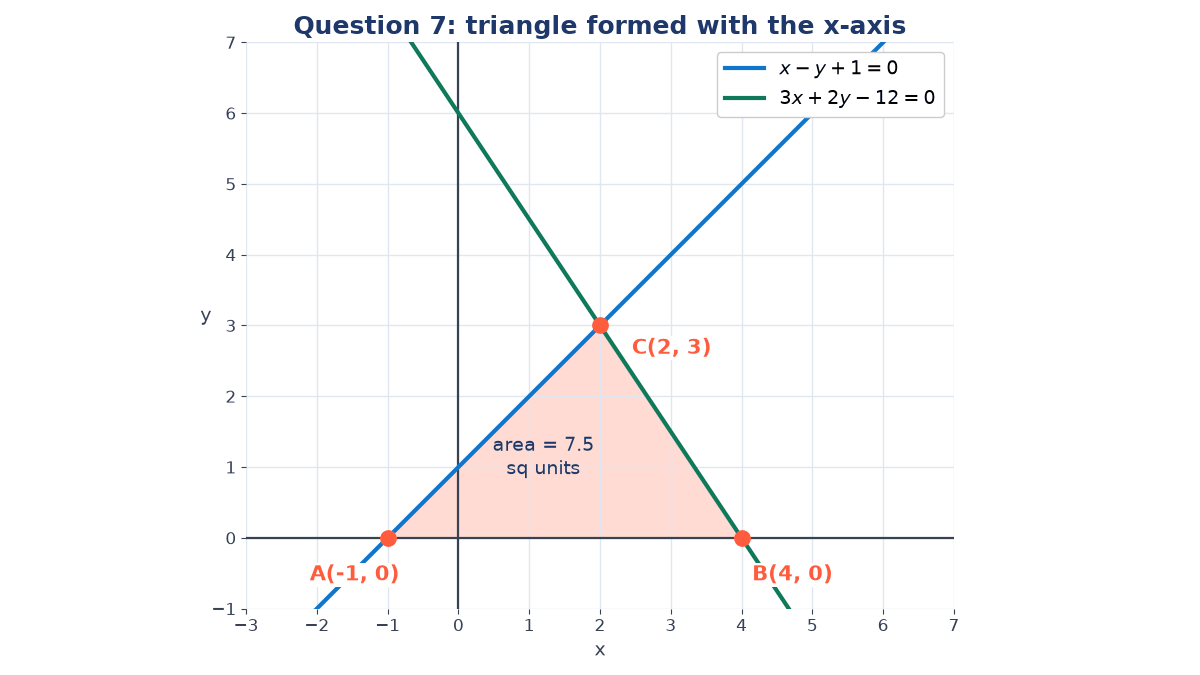
Graph of x - y + 1 = 0 and 3x + 2y - 12 = 0 with the triangle A(-1, 0), B(4, 0), C(2, 3) shaded between the lines and the x-axis, labelled area 7.5 square units.
The shaded tri­an­gle has ver­tices A(1,0)A(-1, 0), B(4,0)B(4, 0) and C(2,3)C(2, 3).

Check: 10+1=0-1 - 0 + 1 = 0; 3(4)+012=03(4) + 0 - 12 = 0; 23+1=02 - 3 + 1 = 0 and 6+612=06 + 6 - 12 = 0.

As an extra check, the base ABAB is 4(1)=54 - (-1) = 5 units and the height is 3 units, so the area is 12×5×3=7.5\displaystyle \dfrac{1}{2} \times 5 \times 3 = 7.5 square units.

Answer: the ver­tices are (1,0)(-1, 0), (4,0)(4, 0) and (2,3)(2, 3); the region enclosed by the two lines and the xx-axis is shaded.

Key terms

Pair of lin­ear equa­tions in two vari­ables
Two equa­tions of the form a1x+b1y+c1=0a_1x + b_1y + c_1 = 0 and a2x+b2y+c2=0a_2x + b_2y + c_2 = 0 con­sid­ered together.
Con­sis­tent pair
A pair with at least one solu­tion; its lines inter­sect or coin­cide.
Incon­sis­tent pair
A pair with no solu­tion; its lines are par­al­lel.
Depen­dent pair
A pair whose equa­tions rep­re­sent the same line, so it has infi­nitely many solu­tions.
Inter­sect­ing lines
Lines with exactly one com­mon point, which gives the unique solu­tion.
Par­al­lel lines
Lines in a plane that never meet.
Coin­ci­dent lines
Lines that lie on top of each other and share every point.
Inter­cept on the xx-axis
The point where a line meets the xx-axis, found by putting y=0y = 0.

Com­mon ques­tions

Do I have to draw a graph if the ques­tion asks for a graph­i­cal solu­tion?

Yes. In the exam, draw the lines on graph paper from a table of points and mark the inter­sec­tion. You may con­firm the answer alge­braically, but the graph is what the ques­tion asks for.

Why does 10x+6y=22-10x + 6y = -22 have c2=22c_2 = 22?

Mov­ing 22-22 to the left-hand side changes its sign, giv­ing 10x+6y+22=0-10x + 6y + 22 = 0. Using c2=22c_2 = -22 would give the ratio 12\displaystyle \dfrac{1}{2} and a wrong answer.

Is there only one cor­rect answer to Ques­tion 6?

No. Any equa­tion meet­ing the required ratio con­di­tion is cor­rect. Always show the ratio check with the equa­tion you choose.

What should I write when a pair is coin­ci­dent and the ques­tion says "obtain the solu­tion"?

State that there are infi­nitely many solu­tions, write the gen­eral form (for Ques­tion 4 (i), y=5xy = 5 - x) and list a few exam­ples.

How do I choose points when the inter­cepts are frac­tions?

Try small whole val­ues of xx until yy comes out whole. For 7x+5y=467x + 5y = 46, x=3x = 3 gives y=5y = 5 and x=8x = 8 gives y=2y = -2.

Ref­er­ences

  1. National Coun­cil of Edu­ca­tional Research and Train­ing. Math­e­mat­ics: Text­book for Class X. NCERT, New Delhi.
  2. Aggar­wal, R. S. Sec­ondary School Math­e­mat­ics for Class 10. Bharati Bhawan.
  3. Hall, H. S. and Knight, S. R. Higher Alge­bra. Macmil­lan.