These are com­plete solu­tions to Exer­cise 3.2 of Chap­ter 3, Pair of Lin­ear Equa­tions in Two Vari­ables, in the NCERT Class 10 math­e­mat­ics text­book. The exer­cise prac­tises the sub­sti­tu­tion method: first on six ready-made pairs of equa­tions, then on one pair used to find an unknown slope, and finally on six word prob­lems where you must form the equa­tions your­self. Every answer below has been checked by putting it back into the orig­i­nal equa­tions.

Quick recap of the method

  1. From one equa­tion, express one vari­able in terms of the other (pick a vari­able with coef­fi­cient 11 or −1-1 if pos­si­ble).
  2. Sub­sti­tute that expres­sion into the other equa­tion and solve the result­ing equa­tion in one vari­able.
  3. Sub­sti­tute the value back to find the sec­ond vari­able.
  4. Check both val­ues in both orig­i­nal equa­tions.

If the vari­able can­cels com­pletely in Step 2, a true state­ment (such as 9=99 = 9) means infi­nitely many solu­tions, and a false state­ment means no solu­tion. For word prob­lems, first name the unknowns clearly, then turn each sen­tence into one equa­tion.

Ques­tion 1: solve by sub­sti­tu­tion

Solve the fol­low­ing pairs of lin­ear equa­tions by the sub­sti­tu­tion method.

Ques­tion 1 (i)

x+y=14x + y = 14 and x−y=4x - y = 4

From the first equa­tion, y=14−xy = 14 - x. Sub­sti­tute into the sec­ond equa­tion:

x−(14−x)=42x−14=42x=18x=9\begin{aligned} x - (14 - x) &= 4 \\ 2x - 14 &= 4 \\ 2x &= 18 \\ x &= 9 \end{aligned}

Then y=14−9=5y = 14 - 9 = 5.

Check: 9+5=149 + 5 = 14 and 9−5=49 - 5 = 4.

Answer: x=9x = 9, y=5y = 5.

Ques­tion 1 (ii)

s−t=3s - t = 3 and s3+t2=6\displaystyle \dfrac{s}{3} + \dfrac{t}{2} = 6

From the first equa­tion, s=t+3s = t + 3. Sub­sti­tute into the sec­ond equa­tion:

t+33+t2=6\displaystyle \frac{t + 3}{3} + \frac{t}{2} = 6

Mul­ti­ply every term by 6, the LCM of 3 and 2, to clear the frac­tions:

2(t+3)+3t=365t+6=365t=30t=6\begin{aligned} 2(t + 3) + 3t &= 36 \\ 5t + 6 &= 36 \\ 5t &= 30 \\ t &= 6 \end{aligned}

Then s=6+3=9s = 6 + 3 = 9.

Check: 9−6=39 - 6 = 3, and 93+62=3+3=6\displaystyle \dfrac{9}{3} + \dfrac{6}{2} = 3 + 3 = 6.

Answer: s=9s = 9, t=6t = 6.

Ques­tion 1 (iii)

3x−y=33x - y = 3 and 9x−3y=99x - 3y = 9

From the first equa­tion, y=3x−3y = 3x - 3. Sub­sti­tute into the sec­ond equa­tion:

9x−3(3x−3)=9  ⇒  9x−9x+9=9  ⇒  9=99x - 3(3x - 3) = 9 \;\Rightarrow\; 9x - 9x + 9 = 9 \;\Rightarrow\; 9 = 9

The vari­able has dis­ap­peared and the state­ment is true for every value of xx. This hap­pens because the sec­ond equa­tion is exactly 3 times the first, so both describe the same line. The ratio test agrees: 39=−1−3=−3−9=13\displaystyle \dfrac{3}{9} = \dfrac{-1}{-3} = \dfrac{-3}{-9} = \dfrac{1}{3}.

Check with two sam­ple points: x=2x = 2 gives y=3y = 3, and 3(2)−3=33(2) - 3 = 3, 9(2)−3(3)=99(2) - 3(3) = 9. x=0x = 0 gives y=−3y = -3, and 3(0)−(−3)=33(0) - (-3) = 3, 9(0)−3(−3)=99(0) - 3(-3) = 9.

Answer: infi­nitely many solu­tions, given by y=3x−3y = 3x - 3 for any real num­ber xx (the lines coin­cide).

Ques­tion 1 (iv)

0.2x+0.3y=1.30.2x + 0.3y = 1.3 and 0.4x+0.5y=2.30.4x + 0.5y = 2.3

Mul­ti­ply both equa­tions by 10 to remove the dec­i­mals:

2x+3y=13(1)4x+5y=23(2)2x + 3y = 13 \quad (1) \qquad 4x + 5y = 23 \quad (2)

From (1), x=13−3y2\displaystyle x = \dfrac{13 - 3y}{2}. Sub­sti­tute into (2):

4⋅13−3y2+5y=232(13−3y)+5y=2326−6y+5y=23−y=−3y=3\displaystyle \begin{aligned} 4 \cdot \frac{13 - 3y}{2} + 5y &= 23 \\ 2(13 - 3y) + 5y &= 23 \\ 26 - 6y + 5y &= 23 \\ -y &= -3 \\ y &= 3 \end{aligned}

Then x=13−92=2\displaystyle x = \dfrac{13 - 9}{2} = 2.

Check: 0.2(2)+0.3(3)=0.4+0.9=1.30.2(2) + 0.3(3) = 0.4 + 0.9 = 1.3 and 0.4(2)+0.5(3)=0.8+1.5=2.30.4(2) + 0.5(3) = 0.8 + 1.5 = 2.3.

Answer: x=2x = 2, y=3y = 3.

Why this works: mul­ti­ply­ing an equa­tion by 10 does not change its solu­tions, it only makes the num­bers eas­ier to han­dle.

Ques­tion 1 (v)

2 x+3 y=0\sqrt{2}\,x + \sqrt{3}\,y = 0 and 3 x−8 y=0\sqrt{3}\,x - \sqrt{8}\,y = 0

From the first equa­tion, 2 x=−3 y\sqrt{2}\,x = -\sqrt{3}\,y, so

x=−32 y\displaystyle x = -\frac{\sqrt{3}}{\sqrt{2}}\,y

Sub­sti­tute into the sec­ond equa­tion, using 8=22\sqrt{8} = 2\sqrt{2}:

3(−32 y)−22 y=0  ⇒  −32 y−22 y=0\displaystyle \sqrt{3}\left(-\frac{\sqrt{3}}{\sqrt{2}}\,y\right) - 2\sqrt{2}\,y = 0 \;\Rightarrow\; -\frac{3}{\sqrt{2}}\,y - 2\sqrt{2}\,y = 0

Write 22=42\displaystyle 2\sqrt{2} = \dfrac{4}{\sqrt{2}} so that both terms have the same denom­i­na­tor:

−32 y−42 y=0  ⇒  −72 y=0  ⇒  y=0\displaystyle -\frac{3}{\sqrt{2}}\,y - \frac{4}{\sqrt{2}}\,y = 0 \;\Rightarrow\; -\frac{7}{\sqrt{2}}\,y = 0 \;\Rightarrow\; y = 0

Then x=−32×0=0\displaystyle x = -\dfrac{\sqrt{3}}{\sqrt{2}} \times 0 = 0.

Check: 2(0)+3(0)=0\sqrt{2}(0) + \sqrt{3}(0) = 0 and 3(0)−8(0)=0\sqrt{3}(0) - \sqrt{8}(0) = 0. Both lines pass through the ori­gin, and since a1a2=23\displaystyle \dfrac{a_1}{a_2} = \dfrac{\sqrt{2}}{\sqrt{3}} is pos­i­tive while b1b2=3−8\displaystyle \dfrac{b_1}{b_2} = \dfrac{\sqrt{3}}{-\sqrt{8}} is neg­a­tive, the ratios dif­fer and the lines inter­sect in exactly one point, the ori­gin.

Answer: x=0x = 0, y=0y = 0.

Ques­tion 1 (vi)

3x2−5y3=−2\displaystyle \dfrac{3x}{2} - \dfrac{5y}{3} = -2 and x3+y2=136\displaystyle \dfrac{x}{3} + \dfrac{y}{2} = \dfrac{13}{6}

Mul­ti­ply each equa­tion by 6 to clear the denom­i­na­tors:

9x−10y=−12(1)2x+3y=13(2)9x - 10y = -12 \quad (1) \qquad 2x + 3y = 13 \quad (2)

From (2), x=13−3y2\displaystyle x = \dfrac{13 - 3y}{2}. Sub­sti­tute into (1):

9⋅13−3y2−10y=−12\displaystyle 9 \cdot \frac{13 - 3y}{2} - 10y = -12

Mul­ti­ply through by 2:

9(13−3y)−20y=−24117−27y−20y=−24−47y=−141y=3\begin{aligned} 9(13 - 3y) - 20y &= -24 \\ 117 - 27y - 20y &= -24 \\ -47y &= -141 \\ y &= 3 \end{aligned}

Then x=13−92=2\displaystyle x = \dfrac{13 - 9}{2} = 2.

Check in the orig­i­nal equa­tions: 3(2)2−5(3)3=3−5=−2\displaystyle \dfrac{3(2)}{2} - \dfrac{5(3)}{3} = 3 - 5 = -2, and 23+32=4+96=136\displaystyle \dfrac{2}{3} + \dfrac{3}{2} = \dfrac{4 + 9}{6} = \dfrac{13}{6}.

Answer: x=2x = 2, y=3y = 3.

Ques­tion 2: solve and find m

Ques­tion 2

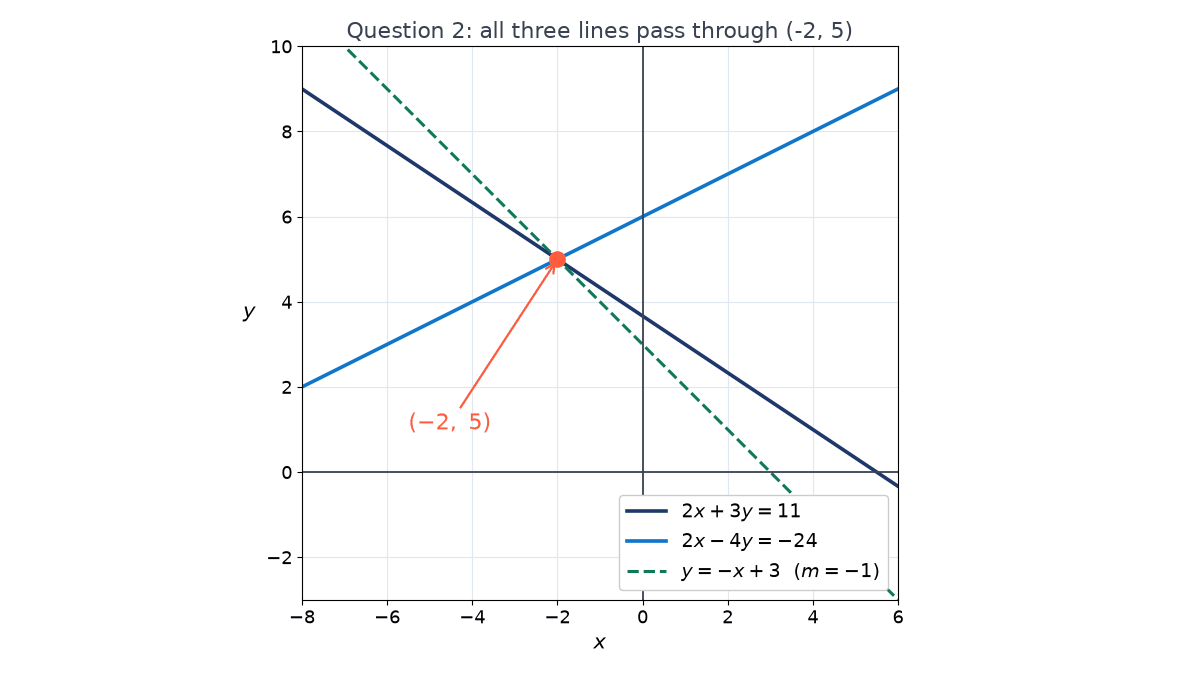
Solve 2x+3y=112x + 3y = 11 and 2x−4y=−242x - 4y = -24, and hence find the value of mm for which y=mx+3y = mx + 3.

From the first equa­tion, x=11−3y2\displaystyle x = \dfrac{11 - 3y}{2}. Sub­sti­tute into the sec­ond equa­tion:

2⋅11−3y2−4y=−2411−3y−4y=−24−7y=−35y=5\displaystyle \begin{aligned} 2 \cdot \frac{11 - 3y}{2} - 4y &= -24 \\ 11 - 3y - 4y &= -24 \\ -7y &= -35 \\ y &= 5 \end{aligned}

Then x=11−152=−2\displaystyle x = \dfrac{11 - 15}{2} = -2.

Check: 2(−2)+3(5)=−4+15=112(-2) + 3(5) = -4 + 15 = 11 and 2(−2)−4(5)=−4−20=−242(-2) - 4(5) = -4 - 20 = -24.

Now the point (−2,5)(-2, 5) must sat­isfy y=mx+3y = mx + 3:

5=m(−2)+3  ⇒  −2m=2  ⇒  m=−15 = m(-2) + 3 \;\Rightarrow\; -2m = 2 \;\Rightarrow\; m = -1

Check: with m=−1m = -1, y=−x+3y = -x + 3 gives y=2+3=5y = 2 + 3 = 5 at x=−2x = -2.

Answer: x=−2x = -2, y=5y = 5 and m=−1m = -1.

Why this works: "hence" means the line y=mx+3y = mx + 3 must pass through the solu­tion point, so its coor­di­nates are put into that equa­tion.

Graph of 2x+3y=11, 2x-4y=-24 and the dashed line y=-x+3, all three passing through the orange point (-2, 5) marked on the grid
Ques­tion 2: the two given lines meet at (−2,5)(-2, 5), and the line y=−x+3y = -x + 3 (so m=−1m = -1) passes through the same point.

Ques­tion 3: form the pair and solve

Form the pair of lin­ear equa­tions for each of the fol­low­ing prob­lems and find their solu­tion by the sub­sti­tu­tion method.

Ques­tion 3 (i)

The dif­fer­ence between two num­bers is 26 and one num­ber is three times the other. Find them.

Let the larger num­ber be xx and the smaller be yy. Then

x−y=26(1)x=3y(2)x - y = 26 \quad (1) \qquad x = 3y \quad (2)

Sub­sti­tute (2) into (1):

3y−y=26  ⇒  2y=26  ⇒  y=133y - y = 26 \;\Rightarrow\; 2y = 26 \;\Rightarrow\; y = 13

Then x=3×13=39x = 3 \times 13 = 39.

Check: 39−13=2639 - 13 = 26 and 39=3×1339 = 3 \times 13.

Answer: the num­bers are 39 and 13.

Ques­tion 3 (ii)

The larger of two sup­ple­men­tary angles exceeds the smaller by 18 degrees. Find them.

Sup­ple­men­tary angles add up to 180∘180^\circ. Let the larger angle be x∘x^\circ and the smaller y∘y^\circ. Then

x+y=180(1)x−y=18(2)x + y = 180 \quad (1) \qquad x - y = 18 \quad (2)

From (2), x=y+18x = y + 18. Sub­sti­tute into (1):

(y+18)+y=180  ⇒  2y=162  ⇒  y=81(y + 18) + y = 180 \;\Rightarrow\; 2y = 162 \;\Rightarrow\; y = 81

Then x=81+18=99x = 81 + 18 = 99.

Check: 99+81=18099 + 81 = 180 and 99−81=1899 - 81 = 18.

Answer: the angles are 99∘99^\circ and 81∘81^\circ.

Ques­tion 3 (iii)

The coach of a cricket team buys 7 bats and 6 balls for ₹3800. Later, she buys 3 bats and 5 balls for ₹1750. Find the cost of each bat and each ball.

Let one bat cost ₹xx and one ball ₹yy. Then

7x+6y=3800(1)3x+5y=1750(2)7x + 6y = 3800 \quad (1) \qquad 3x + 5y = 1750 \quad (2)

From (2), x=1750−5y3\displaystyle x = \dfrac{1750 - 5y}{3}. Sub­sti­tute into (1):

7⋅1750−5y3+6y=3800\displaystyle 7 \cdot \frac{1750 - 5y}{3} + 6y = 3800

Mul­ti­ply through by 3:

7(1750−5y)+18y=1140012250−35y+18y=11400−17y=−850y=50\begin{aligned} 7(1750 - 5y) + 18y &= 11400 \\ 12250 - 35y + 18y &= 11400 \\ -17y &= -850 \\ y &= 50 \end{aligned}

Then x=1750−2503=15003=500\displaystyle x = \dfrac{1750 - 250}{3} = \dfrac{1500}{3} = 500.

Check: 7(500)+6(50)=3500+300=38007(500) + 6(50) = 3500 + 300 = 3800 and 3(500)+5(50)=1500+250=17503(500) + 5(50) = 1500 + 250 = 1750.

Answer: a bat costs ₹500 and a ball costs ₹50.

Ques­tion 3 (iv)

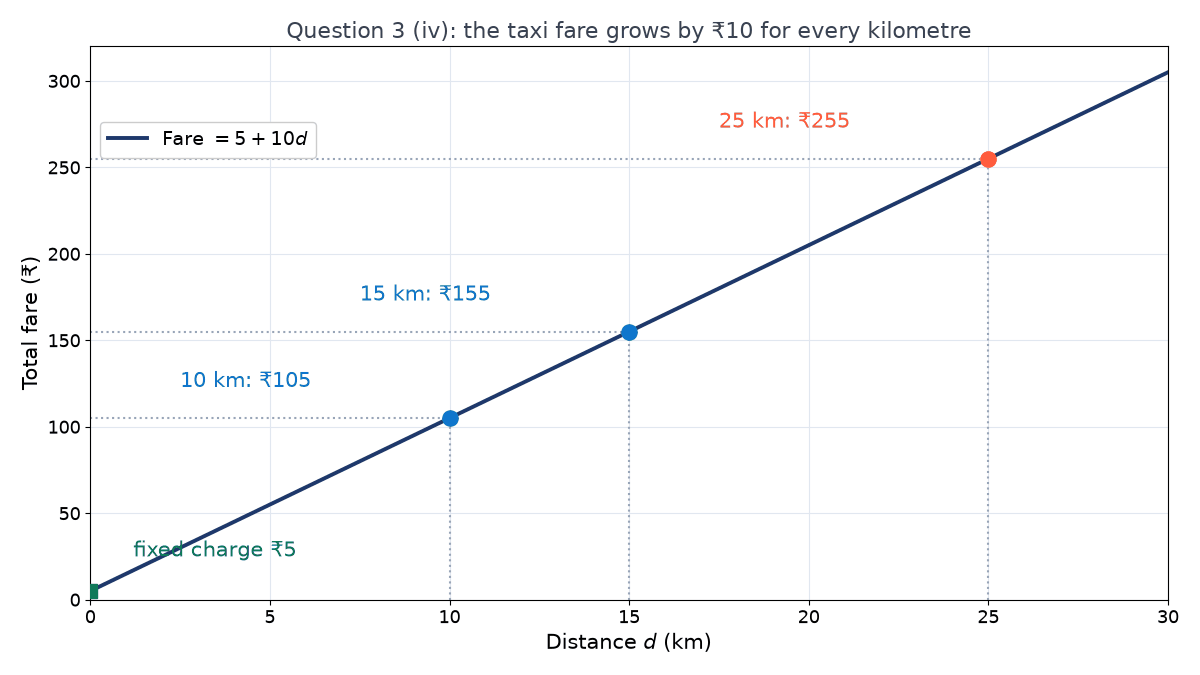
The taxi charges in a city con­sist of a fixed charge together with a charge for the dis­tance cov­ered. For a dis­tance of 10 km the charge paid is ₹105, and for a jour­ney of 15 km the charge paid is ₹155. What are the fixed charge and the charge per km? How much does a per­son have to pay for trav­el­ling 25 km?

Let the fixed charge be ₹xx and the charge per km be ₹yy. Then

x+10y=105(1)x+15y=155(2)x + 10y = 105 \quad (1) \qquad x + 15y = 155 \quad (2)

From (1), x=105−10yx = 105 - 10y. Sub­sti­tute into (2):

(105−10y)+15y=155  ⇒  5y=50  ⇒  y=10(105 - 10y) + 15y = 155 \;\Rightarrow\; 5y = 50 \;\Rightarrow\; y = 10

Then x=105−100=5x = 105 - 100 = 5.

Check: 5+10(10)=1055 + 10(10) = 105 and 5+15(10)=1555 + 15(10) = 155.

For 25 km, the fare is

x+25y=5+25×10=5+250=255x + 25y = 5 + 25 \times 10 = 5 + 250 = 255

Answer: the fixed charge is ₹5, the charge per km is ₹10, and a 25 km jour­ney costs ₹255.

Straight-line graph of taxi fare 5 plus 10d against distance d in km, starting at the fixed charge of 5 rupees, with points at 10 km 105 rupees, 15 km 155 rupees and 25 km 255 rupees
Ques­tion 3 (iv): the fare line starts at the fixed charge ₹5 and rises ₹10 per km, giv­ing ₹255 for 25 km.

Ques­tion 3 (v)

A frac­tion becomes 911\displaystyle \dfrac{9}{11} if 2 is added to both the numer­a­tor and the denom­i­na­tor. If 3 is added to both the numer­a­tor and the denom­i­na­tor, it becomes 56\displaystyle \dfrac{5}{6}. Find the frac­tion.

Let the frac­tion be ab\displaystyle \dfrac{a}{b}. The first con­di­tion gives

a+2b+2=911  ⇒  11a+22=9b+18  ⇒  11a−9b=−4(1)\displaystyle \frac{a + 2}{b + 2} = \frac{9}{11} \;\Rightarrow\; 11a + 22 = 9b + 18 \;\Rightarrow\; 11a - 9b = -4 \quad (1)

The sec­ond con­di­tion gives

a+3b+3=56  ⇒  6a+18=5b+15  ⇒  6a−5b=−3(2)\displaystyle \frac{a + 3}{b + 3} = \frac{5}{6} \;\Rightarrow\; 6a + 18 = 5b + 15 \;\Rightarrow\; 6a - 5b = -3 \quad (2)

From (2), a=5b−36\displaystyle a = \dfrac{5b - 3}{6}. Sub­sti­tute into (1) and mul­ti­ply through by 6:

11(5b−3)−54b=−2455b−33−54b=−24b=9\begin{aligned} 11(5b - 3) - 54b &= -24 \\ 55b - 33 - 54b &= -24 \\ b &= 9 \end{aligned}

Then a=45−36=426=7\displaystyle a = \dfrac{45 - 3}{6} = \dfrac{42}{6} = 7.

Check: 7+29+2=911\displaystyle \dfrac{7 + 2}{9 + 2} = \dfrac{9}{11} and 7+39+3=1012=56\displaystyle \dfrac{7 + 3}{9 + 3} = \dfrac{10}{12} = \dfrac{5}{6}.

Answer: the frac­tion is 79\displaystyle \dfrac{7}{9}.

Ques­tion 3 (vi)

Five years hence, the age of Jacob will be three times that of his son. Five years ago, Jacob's age was seven times that of his son. What are their present ages?

Let Jacob's present age be xx years and his son's be yy years.

Five years hence:

x+5=3(y+5)  ⇒  x−3y=10(1)x + 5 = 3(y + 5) \;\Rightarrow\; x - 3y = 10 \quad (1)

Five years ago:

x−5=7(y−5)  ⇒  x−7y=−30(2)x - 5 = 7(y - 5) \;\Rightarrow\; x - 7y = -30 \quad (2)

From (1), x=3y+10x = 3y + 10. Sub­sti­tute into (2):

(3y+10)−7y=−30  ⇒  −4y=−40  ⇒  y=10(3y + 10) - 7y = -30 \;\Rightarrow\; -4y = -40 \;\Rightarrow\; y = 10

Then x=30+10=40x = 30 + 10 = 40.

Check against the words: five years hence Jacob will be 45 and his son 15, and 45=3×1545 = 3 \times 15. Five years ago they were 35 and 5, and 35=7×535 = 7 \times 5.

Answer: Jacob is 40 years old and his son is 10 years old.

Key terms

Sub­sti­tu­tion method
Solv­ing a pair by express­ing one vari­able in terms of the other from one equa­tion and putting it into the other equa­tion.
Solu­tion of a pair
An ordered pair of val­ues that sat­is­fies both equa­tions at once.
Coin­ci­dent lines
Two equa­tions describ­ing the same line; the pair has infi­nitely many solu­tions, as in Ques­tion 1 (iii).
Sup­ple­men­tary angles
Two angles whose sum is 180∘180^\circ.
Fixed charge
The part of a bill that does not depend on the quan­tity used, such as the ₹5 in the taxi fare.
Slope
The num­ber mm in y=mx+cy = mx + c, which mea­sures how steep a line is.
LCM
Low­est com­mon mul­ti­ple; mul­ti­ply­ing by the LCM of the denom­i­na­tors clears frac­tions from an equa­tion.

Com­mon ques­tions

Why does Ques­tion 1 (iii) not have a sin­gle answer?

The sec­ond equa­tion is 3 times the first, so both describe the same line. Every point on that line is a solu­tion, so there are infi­nitely many.

Is it allowed to clear dec­i­mals or frac­tions before sub­sti­tut­ing?

Yes. Mul­ti­ply­ing an equa­tion by a non-zero num­ber does not change its solu­tions, and it makes the work­ing shorter and safer, as in Ques­tions 1 (iv) and 1 (vi).

In Ques­tion 3 (i), does it mat­ter which num­ber is called x?

No, but you must be con­sis­tent. If xx is the larger num­ber, then x=3yx = 3y and x−y=26x - y = 26.

How should age prob­lems be set up?

Use present ages as the vari­ables. "Five years ago" sub­tracts 5 from each age and "five years hence" adds 5 to each age before you com­pare them.

What does "hence" mean in Ques­tion 2?

It means use the answer you just found. The point (−2,5)(-2, 5) is put into y=mx+3y = mx + 3 to find mm.

Ref­er­ences

  1. National Coun­cil of Edu­ca­tional Research and Train­ing. Math­e­mat­ics: Text­book for Class X. NCERT, New Delhi.
  2. Sharma, R. D. Math­e­mat­ics for Class 10. Dhan­pat Rai Pub­li­ca­tions.
  3. Aggar­wal, R. S. Sec­ondary School Math­e­mat­ics for Class 10. Bharati Bhawan.