Elimination Method for Pair of Linear Equations, Class 10
Learn the elimination method for pairs of linear equations: why adding or subtracting equations works, the steps, worked examples on incomes and digits, and how to spot no solution or infinitely many.
Substitution always works, but rearranging an equation to isolate one variable can create fractions before the real work begins. The elimination method, the second algebraic method in Chapter 3 of the NCERT Class 10 textbook, often avoids this. Instead of rewriting one equation and feeding it into the other, you work with both whole equations at once and combine them so that one variable cancels out, or is eliminated. What remains is a simple equation in a single variable. Elimination is the quickest route in many word problems on incomes, prices, digits and ages, and the same idea of combining equations is used later for larger systems of equations.
If a variable, say y, has the same coefficient in both equations, subtracting one whole equation from the other makes the y-terms cancel exactly. If the coefficients are equal in size but opposite in sign, such as +3y and −3y, adding the equations does the same job. Equations rarely come with matching coefficients, so the first move is usually to multiply each equation by a suitable non-zero number to make them match.
Multiplying both sides of an equation by a non-zero number gives an equation with exactly the same solutions. For example, 2x+3y=8 and 4x+6y=16 are satisfied by the same pairs.
If (x,y) satisfies two equations, it also satisfies their sum and their difference, because equal quantities added to (or subtracted from) equal quantities give equal results.
So any solution of the original pair must satisfy the one-variable equation obtained after elimination. Substituting the value back into an original equation then recovers the full solution, and checking in both equations confirms it.
Multiply one or both equations by suitable non-zero numbers so that one variable has numerically equal coefficients in the two equations. The lowest common multiple of the two coefficients is usually the best target.
Subtract the equations if those coefficients have the same sign; add them if the signs are opposite. One variable disappears.
Solve the resulting equation in one variable.
Substitute this value into either of the original equations to find the other variable, and check the pair in both equations.
If in Step 2 both variables disappear, the leftover statement tells you the type of pair: a true statement such as 0=0 means infinitely many solutions; a false statement such as 0=9 means no solution.
The ratio of the incomes of two persons is 9:7 and the ratio of their expenditures is 4:3. If each of them saves ₹2000 per month, find their monthly incomes.
Because the incomes are in the ratio 9:7, call them ₹9x and ₹7x. Similarly, call the expenditures ₹4y and ₹3y. Since income minus expenditure equals savings,
9x−4y=2000(1)7x−3y=2000(2)
Step 1: match a coefficient. Multiply (1) by 3 and (2) by 4, so that y has coefficient −12 in both:
27x−12y=6000(3)28x−12y=8000(4)
Step 2: subtract. The y-terms have the same sign, so subtract (3) from (4):
(28x−27x)−(12y−12y)=8000−6000⇒x=2000
Step 3: substitute back. Put x=2000 in (1):
18000−4y=2000⇒4y=16000⇒y=4000
So the incomes are 9x=18000 and 7x=14000, that is, ₹18,000 and ₹14,000 per month.
Check.18000:14000=9:7. The expenditures are 18000−2000=16000 and 14000−2000=12000, and 16000:12000=4:3, which also equals 4y:3y with y=4000.
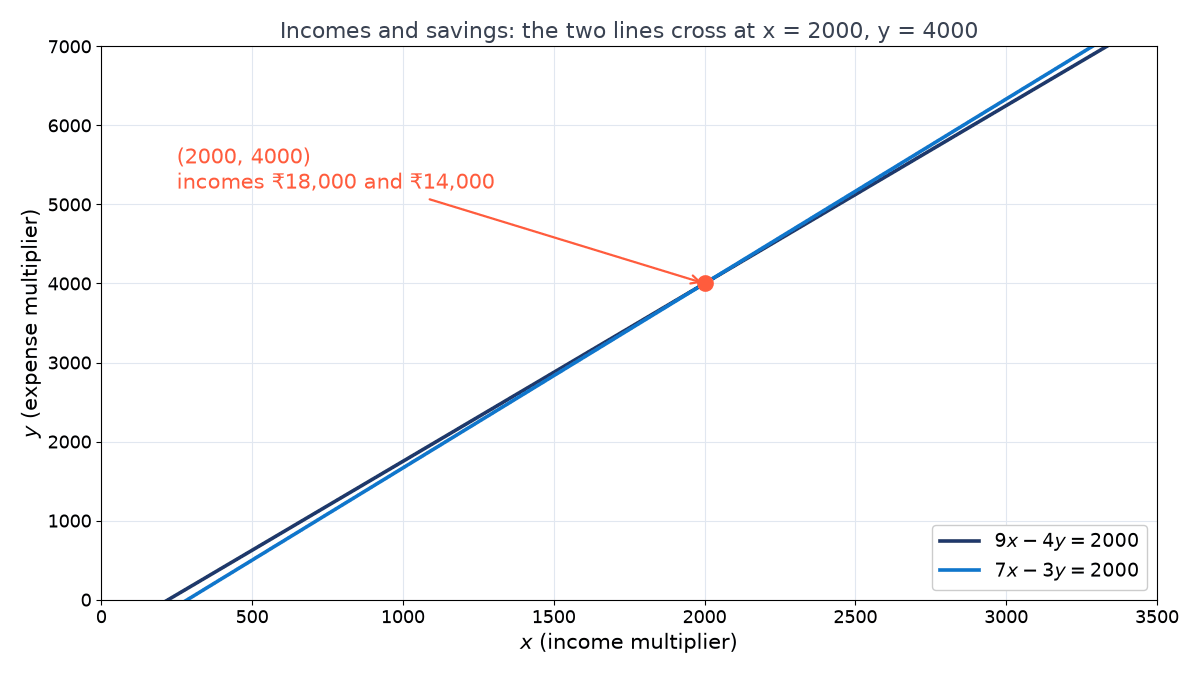
The income equations meet at x=2000, y=4000. The lines are nearly parallel, so reading the point from a graph would be unreliable.
Example 4: when elimination shows there is no solution#
Solve 2x+3y=8(1) and 4x+6y=7(2).
Multiply (1) by 2 so that both equations contain 4x:
4x+6y=16(3)
Subtract (2) from (3):
(4x−4x)+(6y−6y)=16−7⇒0=9
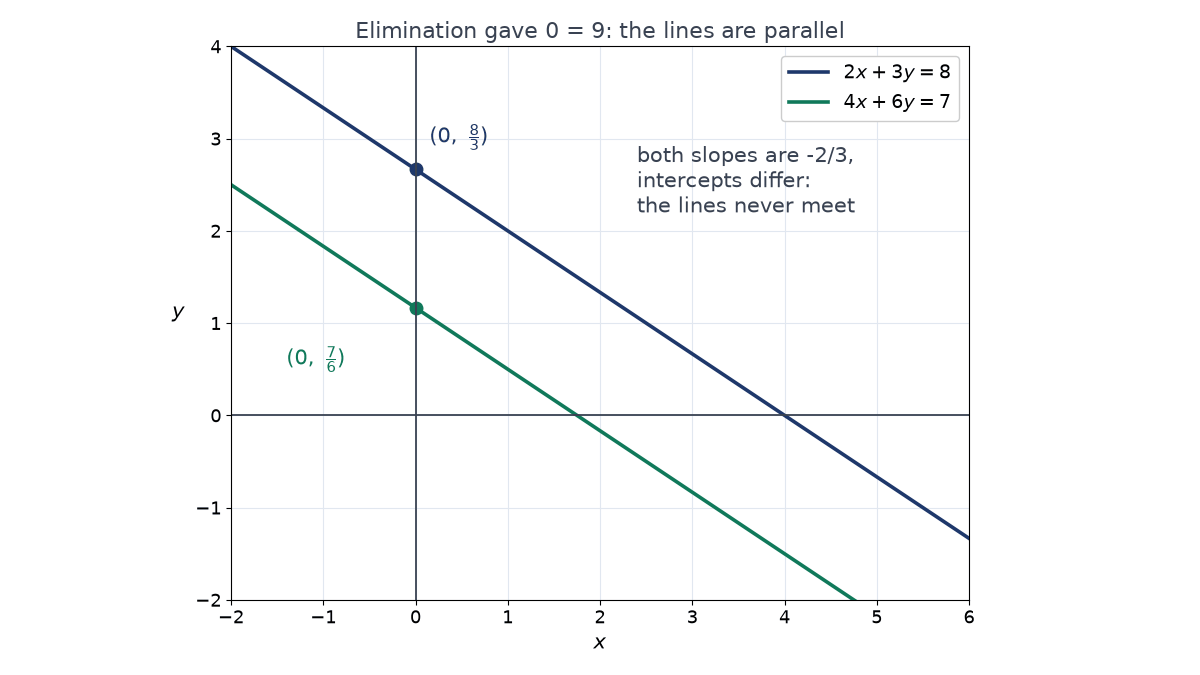
Both variables have vanished and the statement is false, so the pair has no solution. The ratio test agrees: a2a1=42 and b2b1=63 are equal, but c2c1=78 is different, which is the pattern for parallel lines.
Compare this with 3x−y=2 and 6x−2y=4. Doubling the first and subtracting gives 0=0, which is always true, so that pair has infinitely many solutions: the two equations describe the same line.
Elimination gave 0=9: the lines have the same slope and different intercepts, so they never meet.
The sum of a two-digit number and the number obtained by reversing its digits is 66. If the digits of the number differ by 2, find the number. How many such numbers are there?
Let the tens digit be x and the units digit be y. The number is 10x+y (for example, 56=10×5+6), and the reversed number is 10y+x.
The sum condition gives
(10x+y)+(10y+x)=66⇒11(x+y)=66⇒x+y=6(1)
"The digits differ by 2" can mean x−y=2(2) or y−x=2(3), since we do not know which digit is larger. Solve both cases.
Case 1: (1) and (2). Adding them eliminates y: 2x=8, so x=4 and y=2. The number is 42.
Case 2: (1) and (3). Adding them eliminates x: 2y=8, so y=4 and x=2. The number is 24.
Check.42+24=66, and in each number the digits 4 and 2 differ by 2. So there are two such numbers, 42 and 24.
You now have three ways to solve a pair of linear equations in two variables:
Graphical method: draw both lines and see where they meet. It shows most clearly why a pair can have one solution, no solution or infinitely many (intersecting, parallel or coincident lines), but exact values are hard to read unless they are integers.
Substitution method: express one variable in terms of the other and substitute. It is usually quickest when some variable has coefficient 1 or −1.
Elimination method: scale the equations so one variable has matching coefficients, then add or subtract. It is usually quickest when the coefficients are larger numbers or already line up.
All three methods always give the same answer for the same pair; they are different routes to one destination. With practice you will choose the shortest route by looking at the coefficients.
Solve 4x−3y=1 and 12x−9y=3. Answer: infinitely many solutions.
Solve 2x−5y=3 and 4x−10y=5. Answer: no solution.
The digits of a two-digit number add up to 12. Reversing the digits increases the number by 18. Find the number. Answer: 57.
3 chairs and 2 tables cost ₹4,700, while 5 chairs and 3 tables cost ₹7,400. Find the cost of a chair and of a table. Answer: a chair costs ₹700 and a table ₹1,300.
Choose the variable whose coefficients need the smallest multipliers to match, or whose coefficients already match or are opposite. Either choice leads to the same answer.
Can I divide an equation instead of multiplying?#
Yes. Dividing by a non-zero number also gives an equivalent equation. For example, 50x+100y=2000 can be divided by 50 to give x+2y=40.
Why substitute into an original equation at the end?#
The original equations are the ones you copied from the question, so using them avoids carrying forward any slip made while scaling.
Neither is always better. Elimination is often faster when coefficients are larger or already match; substitution is often faster when a variable has coefficient 1.
If one variable remains, there is exactly one solution. If both vanish, a true statement means infinitely many solutions and a false statement means no solution.