Graphical Method for Pair of Linear Equations, Class 10
Learn to solve a pair of linear equations in two variables by drawing graphs, tell intersecting, parallel and coincident lines apart with the coefficient ratio test, and practise with worked examples.
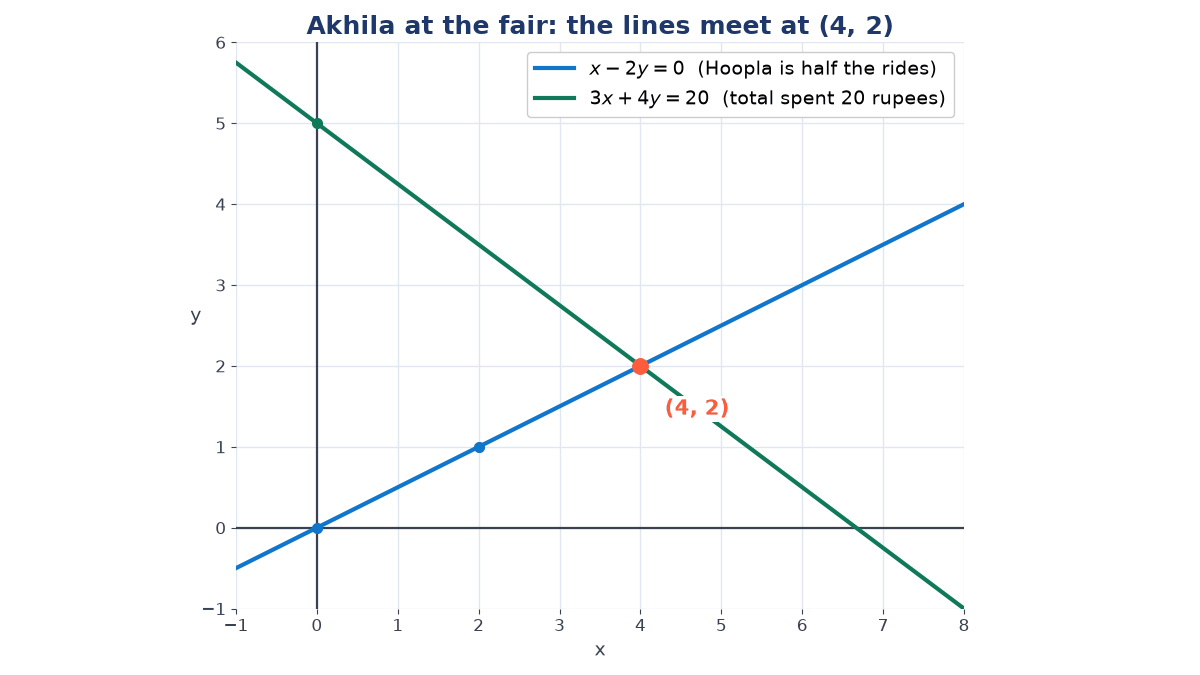
Akhila went to a fair in her village. She wanted to ride the Giant Wheel and play Hoopla, a game in which you throw a ring over the items kept in a stall and win the item if the ring covers it completely. She played Hoopla half as many times as she rode the Giant Wheel. Each ride cost ₹3 and each game of Hoopla cost ₹4. She spent ₹20 in all. How many rides did she take, and how many times did she play Hoopla?
You could guess and check, but there is a neater way. Two unknown numbers and two facts about them give a pair of linear equations in two variables. This lesson, from Chapter 3 of the NCERT Class 10 textbook, shows how to solve such a pair by drawing both lines on one graph, and how to predict from the coefficients alone whether a solution exists. The same ideas are used in money problems, mixture and speed problems, and any situation where two conditions must hold together.
A linear equation in two variablesx and y can be written as
ax+by+c=0
where a, b, c are real numbers and a and b are not both zero. Each variable appears only to the first power, and x and y are never multiplied together.
Every solution (x,y) of a linear equation in two variables is a point on a straight line, and every point on that line is a solution. So a pair of linear equations is a pair of straight lines on the same axes, and solving the pair means finding the point or points that lie on both lines.
Two lines in a plane can behave in only three ways:
They intersect at exactly one point. The pair has a unique solution. Such a pair is called consistent.
They are parallel. They never meet, so the pair has no solution. Such a pair is called inconsistent.
They coincide (they are the same line). Every point on the line is a solution, so there are infinitely many solutions. Such a pair is called dependent, and a dependent pair is also consistent.
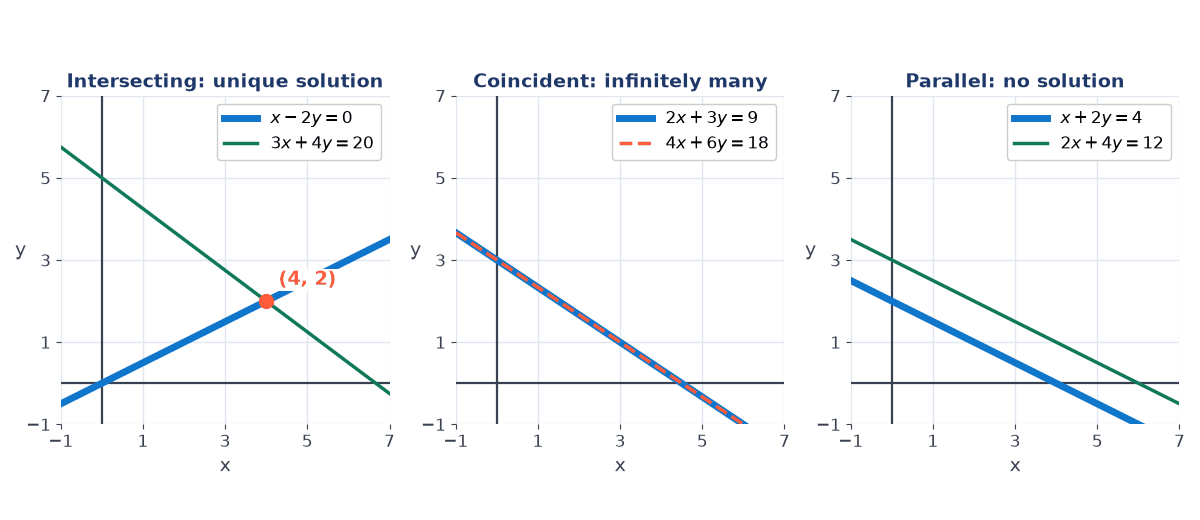
The three possibilities for a pair of lines, drawn from the three pairs in the next section.
Predicting the picture from the coefficients#
If a2a1=b2b1=k, then a1=ka2 and b1=kb2, so the first equation is k(a2x+b2y)+c1=0. Both lines then have the same steepness, so they are either parallel or the same line. If also c1=kc2, the first equation is exactly k times the second, so the two lines are identical. If c1=kc2, then a2x+b2y would have to equal two different numbers at once, which is impossible, so there is no common point. If the first two ratios differ, the lines have different steepness and must cross exactly once.
Pair 1:x−2y=0 and 3x+4y−20=0. Here a2a1=31 and b2b1=4−2=−21. These differ, so the lines intersect.
Pair 2:2x+3y−9=0 and 4x+6y−18=0. Here a2a1=42=21, b2b1=63=21 and c2c1=−18−9=21. All equal, so the lines coincide.
Pair 3:x+2y−4=0 and 2x+4y−12=0. Here a2a1=21 and b2b1=42=21, but c2c1=−12−4=31. The first two agree and the third does not, so the lines are parallel.
Does the pair 5x−8y+1=0 and 3x−524y+53=0 have no solution, one solution or infinitely many?
Multiply the second equation by 35:
35(3x−524y+53)=5x−8y+1
This is exactly the first equation, so the two equations describe the same line. The ratio test agrees: a2a1=35, b2b1=−24/5−8=35 and c2c1=3/51=35.
Answer: the lines are coincident, so the pair has infinitely many solutions.
Champa went to a "Sale" to buy some pants and skirts. When her friends asked how many of each she had bought, she said: "The number of skirts is two less than twice the number of pants purchased. Also, the number of skirts is four less than four times the number of pants purchased." How many of each did she buy?
Let x be the number of pants and y the number of skirts. Then
y=2x−2andy=4x−4
Points on y=2x−2: (0,−2) and (2,2). Points on y=4x−4: (0,−4) and (1,0).
The point (1,0) is also on the first line, since 2(1)−2=0. So the lines meet at (1,0).
Check: twice 1 minus 2 is 0, and four times 1 minus 4 is 0. Both statements hold.
Answer: Champa bought 1 pair of pants and no skirts.
Show that x+2y−4=0 and 2x+4y−12=0 have no common solution.
Multiply the first equation by 2: 2x+4y=8. The second equation says 2x+4y=12. The same expression cannot equal both 8 and 12, so no point lies on both lines.
Answer: the lines are parallel, and the pair is inconsistent.
The graph shows at a glance whether there is one solution, none or infinitely many. Its weakness is precision. If the true solution is something like (3,27), (−1.75,3.3) or (134,191), no pencil drawing can locate it exactly. That is why the chapter goes on to the algebraic methods, substitution and elimination, which give exact answers.
Two points fix a line, but plotting a third is a good habit. If the three points do not lie in a straight line, there is an arithmetic slip somewhere.
Then the ratio cannot be formed directly. Compare the equations instead by checking whether one is a multiple of the other, or draw the lines. For example, y=2 and y=5 are both horizontal, so they are parallel.
Can the answer to a word problem be a fraction?#
It depends on the context. Rupees per item can be a fraction, but a number of people or rides must be a whole number. If you get a fraction where only whole numbers make sense, recheck the equations.
Why learn the graphical method if algebra is more exact?#
The graph explains why a pair can have one, none or infinitely many solutions, and it gives a quick visual check on an algebraic answer.