Multiply the equations by suitable non-zero numbers so that one variable has numerically equal coefficients.
Subtract if those coefficients have the same sign; add if the signs are opposite.
Solve the one-variable equation, then substitute into an original equation to find the other variable.
Substitution:
Express one variable in terms of the other from one equation.
Substitute into the other equation and solve.
Substitute back to find the second variable.
In both methods, finish by checking the pair in both original equations.
Question 1: solve by elimination and by substitution#
Solve the following pairs of linear equations by the elimination method and the substitution method.
Question 1 (i)#
x + y = 5 x + y = 5 x + y = 5 2 x − 3 y = 4 2x - 3y = 4 2 x − 3 y = 4
Elimination. The y y y 1 1 1 − 3 -3 − 3
3 x + 3 y = 15 3x + 3y = 15 3 x + 3 y = 15
The y y y 2 x − 3 y = 4 2x - 3y = 4 2 x − 3 y = 4
5 x = 19 ⇒ x = 19 5 \displaystyle 5x = 19 \;\Rightarrow\; x = \frac{19}{5} 5 x = 19 ⇒ x = 5 19
From x + y = 5 x + y = 5 x + y = 5 y = 5 − 19 5 = 25 − 19 5 = 6 5 \displaystyle y = 5 - \frac{19}{5} = \frac{25 - 19}{5} = \frac{6}{5} y = 5 − 5 19 = 5 25 − 19 = 5 6
Substitution. From x + y = 5 x + y = 5 x + y = 5 y = 5 − x y = 5 - x y = 5 − x 2 x − 3 y = 4 2x - 3y = 4 2 x − 3 y = 4
2 x − 3 ( 5 − x ) = 4 2 x − 15 + 3 x = 4 5 x = 19 x = 19 5 \displaystyle \begin{aligned} 2x - 3(5 - x) &= 4 \\ 2x - 15 + 3x &= 4 \\ 5x &= 19 \\ x &= \frac{19}{5} \end{aligned} 2 x − 3 ( 5 − x ) 2 x − 15 + 3 x 5 x x = 4 = 4 = 19 = 5 19
Then y = 5 − 19 5 = 6 5 \displaystyle y = 5 - \frac{19}{5} = \frac{6}{5} y = 5 − 5 19 = 5 6
Check: 19 5 + 6 5 = 25 5 = 5 \displaystyle \frac{19}{5} + \frac{6}{5} = \frac{25}{5} = 5 5 19 + 5 6 = 5 25 = 5 38 5 − 18 5 = 20 5 = 4 \displaystyle \frac{38}{5} - \frac{18}{5} = \frac{20}{5} = 4 5 38 − 5 18 = 5 20 = 4
Answer: x = 19 5 \displaystyle x = \frac{19}{5} x = 5 19 y = 6 5 \displaystyle y = \frac{6}{5} y = 5 6
Question 1 (ii)#
3 x + 4 y = 10 3x + 4y = 10 3 x + 4 y = 10 2 x − 2 y = 2 2x - 2y = 2 2 x − 2 y = 2
Elimination. The y y y 4 4 4 − 2 -2 − 2
4 x − 4 y = 4 4x - 4y = 4 4 x − 4 y = 4
The y y y 3 x + 4 y = 10 3x + 4y = 10 3 x + 4 y = 10
7 x = 14 ⇒ x = 2 7x = 14 \;\Rightarrow\; x = 2 7 x = 14 ⇒ x = 2
From 2 x − 2 y = 2 2x - 2y = 2 2 x − 2 y = 2 4 − 2 y = 2 4 - 2y = 2 4 − 2 y = 2 2 y = 2 2y = 2 2 y = 2 y = 1 y = 1 y = 1
Substitution. Dividing 2 x − 2 y = 2 2x - 2y = 2 2 x − 2 y = 2 x − y = 1 x - y = 1 x − y = 1 x = y + 1 x = y + 1 x = y + 1 3 x + 4 y = 10 3x + 4y = 10 3 x + 4 y = 10
3 ( y + 1 ) + 4 y = 10 7 y + 3 = 10 7 y = 7 y = 1 \begin{aligned} 3(y + 1) + 4y &= 10 \\ 7y + 3 &= 10 \\ 7y &= 7 \\ y &= 1 \end{aligned} 3 ( y + 1 ) + 4 y 7 y + 3 7 y y = 10 = 10 = 7 = 1
Then x = 1 + 1 = 2 x = 1 + 1 = 2 x = 1 + 1 = 2
Check: 3 ( 2 ) + 4 ( 1 ) = 10 3(2) + 4(1) = 10 3 ( 2 ) + 4 ( 1 ) = 10 2 ( 2 ) − 2 ( 1 ) = 2 2(2) - 2(1) = 2 2 ( 2 ) − 2 ( 1 ) = 2
Answer: x = 2 x = 2 x = 2 y = 1 y = 1 y = 1
Question 1 (iii)#
3 x − 5 y − 4 = 0 3x - 5y - 4 = 0 3 x − 5 y − 4 = 0 9 x = 2 y + 7 9x = 2y + 7 9 x = 2 y + 7
First write both in the form a x + b y = c ax + by = c a x + b y = c
3 x − 5 y = 4 ( 1 ) 9 x − 2 y = 7 ( 2 ) 3x - 5y = 4 \quad (1) \qquad 9x - 2y = 7 \quad (2) 3 x − 5 y = 4 ( 1 ) 9 x − 2 y = 7 ( 2 )
Elimination. Multiply (1) by 3 so that x x x
9 x − 15 y = 12 ( 3 ) 9x - 15y = 12 \quad (3) 9 x − 15 y = 12 ( 3 )
The x x x
( 9 x − 15 y ) − ( 9 x − 2 y ) = 12 − 7 ⇒ − 13 y = 5 ⇒ y = − 5 13 \displaystyle (9x - 15y) - (9x - 2y) = 12 - 7 \;\Rightarrow\; -13y = 5 \;\Rightarrow\; y = -\frac{5}{13} ( 9 x − 15 y ) − ( 9 x − 2 y ) = 12 − 7 ⇒ − 13 y = 5 ⇒ y = − 13 5
Substitute into (1):
3 x + 25 13 = 4 ⇒ 3 x = 52 − 25 13 = 27 13 ⇒ x = 9 13 \displaystyle 3x + \frac{25}{13} = 4 \;\Rightarrow\; 3x = \frac{52 - 25}{13} = \frac{27}{13} \;\Rightarrow\; x = \frac{9}{13} 3 x + 13 25 = 4 ⇒ 3 x = 13 52 − 25 = 13 27 ⇒ x = 13 9
Substitution. From (1), x = 4 + 5 y 3 \displaystyle x = \frac{4 + 5y}{3} x = 3 4 + 5 y
9 ⋅ 4 + 5 y 3 − 2 y = 7 3 ( 4 + 5 y ) − 2 y = 7 12 + 13 y = 7 y = − 5 13 \displaystyle \begin{aligned} 9 \cdot \frac{4 + 5y}{3} - 2y &= 7 \\ 3(4 + 5y) - 2y &= 7 \\ 12 + 13y &= 7 \\ y &= -\frac{5}{13} \end{aligned} 9 ⋅ 3 4 + 5 y − 2 y 3 ( 4 + 5 y ) − 2 y 12 + 13 y y = 7 = 7 = 7 = − 13 5
Then x = 1 3 ( 4 − 25 13 ) = 1 3 ⋅ 27 13 = 9 13 \displaystyle x = \frac{1}{3}\left(4 - \frac{25}{13}\right) = \frac{1}{3} \cdot \frac{27}{13} = \frac{9}{13} x = 3 1 ( 4 − 13 25 ) = 3 1 ⋅ 13 27 = 13 9
Check: 3 ⋅ 9 13 − 5 ⋅ ( − 5 13 ) − 4 = 27 + 25 13 − 4 = 4 − 4 = 0 \displaystyle 3 \cdot \frac{9}{13} - 5 \cdot \left(-\frac{5}{13}\right) - 4 = \frac{27 + 25}{13} - 4 = 4 - 4 = 0 3 ⋅ 13 9 − 5 ⋅ ( − 13 5 ) − 4 = 13 27 + 25 − 4 = 4 − 4 = 0 9 ⋅ 9 13 = 81 13 \displaystyle 9 \cdot \frac{9}{13} = \frac{81}{13} 9 ⋅ 13 9 = 13 81 2 ⋅ ( − 5 13 ) + 7 = − 10 + 91 13 = 81 13 \displaystyle 2 \cdot \left(-\frac{5}{13}\right) + 7 = \frac{-10 + 91}{13} = \frac{81}{13} 2 ⋅ ( − 13 5 ) + 7 = 13 − 10 + 91 = 13 81
Answer: x = 9 13 \displaystyle x = \frac{9}{13} x = 13 9 y = − 5 13 \displaystyle y = -\frac{5}{13} y = − 13 5
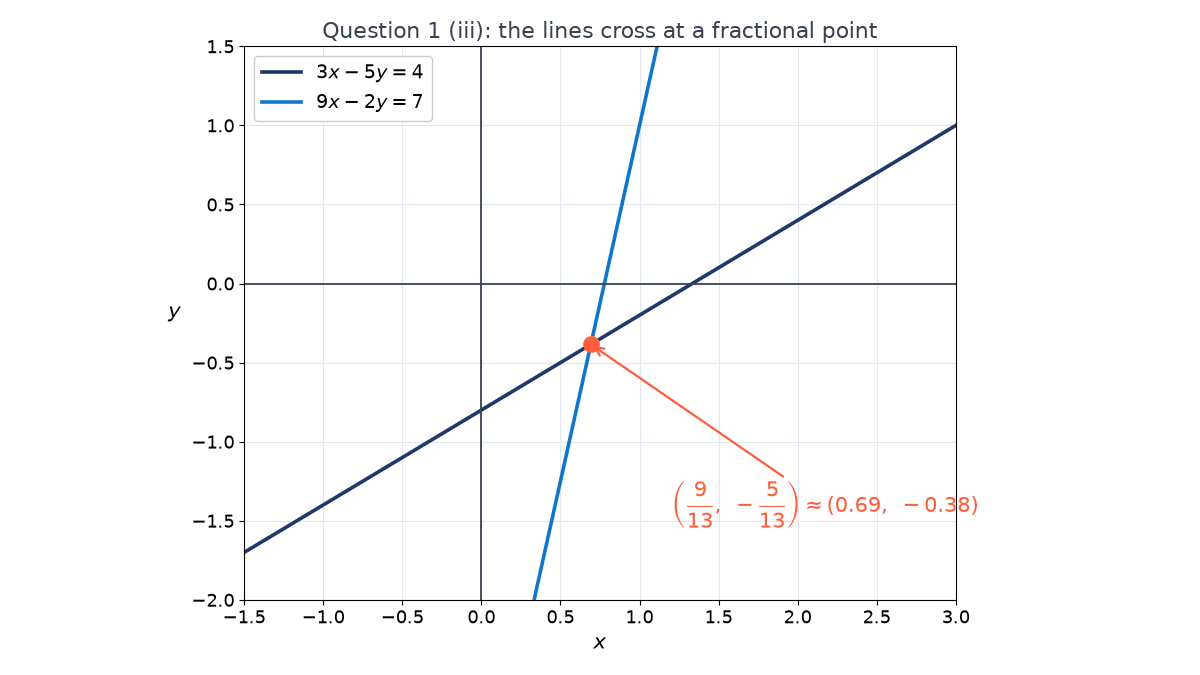
Question 1 (iii): the two lines meet at ( 9 13 , − 5 13 ) \displaystyle \left(\frac{9}{13}, -\frac{5}{13}\right) ( 13 9 , − 13 5 ) Question 1 (iv)#
x 2 + 2 y 3 = − 1 \displaystyle \frac{x}{2} + \frac{2y}{3} = -1 2 x + 3 2 y = − 1 x − y 3 = 3 \displaystyle x - \frac{y}{3} = 3 x − 3 y = 3
Clear the fractions: multiply the first equation by 6 and the second by 3.
3 x + 4 y = − 6 ( 1 ) 3 x − y = 9 ( 2 ) 3x + 4y = -6 \quad (1) \qquad 3x - y = 9 \quad (2) 3 x + 4 y = − 6 ( 1 ) 3 x − y = 9 ( 2 )
Elimination. The x x x
( 3 x + 4 y ) − ( 3 x − y ) = − 6 − 9 ⇒ 5 y = − 15 ⇒ y = − 3 (3x + 4y) - (3x - y) = -6 - 9 \;\Rightarrow\; 5y = -15 \;\Rightarrow\; y = -3 ( 3 x + 4 y ) − ( 3 x − y ) = − 6 − 9 ⇒ 5 y = − 15 ⇒ y = − 3
From (2): 3 x + 3 = 9 3x + 3 = 9 3 x + 3 = 9 x = 2 x = 2 x = 2
Substitution. From (2), y = 3 x − 9 y = 3x - 9 y = 3 x − 9
3 x + 4 ( 3 x − 9 ) = − 6 15 x − 36 = − 6 15 x = 30 x = 2 \begin{aligned} 3x + 4(3x - 9) &= -6 \\ 15x - 36 &= -6 \\ 15x &= 30 \\ x &= 2 \end{aligned} 3 x + 4 ( 3 x − 9 ) 15 x − 36 15 x x = − 6 = − 6 = 30 = 2
Then y = 6 − 9 = − 3 y = 6 - 9 = -3 y = 6 − 9 = − 3
Check in the original equations: 2 2 + 2 ( − 3 ) 3 = 1 − 2 = − 1 \displaystyle \frac{2}{2} + \frac{2(-3)}{3} = 1 - 2 = -1 2 2 + 3 2 ( − 3 ) = 1 − 2 = − 1 2 − − 3 3 = 2 + 1 = 3 \displaystyle 2 - \frac{-3}{3} = 2 + 1 = 3 2 − 3 − 3 = 2 + 1 = 3
Answer: x = 2 x = 2 x = 2 y = − 3 y = -3 y = − 3
Form the pair of linear equations in the following problems, and find their solutions (if they exist) by the elimination method.
Question 2 (i)#
If we add 1 to the numerator and subtract 1 from the denominator, a fraction reduces to 1. It becomes 1 2 \displaystyle \frac{1}{2} 2 1
Let the fraction be x y \displaystyle \frac{x}{y} y x
x + 1 y − 1 = 1 ⇒ x + 1 = y − 1 ⇒ x − y = − 2 ( 1 ) \displaystyle \frac{x + 1}{y - 1} = 1 \;\Rightarrow\; x + 1 = y - 1 \;\Rightarrow\; x - y = -2 \quad (1) y − 1 x + 1 = 1 ⇒ x + 1 = y − 1 ⇒ x − y = − 2 ( 1 )
The second condition gives
x y + 1 = 1 2 ⇒ 2 x = y + 1 ⇒ 2 x − y = 1 ( 2 ) \displaystyle \frac{x}{y + 1} = \frac{1}{2} \;\Rightarrow\; 2x = y + 1 \;\Rightarrow\; 2x - y = 1 \quad (2) y + 1 x = 2 1 ⇒ 2 x = y + 1 ⇒ 2 x − y = 1 ( 2 )
The y y y
( 2 x − y ) − ( x − y ) = 1 − ( − 2 ) ⇒ x = 3 (2x - y) - (x - y) = 1 - (-2) \;\Rightarrow\; x = 3 ( 2 x − y ) − ( x − y ) = 1 − ( − 2 ) ⇒ x = 3
From (1): 3 − y = − 2 3 - y = -2 3 − y = − 2 y = 5 y = 5 y = 5
Check: 3 + 1 5 − 1 = 4 4 = 1 \displaystyle \frac{3 + 1}{5 - 1} = \frac{4}{4} = 1 5 − 1 3 + 1 = 4 4 = 1 3 5 + 1 = 3 6 = 1 2 \displaystyle \frac{3}{5 + 1} = \frac{3}{6} = \frac{1}{2} 5 + 1 3 = 6 3 = 2 1
Answer: the fraction is 3 5 \displaystyle \frac{3}{5} 5 3
Question 2 (ii)#
Five years ago, Nuri was thrice as old as Sonu. Ten years later, Nuri will be twice as old as Sonu. How old are Nuri and Sonu?
Let Nuri's present age be x x x y y y
Five years ago:
x − 5 = 3 ( y − 5 ) ⇒ x − 3 y = − 10 ( 1 ) x - 5 = 3(y - 5) \;\Rightarrow\; x - 3y = -10 \quad (1) x − 5 = 3 ( y − 5 ) ⇒ x − 3 y = − 10 ( 1 )
Ten years later:
x + 10 = 2 ( y + 10 ) ⇒ x − 2 y = 10 ( 2 ) x + 10 = 2(y + 10) \;\Rightarrow\; x - 2y = 10 \quad (2) x + 10 = 2 ( y + 10 ) ⇒ x − 2 y = 10 ( 2 )
The x x x
( x − 2 y ) − ( x − 3 y ) = 10 − ( − 10 ) ⇒ y = 20 (x - 2y) - (x - 3y) = 10 - (-10) \;\Rightarrow\; y = 20 ( x − 2 y ) − ( x − 3 y ) = 10 − ( − 10 ) ⇒ y = 20
From (2): x − 40 = 10 x - 40 = 10 x − 40 = 10 x = 50 x = 50 x = 50
Check against the words: five years ago Nuri was 45 and Sonu 15, and 45 = 3 × 15 45 = 3 \times 15 45 = 3 × 15 60 = 2 × 30 60 = 2 \times 30 60 = 2 × 30
Answer: Nuri is 50 years old and Sonu is 20 years old.
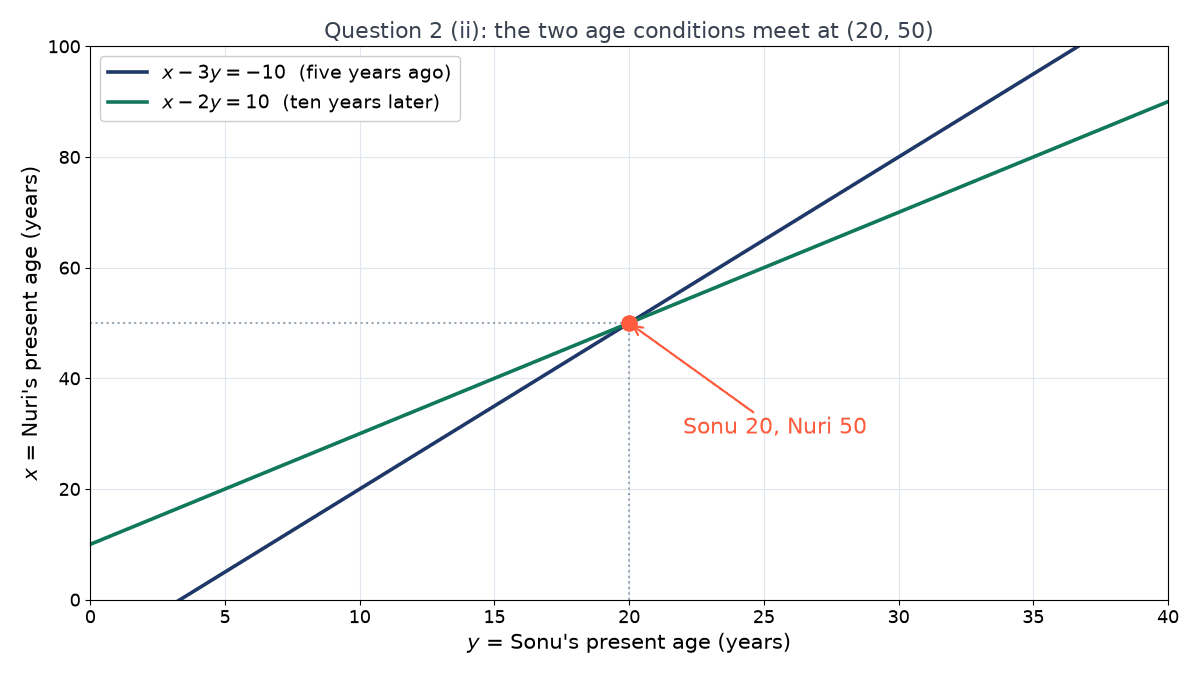
Question 2 (ii): the two age conditions are satisfied together only when Sonu is 20 and Nuri is 50. Question 2 (iii)#
The sum of the digits of a two-digit number is 9. Also, nine times this number is twice the number obtained by reversing the order of the digits. Find the number.
Let the tens digit be x x x y y y 10 x + y 10x + y 10 x + y 10 y + x 10y + x 10 y + x
x + y = 9 ( 1 ) x + y = 9 \quad (1) x + y = 9 ( 1 )
9 ( 10 x + y ) = 2 ( 10 y + x ) ⇒ 90 x + 9 y = 20 y + 2 x ⇒ 88 x − 11 y = 0 ⇒ 8 x − y = 0 ( 2 ) 9(10x + y) = 2(10y + x) \;\Rightarrow\; 90x + 9y = 20y + 2x \;\Rightarrow\; 88x - 11y = 0 \;\Rightarrow\; 8x - y = 0 \quad (2) 9 ( 10 x + y ) = 2 ( 10 y + x ) ⇒ 90 x + 9 y = 20 y + 2 x ⇒ 88 x − 11 y = 0 ⇒ 8 x − y = 0 ( 2 )
The y y y
9 x = 9 ⇒ x = 1 9x = 9 \;\Rightarrow\; x = 1 9 x = 9 ⇒ x = 1
From (1): y = 9 − 1 = 8 y = 9 - 1 = 8 y = 9 − 1 = 8
Check: the number is 18; 1 + 8 = 9 1 + 8 = 9 1 + 8 = 9 9 × 18 = 162 9 \times 18 = 162 9 × 18 = 162 2 × 81 = 162 2 \times 81 = 162 2 × 81 = 162
Answer: the number is 18.
Question 2 (iv)#
Meena went to a bank to withdraw ₹2000. She asked the cashier to give her ₹50 and ₹100 notes only. Meena got 25 notes in all. Find how many notes of ₹50 and ₹100 she received.
Let x x x y y y
x + y = 25 ( 1 ) x + y = 25 \quad (1) x + y = 25 ( 1 )
50 x + 100 y = 2000 ⇒ x + 2 y = 40 ( 2 ) 50x + 100y = 2000 \;\Rightarrow\; x + 2y = 40 \quad (2) 50 x + 100 y = 2000 ⇒ x + 2 y = 40 ( 2 )
(Equation (2) was divided by 50.) The x x x
( x + 2 y ) − ( x + y ) = 40 − 25 ⇒ y = 15 (x + 2y) - (x + y) = 40 - 25 \;\Rightarrow\; y = 15 ( x + 2 y ) − ( x + y ) = 40 − 25 ⇒ y = 15
From (1): x = 25 − 15 = 10 x = 25 - 15 = 10 x = 25 − 15 = 10
Check: 10 + 15 = 25 10 + 15 = 25 10 + 15 = 25 10 × 50 + 15 × 100 = 500 + 1500 = 2000 10 \times 50 + 15 \times 100 = 500 + 1500 = 2000 10 × 50 + 15 × 100 = 500 + 1500 = 2000
Answer: Meena received 10 notes of ₹50 and 15 notes of ₹100.
Question 2 (v)#
A lending library has a fixed charge for the first three days and an additional charge for each day thereafter. Saritha paid ₹27 for a book kept for seven days, while Susy paid ₹21 for the book she kept for five days. Find the fixed charge and the charge for each extra day.
Let the fixed charge be ₹x x x y y y 7 − 3 = 4 7 - 3 = 4 7 − 3 = 4 5 − 3 = 2 5 - 3 = 2 5 − 3 = 2
x + 4 y = 27 ( 1 ) x + 2 y = 21 ( 2 ) x + 4y = 27 \quad (1) \qquad x + 2y = 21 \quad (2) x + 4 y = 27 ( 1 ) x + 2 y = 21 ( 2 )
Subtract (2) from (1):
2 y = 6 ⇒ y = 3 2y = 6 \;\Rightarrow\; y = 3 2 y = 6 ⇒ y = 3
From (2): x = 21 − 6 = 15 x = 21 - 6 = 15 x = 21 − 6 = 15
Check: Saritha pays 15 + 4 × 3 = 27 15 + 4 \times 3 = 27 15 + 4 × 3 = 27 15 + 2 × 3 = 21 15 + 2 \times 3 = 21 15 + 2 × 3 = 21
Answer: the fixed charge is ₹15 and the charge for each extra day is ₹3.
Why this works: the fixed charge already covers the first three days, so only the days beyond three are multiplied by y y y x + 7 y x + 7y x + 7 y
Across Question 2, the algebra is short once the equations are right. The real skill is translating each sentence exactly, so read every question twice before writing an equation.
Key terms#
Elimination method
Solving a pair by adding or subtracting suitable multiples of the equations so that one variable cancels.
Substitution method
Solving a pair by expressing one variable in terms of the other and putting it into the other equation.
Standard form
Writing a linear equation as a x + b y = c ax + by = c a x + b y = c a x + b y + c = 0 ax + by + c = 0 a x + b y + c = 0
Numerator and denominator
The top and bottom numbers of a fraction x y \displaystyle \frac{x}{y} y x
Reversed number
For a two-digit number 10 x + y 10x + y 10 x + y 10 y + x 10y + x 10 y + x
Fixed charge
A charge that does not change with use, such as the library's charge for the first three days.
Consistent pair
A pair of equations with at least one solution; every pair in this exercise has exactly one.
Common questions#
Why solve Question 1 by two methods?#
The question asks for both. Getting the same answer by two routes is also a strong check that no arithmetic slip has occurred.
When do I add and when do I subtract?#
After matching a coefficient, subtract if the matching terms have the same sign and add if they have opposite signs.
Can I simplify an equation before eliminating?#
Yes. Dividing 50 x + 100 y = 2000 50x + 100y = 2000 50 x + 100 y = 2000 88 x − 11 y = 0 88x - 11y = 0 88 x − 11 y = 0
Why is the answer to Question 1 (iii) a fraction?#
The two lines simply cross at a point with fractional coordinates. Fractions are acceptable answers; just give them in lowest terms.
In Question 2 (v), why use 4 and 2 instead of 7 and 5?#
The fixed charge covers the first three days, so only the extra days, 7 − 3 = 4 7 - 3 = 4 7 − 3 = 4 5 − 3 = 2 5 - 3 = 2 5 − 3 = 2
References#
National Council of Educational Research and Training. Mathematics: Textbook for Class X . NCERT, New Delhi.
Sharma, R. D. Mathematics for Class 10 . Dhanpat Rai Publications.
Aggarwal, R. S. Secondary School Mathematics for Class 10 . Bharati Bhawan.