Substitution Method for Pair of Linear Equations, Class 10
Learn the substitution method for a pair of linear equations: why it works, the steps, five worked examples including Aftab's age puzzle, and how to spot one, none or infinitely many solutions.
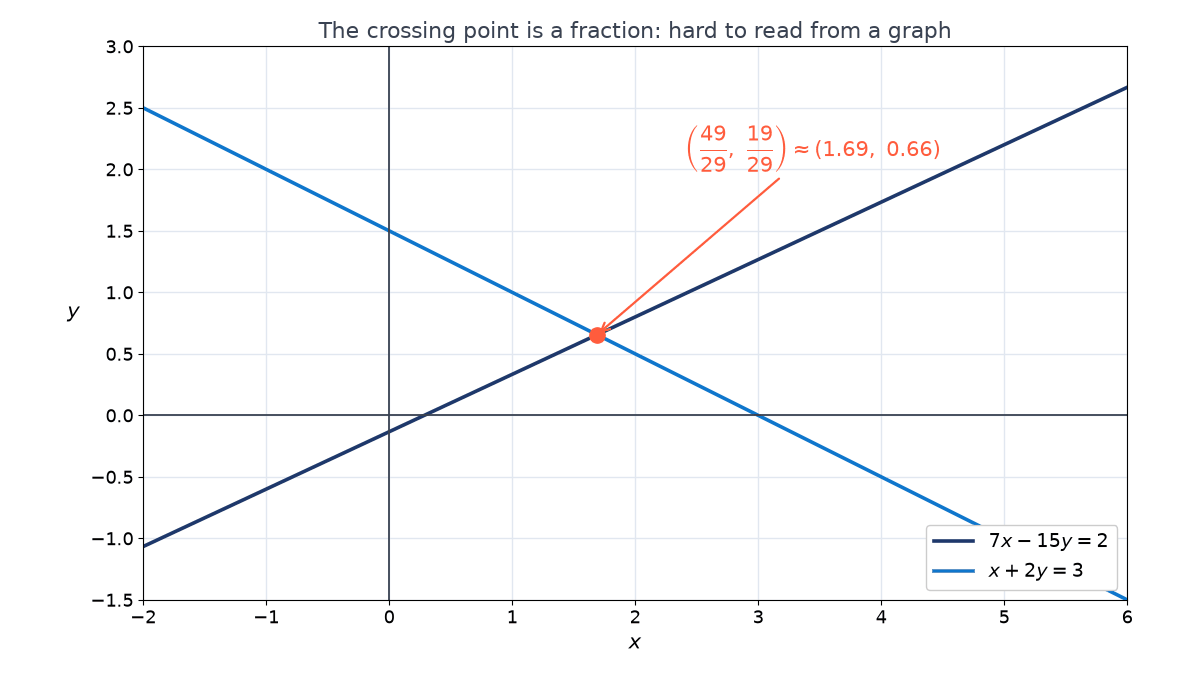
A pair of linear equations in two variables asks one question: which values of x and y make both equations true at the same time? Drawing the two lines answers it visually, but a graph can only be read accurately when the crossing point sits on a neat grid point. When the answer is something like x=2949, no amount of careful drawing will show it exactly. The substitution method is the first of the algebraic methods in Chapter 3 of the NCERT Class 10 textbook. It works only with the equations themselves, always gives the exact answer, and also tells you honestly when there is no answer or when there are infinitely many. You will use it in word problems on ages, prices, fares, fractions and digits, and later in coordinate geometry whenever two lines meet.
A pair of linear equations in two variables can always be written in the general form
a1x+b1y+c1=0,a2x+b2y+c2=0,
where a1,b1,c1,a2,b2,c2 are real numbers, with a12+b12=0 and a22+b22=0. A solution of the pair is an ordered pair (x,y) that satisfies both equations. Geometrically, each equation is a straight line, and a solution is a point lying on both lines.
Use one equation to write one variable, say y, entirely in terms of the other variable, x. Then, wherever y appears in the other equation, put in that expression instead. The second equation now contains only x, so it can be solved like any ordinary equation in one variable. Once x is known, go back and find y.
If (x,y) satisfies both equations, then in particular it satisfies the rearranged first equation, say y=mx+k. Replacing y by mx+k in the second equation therefore does not change which values of x are possible: any solution of the pair must satisfy the new one-variable equation. Conversely, if x satisfies the new equation and we define y=mx+k, then both original equations hold. So the one-variable equation carries exactly the same information as the pair. Nothing is lost and nothing extra is introduced, which is why the method is reliable.
From either equation, express one variable in terms of the other. Choose the variable whose coefficient is 1 or −1 if you can, because this avoids fractions.
Substitute this expression into the other equation. You now have one equation in one variable. Solve it. (If the variable cancels completely, read the special cases below.)
Substitute the value just found into the expression from Step 1 to get the second variable.
Aftab tells his daughter, "Seven years ago, I was seven times as old as you were then. Also, three years from now, I shall be three times as old as you will be." Find their present ages.
Let Aftab's present age be s years and his daughter's be t years.
Seven years ago their ages were s−7 and t−7, so
s−7=7(t−7)⇒s−7t+42=0(1)
Three years from now their ages will be s+3 and t+3, so
s+3=3(t+3)⇒s−3t=6(2)
From (2), s=3t+6. Substitute into (1):
(3t+6)−7t+42−4t+48t=0=0=12
Then s=3(12)+6=42.
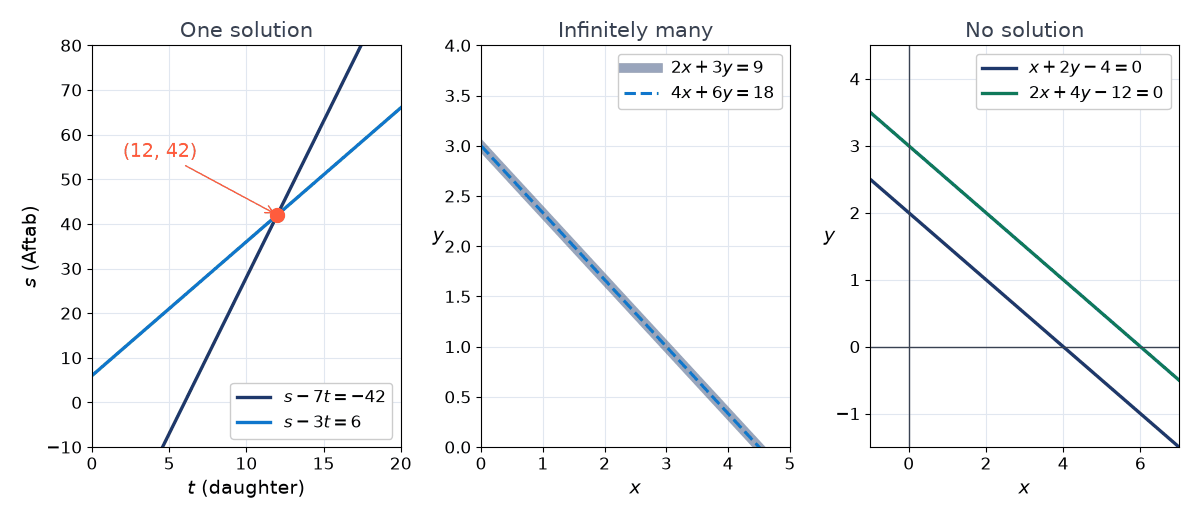
Check against the words. Seven years ago Aftab was 35 and his daughter 5, and 35=7×5. Three years from now they will be 45 and 15, and 45=3×15. So Aftab is 42 years old and his daughter is 12.
In a shop, 2 pencils and 3 erasers cost ₹9, and 4 pencils and 6 erasers cost ₹18. Find the cost of one pencil and one eraser.
Let a pencil cost ₹x and an eraser ₹y. Then
2x+3y=9(1)4x+6y=18(2)
From (1), x=29−3y. Substitute into (2):
4(29−3y)+6y=18⇒18−6y+6y=18⇒18=18
The variable has disappeared and what is left is always true. Every value of y works, with x=29−3y. The reason is that equation (2) is just equation (1) multiplied by 2, so the shop has really given only one piece of information. The pair has infinitely many solutions, and the costs cannot be pinned down from these two statements alone.
Two rails are represented by x+2y−4=0 and 2x+4y−12=0. Will the rails cross?
From the first equation, x=4−2y. Substitute into the second:
2(4−2y)+4y−12=0⇒8−4y+4y−12=0⇒−4=0
This statement is false whatever y is. So no pair (x,y) satisfies both equations: the pair has no solution, and the rails never meet. That is exactly what railway tracks are built to do; they are parallel.
After substitution, the one-variable equation always falls into one of three types, and each type matches a picture of the two lines.
A normal equation, such as −29y=−19: there is exactly one solution, and the lines intersect at one point. The pair is consistent.
A statement that is always true, such as 18=18: the two equations describe the same line, the lines coincide, and there are infinitely many solutions. The pair is dependent (and consistent).
A statement that is always false, such as −4=0: the lines are parallel and there is no solution. The pair is inconsistent.
You can predict the outcome before solving by comparing the ratios of the coefficients:
a2a1=b2b1: one solution (intersecting lines).
a2a1=b2b1=c2c1: infinitely many solutions (coincident lines).
a2a1=b2b1=c2c1: no solution (parallel lines).
For the pencils, 42=63=−18−9, so the lines coincide. For the rails, 21=42 but −12−4=31=21, so the lines are parallel. Substitution and the ratio test always agree.
One solution, infinitely many solutions and no solution: the three outcomes of Examples 3, 4 and 5.
Substituting the expression back into the same equation it came from. This always gives something like 0=0 and tells you nothing. Substitute into the other equation.
Forgetting brackets. x−(14−x) is 2x−14, not −14; write the bracket first, then expand.
Sign slips when moving terms: from x+2y=3 we get x=3−2y, not x=3+2y.
Stopping after finding one variable. The answer to a pair is always an ordered pair; find both values.
Reading 18=18 as "no solution" or −4=0 as "infinitely many". A true statement means infinitely many solutions; a false one means none.
Skipping the check. Put both values into both original equations, and in word problems check against the sentences, not only against your own equations.
Pick a variable whose coefficient is 1 or −1. Then the expression has no fractions and the arithmetic stays simple. Any choice gives the same final answer.
Is substitution better than the graphical method?#
For finding exact values, yes. A graph shows how many solutions there are and roughly where they lie, but substitution gives exact answers even when they are fractions or surds.
What does it mean when the variable disappears?#
If what remains is true, such as 18=18, the equations describe the same line and there are infinitely many solutions. If it is false, such as −4=0, the lines are parallel and there is no solution.
It is not always required for marks, but it takes only a line and catches most sign errors. In word problems, checking against the original sentences is the surest test.
Can substitution be used when the equations have decimals or fractions?#
Yes. It usually helps to multiply each equation by a suitable number first so that all coefficients become whole numbers.