Exercise 9.1 of the NCERT Class 10 chapter Some Applications of Trigonometry has fifteen word problems on heights and distances: poles, towers, kites, slides, lighthouses and a moving car. Each one hides a right triangle. Once you find that triangle and label it, one trigonometric ratio gives the answer. The solutions below set out every step, give exact answers with , and add decimals using where the textbook does.
The method you need
Angles of elevation and depression
The angle of elevation is the angle between the horizontal and the line of sight when you look up at an object. The angle of depression is the angle between the horizontal and the line of sight when you look down. When one observer looks down at a point and another looks up from that point, the two angles are equal, because they are alternate angles between parallel horizontal lines.
Values used in this exercise
Steps for every problem
- Draw a rough figure and mark the right angle, the given angle, the known length and the unknown length.
- If the observer's height is given, measure the angle from eye level and subtract the eye height from the object's height.
- Choose the ratio that links the known side and the unknown side: for opposite and adjacent sides, for opposite side and hypotenuse, for adjacent side and hypotenuse.
- Solve, simplify the surd, and check the answer by substituting it back.
Solutions to Exercise 9.1
Question 1
A circus artist is climbing a 20 m long rope, which is tightly stretched and tied from the top of a vertical pole to the ground. Find the height of the pole if the angle made by the rope with the ground is .
Figure. Let be the pole, with on the ground, and let m be the rope, with and .
Solution. We know the hypotenuse and want the side opposite the angle, so we use sine:
Check: the base is m, and .
Answer: the pole is 10 m high.
Question 2
A tree breaks due to a storm, and the broken part bends so that the top of the tree touches the ground, making an angle of with it. The distance between the foot of the tree and the point where the top touches the ground is 8 m. Find the height of the tree.
Figure. Let be the foot of the tree and the point where it broke, so is still standing. Let be the point where the top touches the ground. Then m, , and the broken part is the hypotenuse.
Step 1. Find the standing part:
Step 2. Find the broken part:
Step 3. Before the storm, the tree was the standing part plus the broken part:
Check: m and m, which add up to m. Also .
Answer: the height of the tree is m m.
Why this works: the tree's original height is the sum of both pieces, not just the part still standing.
Question 3
A contractor plans to install two slides in a park. For children below 5 years, the top of the slide is at a height of 1.5 m and the slide is inclined at to the ground. For elder children, the slide is steeper, at to the ground, with its top at a height of 3 m. What should be the length of each slide?
In each case the slide is the hypotenuse and the height is the side opposite the given angle, so we use sine.
Slide for younger children:
Slide for elder children:
Check: and .
Answer: the slides should be 3 m and m m long.
Question 4
The angle of elevation of the top of a tower from a point on the ground, 30 m away from the foot of the tower, is . Find the height of the tower.
Solution. Let the tower have height m. We know the adjacent side (30 m) and want the opposite side, so we use tangent:
Check: .
Answer: the tower is m m high.
Question 5
A kite is flying at a height of 60 m above the ground. The string attached to the kite is temporarily tied to a point on the ground, and its inclination with the ground is . Find the length of the string, assuming there is no slack.
Solution. The string is the hypotenuse and the height of 60 m is opposite the angle:
Check: .
Answer: the string is m m long.
Question 6
A 1.5 m tall boy is standing at some distance from a 30 m tall building. The angle of elevation from his eyes to the top of the building increases from to as he walks towards the building. Find the distance he walked towards the building.
Setting up. The angles are measured from his eyes, which are 1.5 m above the ground. So the vertical side of each triangle is
Let and be his horizontal distances from the building when the angle is and .
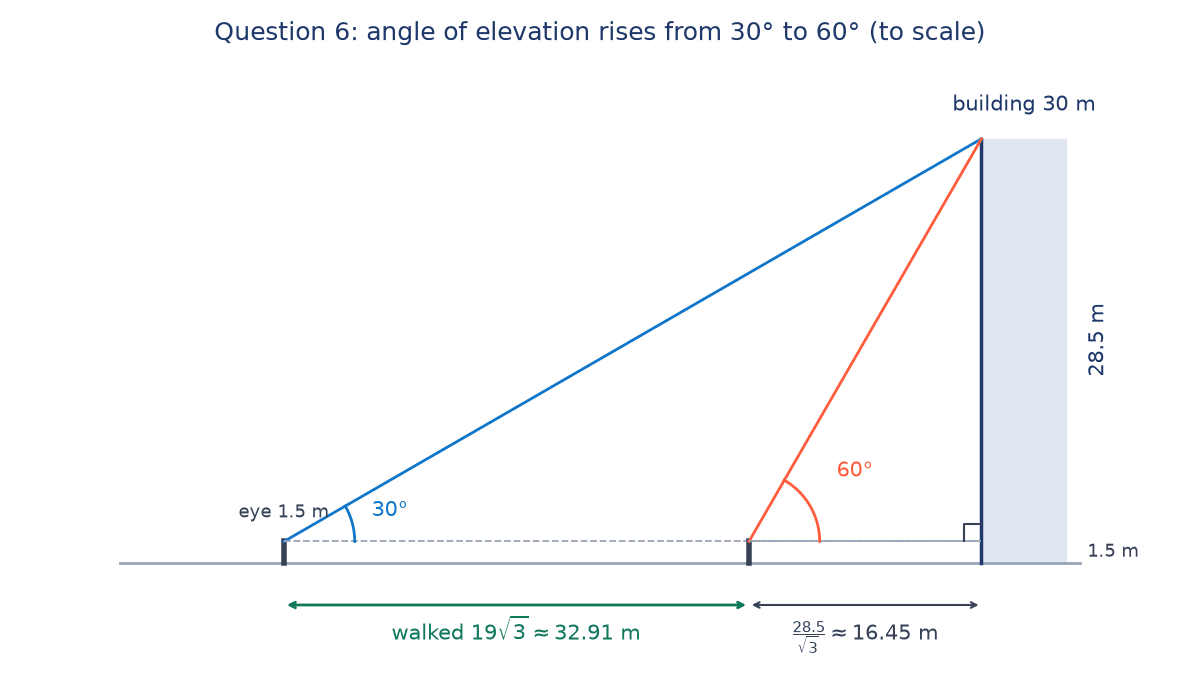
Step 1.
Step 2.
Step 3. The distance walked is the difference:
Check: m and m. Their difference is m, and .
Answer: he walked m m towards the building.
Question 7
From a point on the ground, the angles of elevation of the bottom and the top of a transmission tower fixed at the top of a 20 m high building are and respectively. Find the height of the tower.
Setting up. Let the observer be m from the building, and let the tower be m tall. The bottom of the tower is 20 m above the ground and its top is m above the ground.
Step 1. Use the angle to the bottom of the tower:
Step 2. Use the angle to the top of the tower:
Check: m, and .
Answer: the tower is m m high.
Question 8
A statue, 1.6 m tall, stands on the top of a pedestal. From a point on the ground, the angle of elevation of the top of the statue is , and from the same point the angle of elevation of the top of the pedestal is . Find the height of the pedestal.
Setting up. Let the pedestal be m tall and the point be m from its foot.
Step 1.
Step 2.
Step 3. Rationalise the denominator:
Check: m, and .
Answer: the pedestal is m m high.
Question 9
The angle of elevation of the top of a building from the foot of a tower is , and the angle of elevation of the top of the tower from the foot of the building is . If the tower is 50 m high, find the height of the building.
Setting up. Let the building be m tall and the distance between the feet of the two structures be m.
Step 1. From the foot of the building, looking at the 50 m tower:
Step 2. From the foot of the tower, looking at the building:
Check: m, and .
Answer: the building is m m m high.
Question 10
Two poles of equal height stand opposite each other on either side of a road that is 80 m wide. From a point between them on the road, the angles of elevation of the tops of the poles are and . Find the height of the poles and the distances of the point from the poles.
Setting up. Let each pole be m tall. Let the point be m from the pole seen at , so it is m from the other pole.
Step 1.
Step 2.
Step 3. Set the two expressions for equal:
So , and the other distance is m.
Check: and .
Answer: each pole is m m high. The point is 20 m from the pole seen at and 60 m from the pole seen at .
Question 11
A TV tower stands vertically on a bank of a canal. From a point on the other bank directly opposite the tower, the angle of elevation of the top of the tower is . From another point 20 m away from this point, on the line joining this point to the foot of the tower, the angle of elevation of the top of the tower is . Find the height of the tower and the width of the canal.
Setting up. Let the tower be m tall and the canal m wide. The second point is farther from the tower, at a distance of m.
Step 1.
Step 2.
Step 3. Set the two expressions equal:
Check: and .
Answer: the tower is m m high, and the canal is 10 m wide.
Question 12
From the top of a 7 m high building, the angle of elevation of the top of a cable tower is and the angle of depression of its foot is . Determine the height of the tower.
Setting up. Draw a horizontal line from the top of the building to the tower. It meets the tower 7 m above the ground and splits the tower into a lower part of 7 m and an upper part of m, where is the tower's height. Let be the distance between the building and the tower.
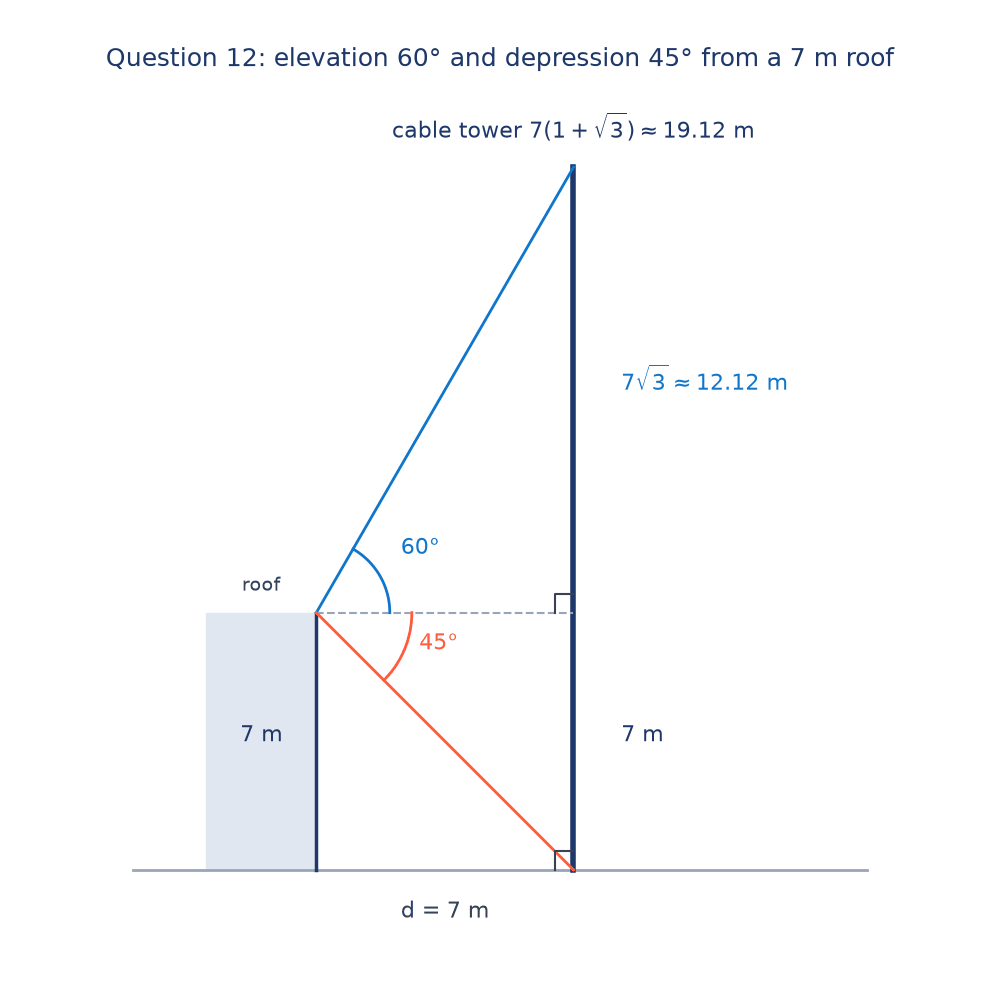
Step 1. The angle of depression of the foot is , so
Step 2. The angle of elevation of the top is , so
Check: m.
Answer: the cable tower is m m high.
Question 13
As observed from the top of a lighthouse 75 m high above sea level, the angles of depression of two ships are and . If one ship is exactly behind the other on the same side of the lighthouse, find the distance between the two ships.
Setting up. The nearer ship is seen at the larger angle of depression, . Let the two ships be and m from the foot of the lighthouse. Because the angle of depression equals the angle of elevation from the ship (alternate angles), we can work in the right triangles at sea level.
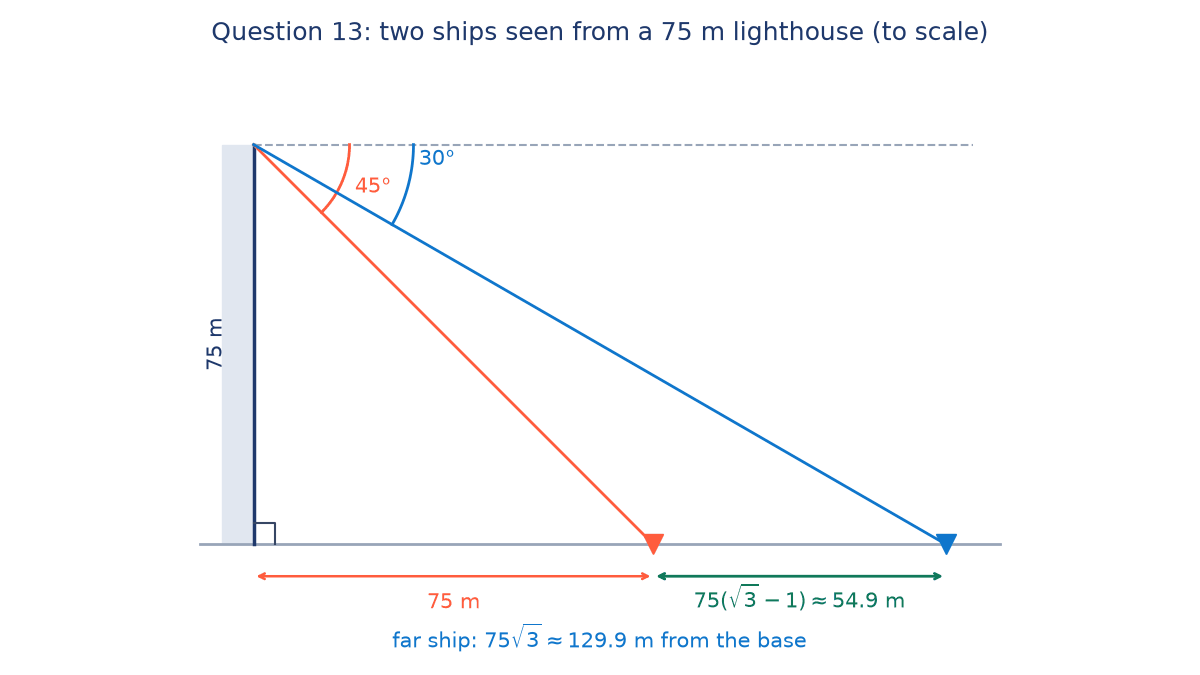
Step 1.
Step 2.
Step 3.
Check: , and .
Answer: the ships are m m apart.
Question 14
A 1.2 m tall girl spots a balloon moving with the wind in a horizontal line at a height of 88.2 m from the ground. The angle of elevation of the balloon from her eyes at any instant is . After some time, the angle of elevation reduces to . Find the distance travelled by the balloon during the interval.
Setting up. As in Question 6, measure from eye level. The balloon is
above her eyes. Let and be the horizontal distances of the balloon at the two instants.
Step 1.
Step 2.
Step 3. The angle decreased, so the balloon moved away from her. The distance it travelled is
Check: m and m, so the difference is m, and .
Answer: the balloon travelled m m.
Question 15
A straight highway leads to the foot of a tower. A man standing at the top of the tower observes a car at an angle of depression of , approaching the foot of the tower with a uniform speed. Six seconds later, the angle of depression of the car is found to be . Find the time taken by the car to reach the foot of the tower from this point.
Setting up. Let the tower be m tall. Let the car be m from the foot at the first sighting and m at the second.
Step 1.
Step 2.
Step 3. In 6 seconds the car covers
so its speed is
Step 4. The remaining distance is , so the time needed is
Shortcut: , so the remaining distance is half of the the car has already covered. At a uniform speed, it therefore takes half of 6 seconds.
Check: if m, then m and m. The speed is m/s, and s.
Answer: the car takes 3 seconds to reach the foot of the tower.
In every question, the work comes down to finding the right triangle, choosing the ratio that links the known and unknown sides, and remembering to subtract the observer's height when the angle is measured from the eyes (Questions 6 and 14).
Key terms
- Line of sight
- The line from the observer's eye to the object being viewed.
- Angle of elevation
- The angle between the horizontal and the line of sight to an object above eye level.
- Angle of depression
- The angle between the horizontal and the line of sight to an object below eye level.
- Horizontal level
- The line through the observer's eye parallel to the ground; every angle in this exercise is measured from it.
- Hypotenuse
- The side opposite the right angle, for example a rope, a kite string or a slide.
- Tangent ratio
- Opposite side divided by adjacent side; the ratio used for most height and distance problems.
- Rationalising
- Multiplying by a conjugate such as to remove a surd from a denominator.
Common questions
When should I use sine instead of tangent?
Use sine when the hypotenuse (a rope, a string or a slide) is involved together with a height. Use tangent when the two sides you are working with are a height and a horizontal distance.
Why subtract the observer's height?
The angle is measured from the eyes, so the vertical side of the triangle starts at eye level, not at the ground.
Is the angle of depression inside the triangle?
No, it lies between the horizontal line and the line of sight. It is equal to the angle of elevation at the other end, because they are alternate angles, so you can use that angle inside the triangle.
Should I leave answers with ?
Give the exact surd form first, as NCERT does. Add a decimal using when the question asks for one.
Why does the height cancel out in Question 15?
Both distances are multiples of , so their ratio depends only on the angles. The time therefore does not depend on how tall the tower is.
References
- National Council of Educational Research and Training. Mathematics: Textbook for Class X. NCERT, New Delhi.
- Loney, S. L. Plane Trigonometry. Cambridge University Press.
- Sharma, R. D. Mathematics for Class 10. Dhanpat Rai Publications.