When you first learnt to count, every number you used was a counting number. Later you met zero, then negative numbers on a thermometer, then fractions and decimals, and then strange numbers such as and . Each new kind of number was needed for a new job. Mathematicians sort all these numbers into sets, and the names of those sets are used in every chapter of algebra and geometry that follows.
So numbers get sorted into groups, and each group is called a set. There are six sets to get to know here, and you'll hear their names again and again all through the course, so it really pays to learn them well now.
The six sets
1. Natural numbers
Natural numbers are the counting numbers, the very first numbers you ever used. You begin at and keep going.
The curly brackets hold everything in the set, and the numbers inside are called its members. The three dots mean the list never ends.
These are the numbers you count real things with: three apples, ten steps, one door.
2. Whole numbers
Whole numbers are the natural numbers with added.
Zero earns its place, because you need it to say you have none of something. Ask any student with an empty tiffin box after lunch!
3. Integers
Integers are the whole numbers and their negatives.
Notice the dots at both ends now: the list runs on for ever in both directions. The chapter sometimes writes this set as ; both letters mean the same set.
Negative numbers let you count below zero, and you need them for money owed or a cold winter night in the hills.
4. Rational numbers
A rational number is one you can write as a fraction. is rational, and so is .
Call the top number and the bottom number ; both are integers. The bottom number is never , because you cannot share a cake into parts.
In symbols you write , where the sign means "is not equal to".
Every integer is rational too, since any integer can sit over a .
, and .
Why the answer is a rational number
Here's a handy test: a rational number in decimal form either stops or repeats. stops, while repeats for ever.
5. Irrational numbers
Surprisingly, some numbers cannot be written as a fraction at all, and is one of them. No pair of integers and will ever do it. Numbers like this are the irrational numbers.
means the number that multiplies by itself to give .
comes from a circle: divide the distance round a circle by the distance across it and you get . And is irrational too.
An irrational number has a decimal that never stops, and it never settles into a repeating pattern either.
Worked example: rational or irrational?
stops, so it is rational: .
repeats, so it is rational: .
looks like a square root, but , so , which is rational (and natural too).
is irrational, because no whole number or fraction multiplies by itself to give . Its decimal, , never stops and never repeats.
6. Real numbers
All the rational and irrational numbers together form the real numbers.
is the biggest set here, and every number you meet in this course is real. For instance, is a real number that you will meet later on.
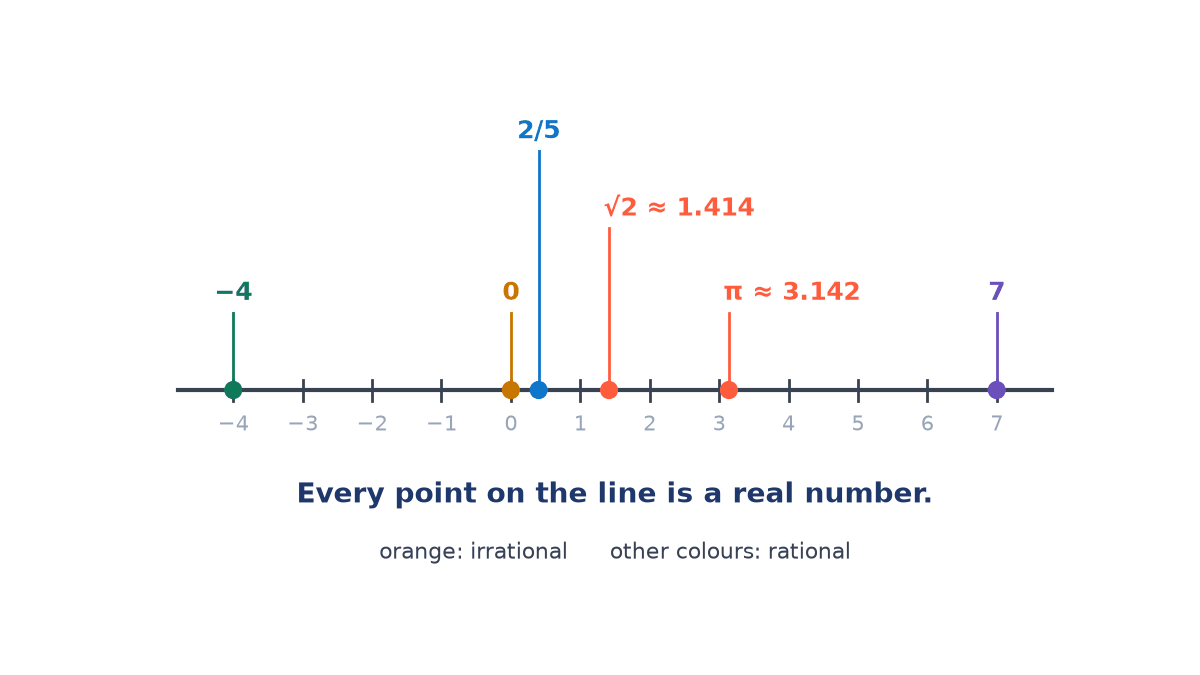
The number line in the picture holds every real number. The rational numbers and the irrational numbers are mixed together along it: between any two rational numbers you can always find an irrational one, and between any two irrational numbers you can always find a rational one.
How the sets fit together
| Set | Symbol | A number in it |
|---|---|---|
| Natural numbers | ||
| Whole numbers | ||
| Integers | ||
| Rational numbers | ||
| Irrational numbers | ||
| Real numbers | every number in the rows above |
- Every natural number is a whole number. is in , and is in .
- Every whole number is an integer. is in , and is in .
- Every integer is a rational number. .
- Every rational number is a real number. is in , and is in .
Picture a set of steel dabbas nested one inside the next. sits inside , and sits inside . Then sits inside , and sits inside .
The irrational numbers live inside too, but they stay outside for good, because no fraction can ever equal them.
So sits in every set except , while sits only in and .
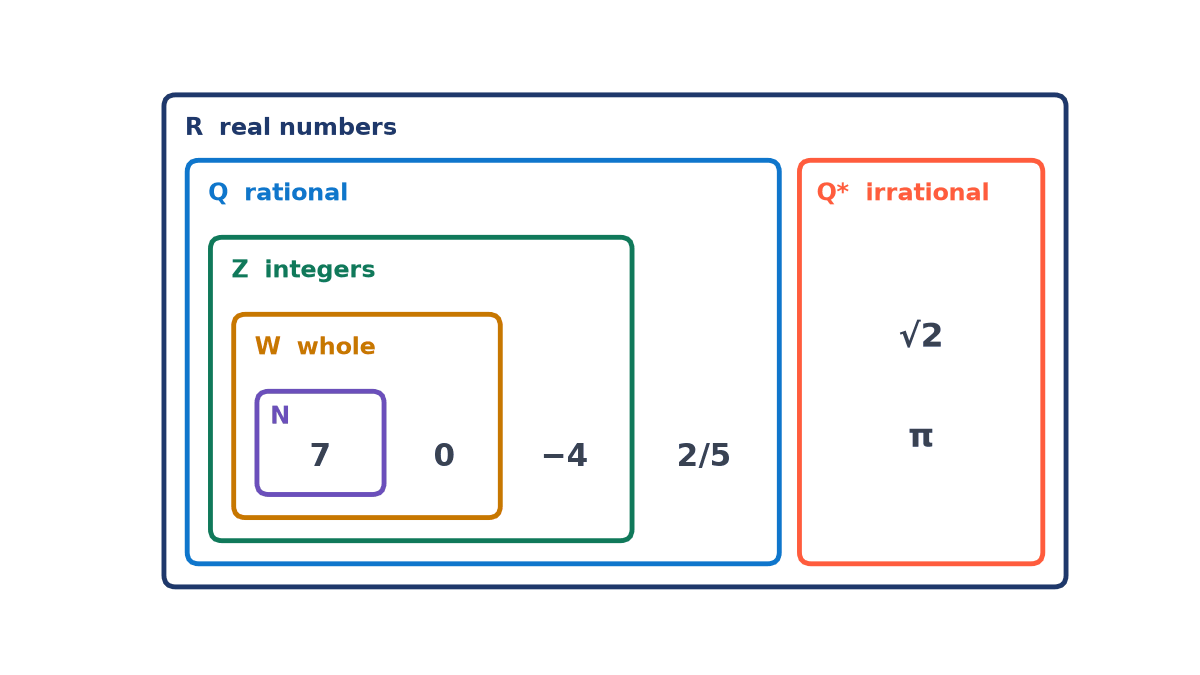
Remember. The sets grow in this order: , , , , . Each one holds all the sets before it.
The symbol
is a short way of writing "belongs to". So is read as " belongs to ".
You can use it with any set: says is a natural number. is true, but is false, because natural numbers start at .
Only one number and one set sit either side of the sign, so you write the sign again for each set. It's a small symbol that saves you writing the same words over and over.
Worked example: find every set for each number
looks like a fraction, but it simplifies to . So , and . It is not in or , because it is below zero.
, so belongs to , , , and .
, so and , but it is not an integer.
A teacher's tip: always simplify a number before you decide which sets it belongs to. Many numbers are not what they first look like.
Practice
Write down every set each number below belongs to.
| 1) | 3) | 5) |
| 2) | 4) | 6) |
| Question | Answer | Question | Answer |
|---|---|---|---|
Now write for true or for false beside each line.
| 1) | 3) |
| 2) | 4) |
| Question | Answer | Question | Answer |
|---|---|---|---|
Common mistakes
- Putting 0 in . The natural numbers start at ; first appears in .
- Thinking a number belongs to only one set. is natural, whole, an integer, rational and real, all at once.
- Calling every square root irrational. and are rational.
- Calling a long decimal irrational. goes on for ever but repeats, so it is , a rational number.
- Thinking is . It is only an approximation. is rational; is irrational.
- Writing two sets after one . Write and separately.
Key terms
- Set
- A collection of numbers, written inside curly brackets.
- Member
- A number that belongs to a set.
- Natural numbers
- The counting numbers
- Whole numbers
- The natural numbers together with .
- Integers
- The whole numbers and their negatives.
- Rational numbers
- Numbers that can be written as with , integers and .
- Irrational numbers
- Real numbers that cannot be written as such a fraction; their decimals never stop or repeat.
- Real numbers
- All the rational and irrational numbers together.
Answers
Every set each number belongs to
- : , , , and .
- : , , and .
- : , and .
- : and .
- : and .
- : and .
True or false
- : , natural numbers start at .
- : , whole numbers are never negative.
- : .
- : .