When you add a long bill in your head, you rarely go strictly from left to right. You pick the pairs that are easy and do them first. Why is that allowed for adding and multiplying, but not for taking away and dividing? We'll find out, and then meet two special numbers, and , along with the partners that undo a number. You'll use every one of these ideas again in algebra, where letters take the place of numbers.
You've already met swapping. Now we turn to grouping, which simply means choosing which pair of numbers you work out first.
Brackets tell you what to do first
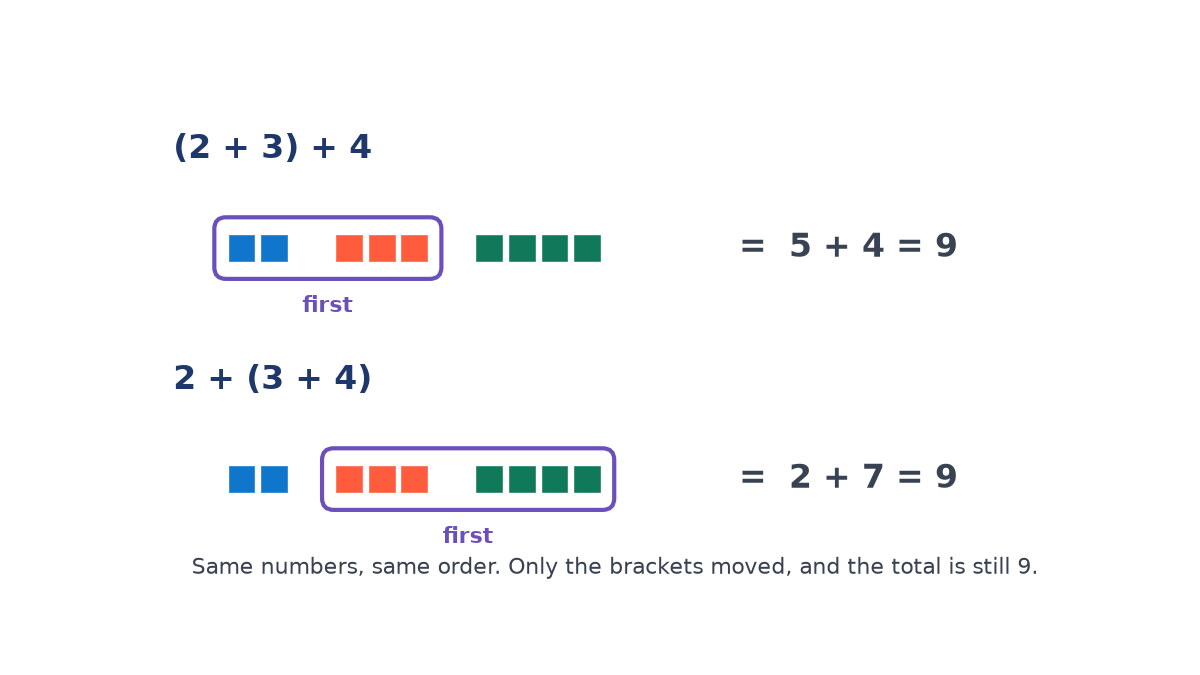
Brackets are the curved marks around part of a sum, and their message is simple: do this bit first. In you add and first. In you add and first.
First pair first
Second pair first
Both answers are . The numbers stayed in the same order and only the grouping changed, so addition clearly doesn't mind how you group.
Grouping to make sums easy
This is more than a curiosity; it lets you pick the easy pair. Look at .
Choosing the friendly pair
The second way is far easier, because makes a round . The associative property promises that both ways give the same answer, so you are free to take the easy road.
Swapping and grouping are not the same
Students often mix these two ideas up, so let's be clear about the difference.
Swapping is about two numbers changing places. You saw , where both give . That is the commutative property.
Grouping is about which pair you do first. You saw , where the order of the numbers never moved. That is the associative property.
Remember. Commutative is about swapping two numbers. Associative is about which pair you do first.
Multiplying works the same way
First pair first
Second pair first
Both answers are , so multiplication doesn't mind how you group either.
The same trick makes multiplying easier. Look at .
Grouped the other way, you'd need , which is a lot harder. Both give , but one of them is done in a blink.
Taking away does mind
Now try the same trick with subtraction, and watch carefully what happens.
First pair first
Second pair first
You get one way and the other. They are not equal, so subtraction is not associative.
Why the difference? In the second sum the brackets turn a take away into an add. You take away in total instead of , so you are left with more.
Let's test the idea on one more pair.
Once again the two answers differ. In fact, a single example where the answers differ is enough to show a rule does not hold, and mathematicians call such an example a counterexample.
Dividing minds too
First pair first
Second pair first
You get one way and the other, so division is not associative.
The reason: in the second sum the brackets shrink the number you divide by. You divide by instead of by , so you end up with more.
Writing it with letters
So far you have used ordinary numbers you can count and measure with. All the rational and irrational numbers together are called the real numbers, as you saw in The number system. That takes in whole numbers, negative numbers, fractions, and numbers like .
Letters let us state the rule for all of them at once. Pick any three real numbers and call them , and .
When two letters sit side by side, it means multiply them. So is a short way of writing . You cannot do that with digits, because would look like twenty-three.
Remember. Real numbers are associative under addition and multiplication. They are not associative under subtraction or division.
The numbers that change nothing
Some numbers leave others exactly as they were, like a guest who visits and changes nothing. Look at these four sums.
| Sum | Answer |
|---|---|
The word identity means sameness: the number keeps being itself.
Adding left the number alone, and it didn't matter which side the sat on. So is called the additive identity.
Multiplying by also left the number alone, whichever side the sat on. So is called the multiplicative identity.
Here are both rules written in letters.
The numbers that undo
An inverse is a partner that undoes a number.
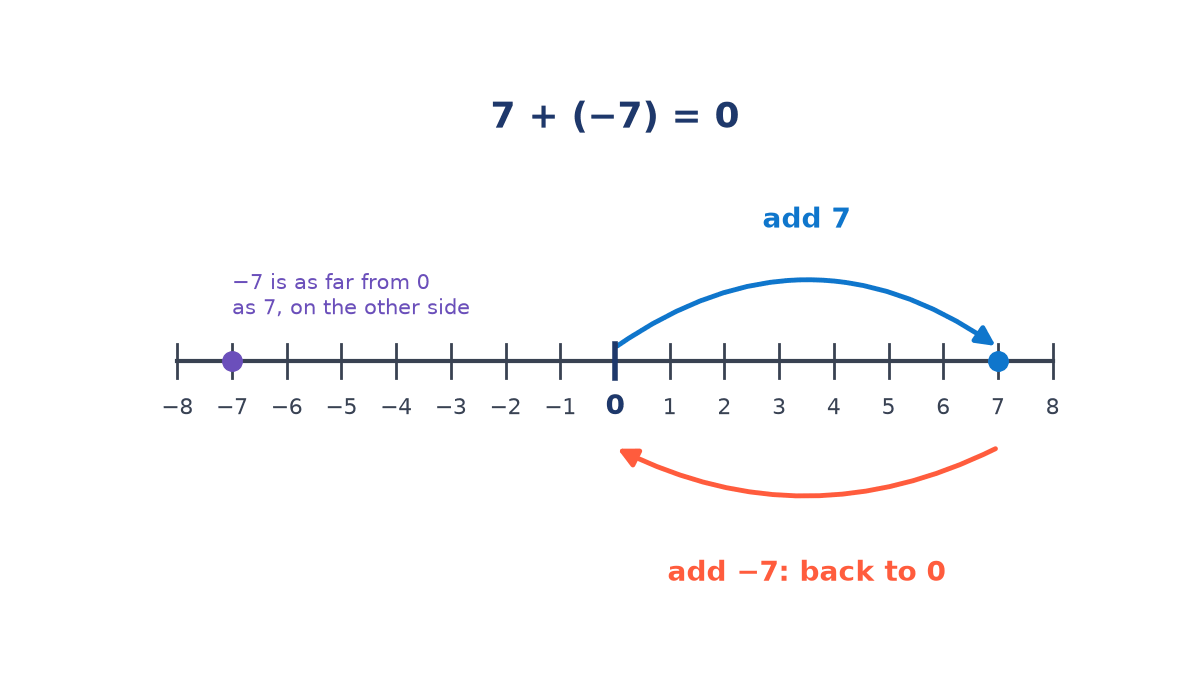
means seven below zero. It sits the same distance from zero as , just on the other side. So if you add and , you land right back on .
Adding the partner
So is the additive inverse of . In letters, . The partner takes you back to , the additive identity.
Multiplying has its own kind of partner. Multiply by and you land back on .
Multiplying by the partner
So is the multiplicative inverse of . In letters, , as long as is not zero.
More partners
Every real number has an additive inverse, and fractions are no exception.
To find a multiplicative inverse of a fraction, turn it upside down. The fraction has the partner .
Why must not be zero
There are two reasons, and both are easy to see.
First, has no meaning, because you cannot share something into zero groups.
Second, anything times zero is zero: , and .
However big the other number is, the answer stays zero, so no number times zero can ever give . Zero simply has no multiplicative inverse.
Remember. An inverse takes you back to an identity. takes you back to . takes you back to , and here cannot be zero.
Three small facts
Here are three last facts. They look easy, but they're worth saying out loud.
- Take nothing away and nothing changes. , so .
- Take a number away from nothing and you are left with its negative. , so .
- One times a number leaves it alone. , so .
The small dot in is one more way to write multiply.
Your turn
Work each one out, then check yourself below.
| 1) | 6) | 11) |
| 2) | 7) | 12) |
| 3) | 8) | 13) |
| 4) | 9) | |
| 5) | 10) |
| Question | Answer | Question | Answer |
|---|---|---|---|
The first two pairs give the same answer. The next two pairs do not, and that difference is the whole point of this lesson.
The last two questions show a number meeting its partner. is the additive inverse of . is the multiplicative inverse of .
Common mistakes
- Mixing up the two properties. Moving numbers to new places is commutative. Moving only the brackets is associative.
- Regrouping a subtraction or a division. and are different.
- Thinking is the identity for multiplying. , not . The identity for multiplying is .
- Giving the wrong inverse. The additive inverse of is ; the multiplicative inverse is .
- Looking for a multiplicative inverse of . There is none.
Key terms
- Associative property
- Changing the grouping does not change the answer: and .
- Commutative property
- Swapping two numbers does not change the answer, as in .
- Additive identity
- The number , because .
- Multiplicative identity
- The number , because .
- Additive inverse
- The partner that gives .
- Multiplicative inverse
- The partner that gives , for not zero.
- Counterexample
- One example that shows a rule does not always hold.