Every time you work out a sum, you are quietly trusting two facts. The first is that the answer will be a number you already know how to handle. The second is that, for some operations, you may write the two numbers in either order. Here we give those two facts their proper names: closure and the commutative property. You will meet both again and again, in mental arithmetic, when you rearrange a bill at the shop, and later when you simplify algebra such as .
Real numbers in one place
All the rational and irrational numbers together form the real numbers. We write the whole set as .
A rational number can be written as one integer over another, like or . An integer is a counting number, or zero, or one with a minus sign. An irrational number cannot be written that way.
The decimal of an irrational number never stops and never repeats; two famous examples are and
So whole numbers, fractions and decimals are all real, and so are numbers below zero, like .
We are going to ask two simple-sounding questions about real numbers.
- If you work with two real numbers, is the answer real too?
- May you swap the two numbers round and still get the same answer?
Question one: does the answer stay in ?
Pick any two real numbers, say 7 and 4. Now add them, take one from the other, and multiply them.
Working with 7 and 4
Every answer is a real number. You never fell out of .
Bigger numbers behave the same way: , and is real. (Here means ; a number right beside a bracket means multiply.)
Closure doesn't care whether the numbers are whole, either. Try two fractions, one of them negative.
Working with and
Both answers are fractions, and every fraction is real. Even an irrational number cannot push you out: and are still real numbers, because they still sit somewhere on the number line.
That is what closure means. A set is closed under an operation when the answer always stays inside the set.
Remember. Closed means you cannot escape. You start in and you land in .
Division is the odd one
Division is a little different. It works every single time but one: you cannot divide by zero.
Dividing real numbers
Both answers are real. isn't a whole number, but it is still real.
The next bit is extra, but worth knowing: why does dividing by zero fail?
Think about what is asking: which number times zero gives 6? No number can do that, because zero times anything is zero.
So has no answer at all. There's nothing to write down, and so no real number to land on.
Zero is the only troublemaker. Every other division of two real numbers gives a real number.
Remember. Real numbers are closed under addition, subtraction and multiplication. They are not closed under division.
The same idea in letters
Let and stand for any two real numbers. Then:
Closure
Read as: plus belongs to .
Read the last line as: divided by belongs to as long as is not zero.
The fourth line says "may" for a reason: there is no answer at all when is zero, and that is the only thing that can go wrong.
Question two: may you swap them round?
Add 3 and 5, and then add the same two numbers the other way round.
Adding both ways
The same answer twice, so the order made no difference. Multiplying behaves just the same way.
Multiplying both ways
There's a word for this: commutative. It simply means you may swap the two numbers round. Think of adding up a shopping bill; whether you add the rice first or the dal first, the total is the same.
Remember. Commutative means the order of the two numbers does not change the answer.
Taking away says no
A number line shows why the order matters. Starting point and size of jump both change when you swap.
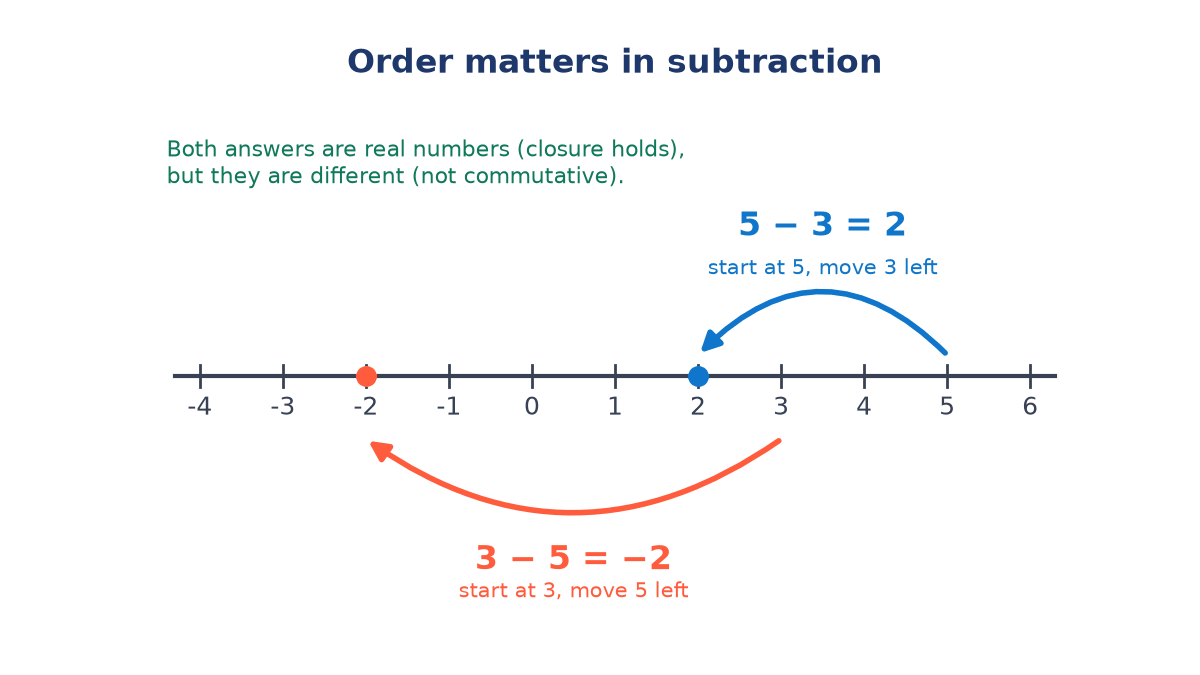
Taking away both ways
Those two answers are not the same: one is and the other is .
is a real number too, so subtraction hasn't escaped . But the order has changed the answer, so subtraction is not commutative. Here the order really matters.
Dividing says no as well
Dividing both ways
Once again the two answers differ, so division is not commutative either.
A few more pairs to test
Here are some harder pairs. Try each one both ways yourself before you peek at the answer.
- and . The same, as multiplication is commutative even with decimals.
- and . The same again. A minus sign does not stop you swapping.
- but . Different. The two answers are opposites of each other.
- but . Different. Swapping a division turns the answer upside down.
Notice the pattern in the last two. Swapping a subtraction gives the negative of the answer. Swapping a division gives the reciprocal. So the swapped answer is related to the first one, but it is not the same.
The same idea in letters
Two letters side by side mean multiply. So is short for .
For any two real numbers and , these two always hold:
You may swap
And here you may not swap:
You may not swap
Now and then these two can be equal by accident: is either way round. But you can't count on luck, so you may not swap.
Both answers on one page
| What you do | Answer stays real? | May you swap? |
|---|---|---|
| Add | Yes | Yes |
| Take away | Yes | No |
| Multiply | Yes | Yes |
| Divide | No | No |
Remember. Addition and multiplication of real numbers are commutative. Subtraction and division are not. Swap the two numbers there and the answer usually changes.
Practice
- Work out and then .
- Work out and then .
- Work out and then .
- Work out and then .
- Is the answer to a real number?
- One of these has no answer. Is it or ?
| Question | Answer | Question | Answer |
|---|---|---|---|
| and | and . Adding is commutative. | and | and . The order matters. |
| and | and . Multiplying is commutative. | Is real? | Yes. It is , and is closed under addition. |
| and | and . The order matters. | Which has no answer? | , because you cannot divide by zero. . |
Common mistakes
- Thinking a negative answer means you have left the real numbers. is as real as ; subtraction is still closed.
- Saying division is closed. One case, dividing by zero, has no answer at all, so the set is not closed under division.
- Mixing up and . The first is ; the second has no answer.
- Deciding an operation is commutative from one lucky example, such as . One example where the order fails is enough to show it is not commutative.
- Treating as two separate numbers. Letters written side by side mean multiply.
Key terms
- Real numbers ()
- All the rational and irrational numbers together.
- Rational number
- A number that can be written as one integer over another, with the bottom not zero.
- Irrational number
- A number whose decimal never stops and never repeats, such as .
- Closure
- A set is closed under an operation when the answer always stays inside the set.
- Commutative
- The order of the two numbers does not change the answer.
- Belongs to ()
- The symbol that says a number is a member of a set.
Answers
Answers to the Practice questions.
- and . The same, so addition is commutative.
- and . The same, so multiplication is commutative.
- and . Different, so the order matters.
- and . Different, so the order matters.
- Yes. , which is real, because is closed under addition.
- has no answer. .