What this lesson is about
You have added whole numbers, fractions and decimals for years. Real numbers include all of those, and also numbers such as whose decimals never end or repeat. You meet them when you find the diagonal of a square, the side of a right-angled triangle, or a length on a geometry diagram in Class 9 and beyond.
The good news is that adding and subtracting real numbers follows the same rules you already trust. The only new skill is deciding when two roots can be combined, and when an answer must simply be left as it stands.
A few words you will need
Whole numbers are the counting numbers with nothing after the point. They are and so on.
The mark asks you a question: which number, multiplied by itself, gives what is inside?
So , because . A number written like this is called a root.
The chapter builds the real numbers out of six sets, shown here.
| The set | Sign | What is in it |
|---|---|---|
| Natural numbers | The counting numbers and so on | |
| Whole numbers | The counting numbers with nought added: | |
| Integers | The whole numbers and their opposites, like and | |
| Rational numbers | Numbers you can write as , like . Here and are integers, and | |
| Irrational numbers | Numbers you cannot write that way, like | |
| Real numbers | All the rational and irrational numbers together |
So the real numbers are the rational and irrational numbers put together. That is the chapter's own definition of .
You write and read it as " belongs to ".
The number belongs to too. Its digits never end, and it has a name of its own because it turns up so often in later work.
Adding and subtracting numbers you know
Let's warm up with what you already know. You've been adding for years, and you know that . Swap the two numbers over and the answer stays the same, so .
Subtracting is a different story. To subtract is to take away, and . But swap those two and you get , which is . That's below nought, so here the order matters.
Nought is gentle when you add: , and , and . But , because taking a number away from nought turns it into its opposite.
Every number has an opposite. The opposite of is , and .
Grouping doesn't matter when you add: , and . It does matter when you subtract: , but .
Remember. Real numbers follow the same adding rules you learnt with small numbers. The numbers look different, but the adding does not.
The same rules, written with letters
A letter can stand for any real number, so don't be put off: nothing new is happening below. The rules are numbered just as the chapter numbers them.
| The chapter's rule | With numbers | With letters |
|---|---|---|
| 1) Closed | , and is a real number | and |
| 2) Commutative, so you may swap | ||
| 2) Not commutative when you subtract | , but | is not always |
| 3) Associative, so you may regroup | ||
| 3) Not associative when you subtract | , but | is not always |
| 4) Nought is the additive identity | ||
| 5) Every number has an additive inverse | ||
| 6) Nought and subtracting | , and | and |
Rules 2 and 3 have one gap each for subtraction. Swapping gives the same answer when the two numbers are equal, as in . Regrouping gives the same answer when the last number is nought, as in . Otherwise the answers differ.
What the chapter says in words
The chapter puts it this way. Real numbers are closed under addition, subtraction and multiplication, but not under division.
They are commutative under addition and multiplication, but not under subtraction or division.
And they are associative under addition and multiplication, but not under subtraction or division.
The multiplication and division halves of those sentences are waiting for you in the next two lessons.
Adding things of the same kind
Picture a fruit seller with apples in one basket and apples in another. Together he has apples. You added the counts, but the word apples didn't change at all.
Now try tens and tens. That is tens, and .
Both times you added the number in front, and the thing being counted stayed put. But apples and pears are not the same thing, and you can't fold them into one count.
Adding and subtracting roots
A root like is a real number. It isn't a whole number, but it is still one number, and you can count lots of it.
So means two lots of , and means five lots of .
A root on its own is one lot of it, so means the same as , with a count of .
Both and are counting s, so you add the counts, exactly as you did with the apples.
Adding counts of the same root
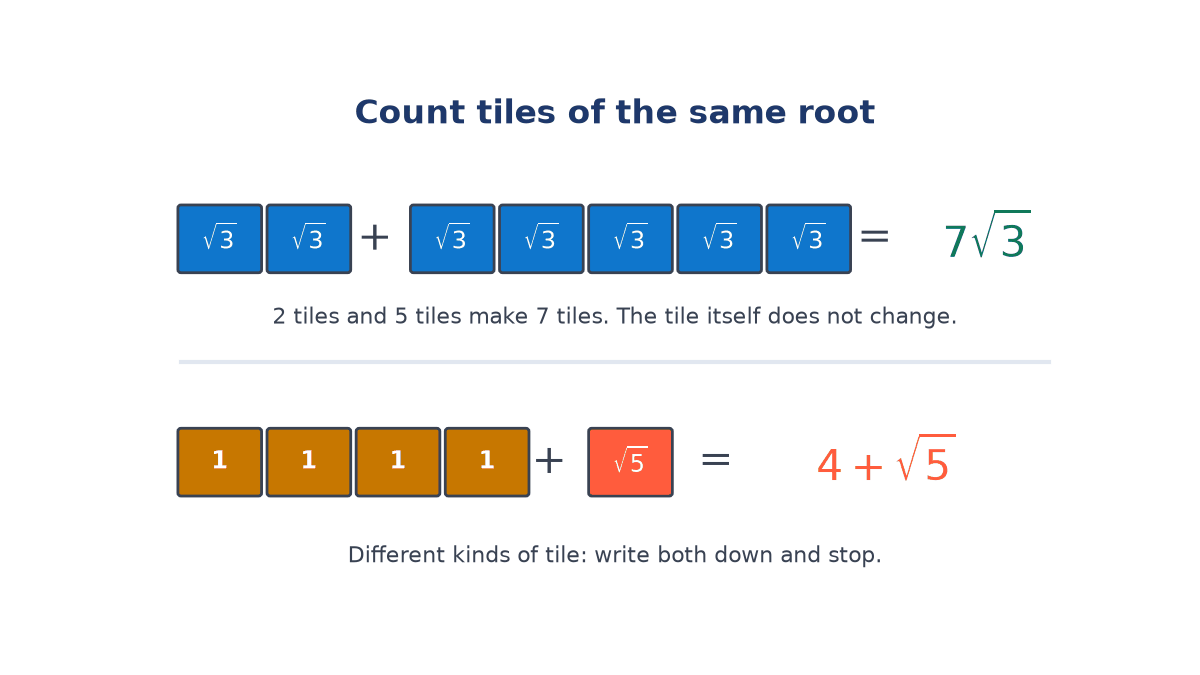
The didn't change; only the count in front of it did.
Subtracting works the same way. This time you take from .
Subtracting counts of the same root
You worked out and kept the as it was.
Bare roots have a count of , so they add in the same way.
Adding two bare roots
And sometimes the counts cancel each other out completely.
When the counts cancel
Nought lots of anything is nought. With no root left to write, you simply write .
Remember. You can only add or subtract counts of the same root. and are different things, in the way apples and pears are.
When the answer stays as it is
Now look at . The is a whole number, but the is not.
Since and , and five sits between four and nine, must sit between and .
In fact is irrational: its digits run on for ever and never settle into a pattern.
So the two parts are not the same kind of thing. It's like adding apples and one pear.
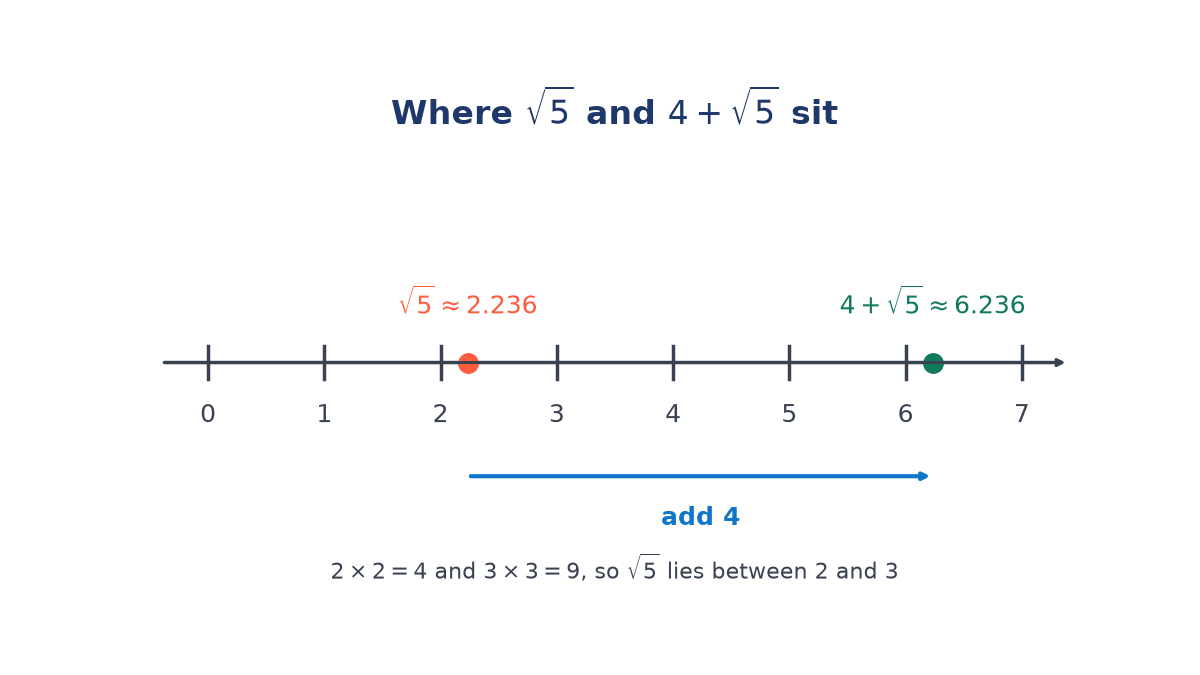
You have both, so you write both down, and the answer is just .
and are two different roots. So stays as it is too.
Order does not matter here, because rule 2 lets you swap. So and are the same answer.
Remember. Leaving alone is the answer. It is exact, and it is finished.
By rule 1 that answer is still a real number. Adding two real numbers always gives a real number.
It's natural to want a sum to end in one tidy number. Here, though, that would mean rounding, and rounding throws a little of the truth away. So resist the urge!
How to decide
- Look at the two parts. Ask what each one is counting.
- If they count the same root, add or subtract the numbers in front. A root with no number in front counts as one.
- Write that root down again, unchanged.
- If the counts come to nothing, the answer is just . No root is left to write.
- If the parts are not the same kind, leave the sum as it stands.
| The sum | Same kind? | The answer |
|---|---|---|
| Yes, both count | ||
| Yes, both count | ||
| Yes, and the counts cancel | ||
| No, one is whole and one is a root | ||
| No, the roots are different |
More worked examples
These go one step further, but each one uses only the steps from the list above.
Collecting two kinds of root
Simplify . There are two kinds here, so gather each kind on its own, the way you would sort apples from pears.
The two parts still count different roots, so the answer stays in two parts. Rule 2 let you move the terms into their groups, and rule 3 let you bracket them.
A root that hides a like root
Sometimes a root can be rewritten so that it matches another. Since and , the root is the same as .
The counts cancel, so nothing is left to write except .
Whole numbers and roots together
Simplify . Open the brackets first. The minus in front of the last bracket changes the sign of both parts inside it.
The whole numbers were collected with each other and the roots with each other, and both groups came to nought. A long question with a very short answer!
Try these
Work each one out. Some of them stay exactly as they are, and that is perfectly fine.
| Question | Answer | Question | Answer |
|---|---|---|---|
Remember. Count what is alike. Keep the root the same, unless the counts cancel. Leave the rest as it stands.
Common mistakes
- Adding the numbers under the root: is not . Check with a calculator: about , but is about .
- Adding a whole number to the count: is not . The is not counting roots.
- Forgetting that a bare root has a count of , so is written as instead of .
- Writing as the final answer instead of .
- Swapping or regrouping in a subtraction as if it were an addition.
- Rounding a root to a decimal when the question wants the exact answer.
Key terms
- Real numbers
- All the rational and irrational numbers together, written .
- Irrational number
- A number that cannot be written as ; its decimals never end and never repeat, like .
- Root
- A number written with the sign ; it is the number which, multiplied by itself, gives what is inside.
- Like roots
- Roots with the same number inside, such as and . Only these can be combined.
- Closure
- Adding or subtracting two real numbers always gives a real number.
- Additive identity
- Nought, because adding it leaves any number unchanged.
- Additive inverse
- The opposite of a number; the two add to nought, as .
Answers
Show answers
- stays as it is: one part is a whole number and one is a root.
- stays as it is. By rule 2 it may also be written .