Whenever you work out the area of a square whose side is cm, or share a length like m into equal parts in a geometry problem, you are multiplying and dividing real numbers. The good news is that the rules you use for whole numbers carry straight over. We'll check each rule on numbers you know well, and then use it on roots, where it really earns its keep.
Real numbers are all the rational and irrational numbers together, as you saw in The number system. Whole ones, fractions, negative ones, and roots like all count. We write the real numbers as for short.
You can already add real numbers and take one away from another. Now it's time to multiply and divide them.
Start with numbers you know
Take and turn it round: you get .
The answer didn't change. Try another pair: and .
Why does this always happen? Think of as three rows of five dots, like chairs in a small hall. Turn the page sideways and now it is five rows of three dots.
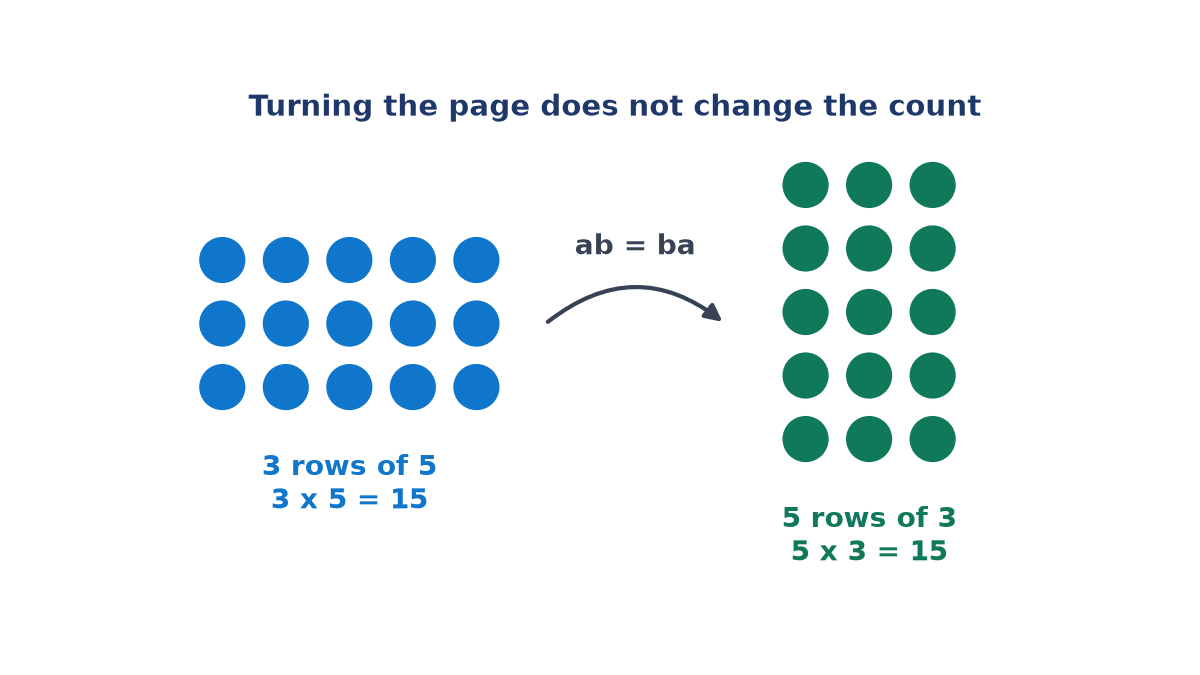
They're the very same dots, so the answer has to be the same.
Swapping is safe for every pair of numbers, so we can write it with letters: for any real numbers and , . The letters aren't new maths; they just mean "any number you like".
Your chapter has a name for this. Multiplication is commutative, which is a long word meaning you may swap.
Adding is commutative too, but taking away and dividing are not. , but is certainly not .
Brackets do not matter either
Look at . You can start from either end.
The first two numbers first
The last two numbers first
Both ways give . With letters, .
Your chapter calls this associative. Adding is associative as well; taking away and dividing are not.
Put these two facts together and you get something really useful: a long multiplication can be done in any order you like.
Roots multiply in a neat way
A square root has just one job. is the positive number that gives when you multiply it by itself.
You know that number already: it is , and . So . The root sign went away and left a plain number behind.
Try it with . You probably don't know that number as a decimal, but all the same.
Remember. For any real number that is not negative, . A root times itself gives back the number under the root.
The number under the root must not be negative, because no real number times itself gives a negative answer. So is not a real number at all.
This one rule makes root sums easy, so keep it close by for the rest of the page.
A first example
Multiply the plain numbers first, then multiply the roots.
Multiply by
We changed the order to bring the two roots side by side. Swapping and regrouping are both safe, so nothing was broken.
The two roots became a single , and then .
A second example
This one works in just the same way.
Multiply by
is not a whole number, yet you never needed its decimal. The rule did all the work for you.
A check you can do two ways
Some roots are whole numbers in disguise. is one of them, because .
Multiply by
Now do it without the rule. Here , so and , and once more. The two paths agree, which is always reassuring.
We picked this sum because you can do it both ways. Most roots, like , are not whole numbers in disguise, and then the rule is the only way through.
A harder example: a bracket with a root inside
Share the outside number out, then use the root rule on any root times itself.
Multiply out
The and the cannot be joined into one number. One has a root and the other does not, just as apples and oranges stay as they are.
Three roots in a row
Multiply
Only two of the three roots could pair up. The third one has no partner, so it stays in the answer.
A number outside a bracket
Sometimes a number sits outside a bracket, and then it must multiply every part inside.
Look at . You could do the bracket first.
The bracket first
Or you could share the out, giving it to the and to the , the way a mother hands out sweets to each child.
Sharing the 6 out
Both ways give , and that is why sharing out is safe.
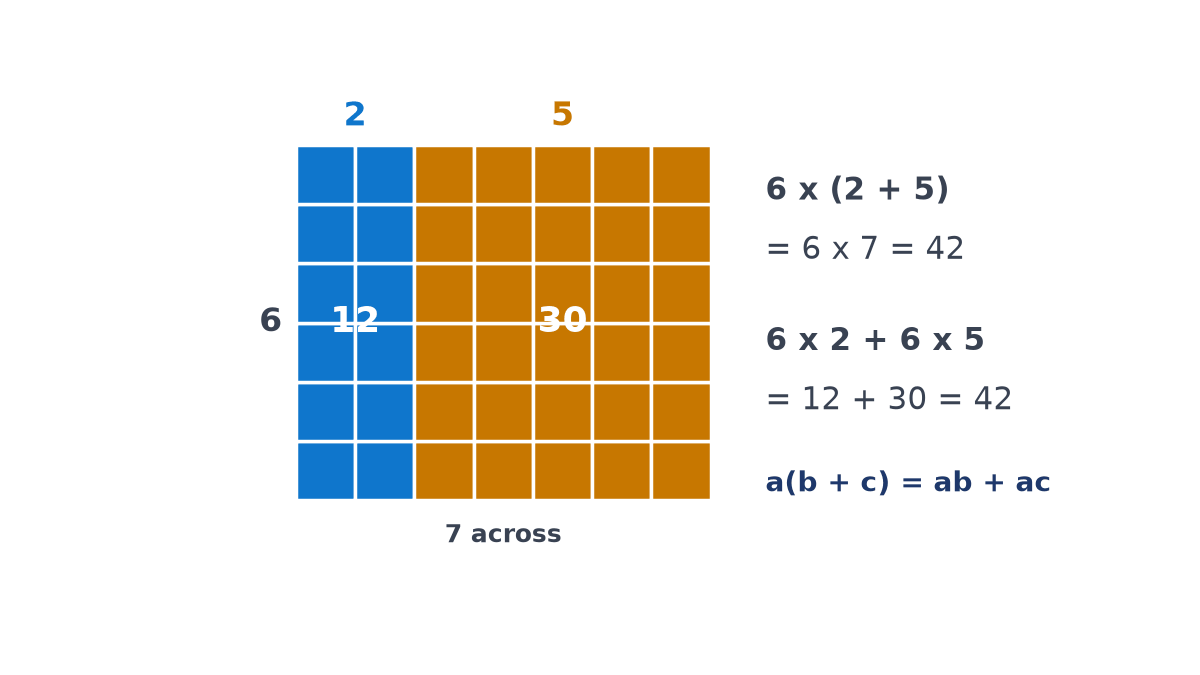
With letters we write .
Your chapter calls this distributive: multiplication is distributive over addition.
It works just as well when the bracket has a take away in it: .
With letters, .
Sharing out works with roots too, so . The reached both parts, and nothing inside the bracket was left out.
Dividing real numbers
Dividing undoes multiplying. because .
Roots divide in a tidy way as well. Any number divided by itself is , and a root is just a number, so over is . (The number under the root has to be bigger than zero here; you'll see why zero is special very soon.)
Divide by
The roots cancelled each other, leaving only to do.
When the root is on the bottom
A root on the bottom of a fraction is awkward to read, so we like to move it to the top. The trick is to multiply the top and the bottom by the same root.
Doing the same thing to the top and the bottom is really multiplying by . That is , and multiplying by changes nothing.
It's like cutting a cake into more slices: you still hold the same amount of cake.
Divide by
The bottom turned into because , and the root now sits happily on top.
A number like cannot be written as one integer over another; numbers that can are called rational. Because this move leaves a plain whole number on the bottom, it is called rationalising.
Two more divisions
Divide by
Divide the plain numbers first, then move the root to the top.
Divide by
Check by multiplying back: . Since dividing undoes multiplying, this check never lets you down.
Why division is the awkward one
The next idea has its own word. Closed means the answer is always a real number again.
Adding, taking away and multiplying are all closed: , , . Every one of those answers is still a real number, and you can never land on something that isn't.
Your chapter puts it like this: real numbers are closed under addition, subtraction and multiplication.
Division is the odd one out, because real numbers are not closed under division. That isn't because the answer escapes somewhere; it's because one division has no answer at all.
Think about what division asks. asks how many s fit inside . Now ask how many zeros fit inside . Zeros add nothing, so you could take a million of them and still have nothing. You never reach .
So has no answer, and dividing by zero is simply not allowed.
Remember. You may divide by any real number except zero. Never put zero on the bottom of a fraction.
The rules on one page
| What you are doing | The rule |
|---|---|
| Swapping two numbers (commutative) | |
| Regrouping a long multiplication (associative) | |
| A root times itself ( not negative) | |
| A number outside a bracket (distributive) | |
| A root on the bottom | Multiply top and bottom by that root |
| Dividing by zero | Never allowed |
Practice
Try these on paper. The answers come after them.
- Work out .
- Multiply by .
- Work out .
- Divide by .
- Multiply out .
- Write with no root on the bottom.
| Question | Answer | Question | Answer |
|---|---|---|---|
Common mistakes
- Writing and stopping. It is right but unfinished: .
- Sharing the outside number with only the first part of a bracket. is , not .
- Swapping the order in a division. , but is a quarter.
- Multiplying only the bottom by the root when rationalising. Top and bottom must both be multiplied, or the value changes.
- Adding a root to a plain number, as in . They are different kinds of number and stay apart.
- Dividing by zero. It has no answer at all.
Key terms
- Real numbers ()
- All the rational and irrational numbers together.
- Commutative
- The order can be swapped without changing the answer: .
- Associative
- The grouping can be changed without changing the answer: .
- Distributive
- A number outside a bracket multiplies every part inside: .
- Square root
- is the number that is not negative and gives when multiplied by itself.
- Rationalising
- Multiplying top and bottom by a root so that no root is left on the bottom.
- Closed
- An operation is closed when its answer is always a number of the same set.