What this lesson is about
When a shopkeeper says a pen costs ₹5 more than a pencil, and you do not yet know the price of the pencil, you can still write the price of the pen: . That short line is an algebraic expression. Expressions like it appear in formulas for area and perimeter, in word problems, and in every equation you will solve.
First we'll give a proper name to what you write when you put terms together. Then we'll sort such expressions into five types, so that when a question says binomial or polynomial, you know exactly what it means and don't have to guess.
You already know what a term is; the Early Years course "Introduction to Algebra" defines it in full.
The fundamental operations
Four operations are called the fundamental operations: adding, taking away, multiplying and dividing. You've been using all four on plain numbers since primary school.
The same four signs work with letters too. Nothing new has been added; the numbers have simply been replaced by letters.
What an algebraic expression is
An algebraic expression is one or more terms joined by or signs. Multiplying and dividing don't join terms; they stay inside one term, which is exactly what the word term means.
The chapter puts it this way: the combination of terms obtained by the fundamental operations.
Here are three algebraic expressions to look at.
Look at . Its terms are and , and a plus sign joins them, so the whole line is an expression.
Why bother joining terms? Because one term on its own says very little, while joined terms carry a whole rule: says take a number, multiply it by , then add .
Reading an expression term by term
Take . Split it wherever a plus or minus sign joins two parts. The terms are and ; the minus sign travels with the term after it. Inside the operation is multiplying, so , and stay together as one term.
Now take . The division sits inside the first term, so is one term and is the second: two terms, joined by a plus sign.
Writing an expression from words
Words turn into expressions one operation at a time. "Three times a number, less two" becomes . "The sum of a number and its square" becomes . "Half of a number, added to seven" becomes . In each one, check that you can point to the terms and to the signs that join them.
Remember. An algebraic expression is terms joined by the fundamental operations.
The five types
Expressions are sorted by how many parts they hold. Four of the five names are built from monomials, so they carry the power rule along with them; only the multinomial is built from plain terms.
Monomial
An expression with only one term is called a monomial, and is one. But there's a condition: every power in it must be a whole number, , , , and so on.
In the power of is and the power of is . Both are whole numbers, so it passes.
(A variable, by the way, is a letter standing in for a number, and the formal name for whole numbers like these is the non-negative integers.)
So a power below zero is shut out, and a power that is a fraction is shut out too.
The number in front of the letter, though, may still be a fraction. is a monomial, because the power of is .
Why such a strict rule about powers? Because a whole number power simply counts how many times the letter is multiplied by itself.
What a whole number power means
Now look at . Its power is , which sits below zero, so it is not a monomial.
You can't write as a row of s multiplied together. It means , which is a division.
Keep in mind that the test is about the letters, not the numbers. Every letter's power must be a whole number. A number underneath, as in , does not matter, because that is just of and the power of is still . But a letter underneath, as in , means the power of is , and that is not a whole number.
Look at as well. A square root is the power , and a half is not a whole number, so is not a monomial either.
You can't make a row of s out of half an , so falls outside as well.
Remember. One term is not enough. A monomial also needs every power to be a whole number.
Binomial
An expression containing two monomials is called a binomial ("bi" means two, as in bicycle). is a binomial, and so is .
Trinomial
An expression containing three monomials is called a trinomial ("tri" means three, as in tricycle). is a trinomial, and so is .
Polynomial
An expression containing one or more monomials is called a polynomial. is a polynomial holding four monomials.
Polynomial is the wide, umbrella name. Every monomial is a polynomial, and so is every binomial and every trinomial.
Multinomial
An expression containing one or more terms is called a multinomial. is a multinomial.
Now read the last two definitions side by side. A polynomial is built from monomials; a multinomial is built from terms.
That one word is the whole difference. A term may divide by a letter, which puts the power below zero, but a monomial may not.
Remember. All polynomials are multinomials. Not every multinomial is a polynomial.
The first half is easy: a monomial is a term, so an expression made of monomials is made of terms.
For the second half, one example is enough. Test against both definitions.
- Count the terms. is one term and is another.
- Two terms is one or more terms, so this is a multinomial.
- Now test the terms. Write as .
- The power is , which is below zero. That term is not a monomial.
- A polynomial is made of monomials only. So is not a polynomial.
Just one bad term spoils it, like one rotten mango in the basket. So count the terms first, then check each power.
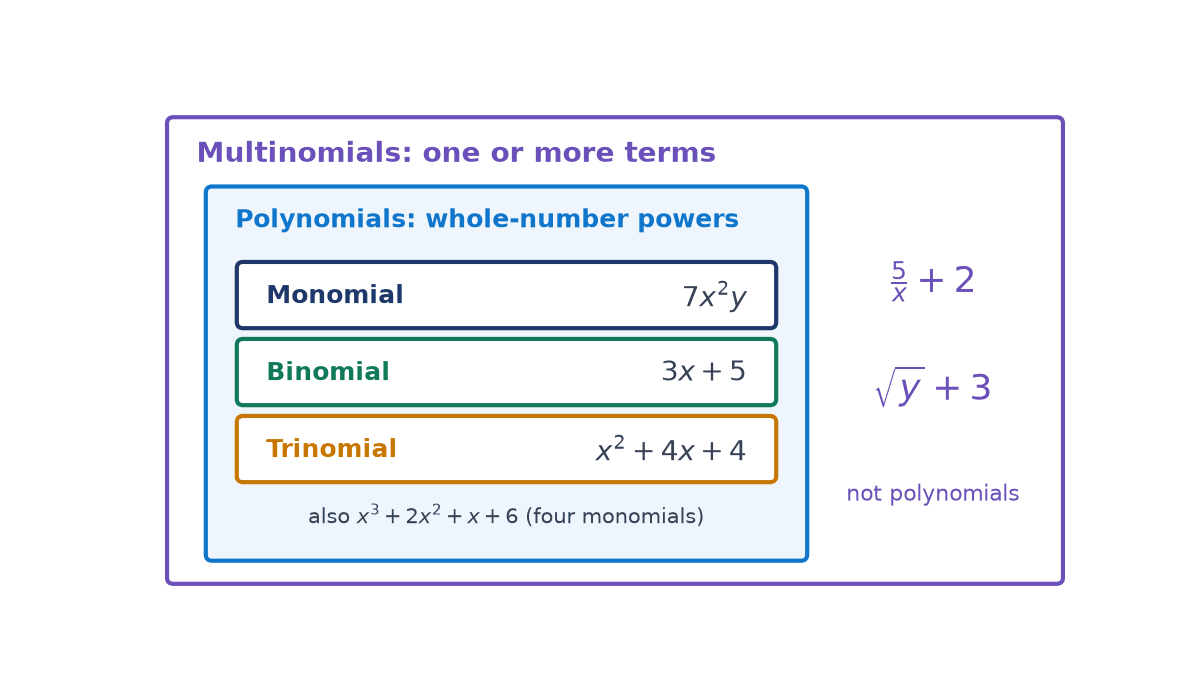
A worked sorting example
Sort .
- Split at the signs. The terms are , , and . That is four terms.
- Check each power. In the power is . In both powers are . In the power is . The number has no letter at all. Every power is a whole number, so all four terms are monomials.
- Four monomials is more than three, so it is not a trinomial. It is a polynomial, and therefore a multinomial as well.
| Type | What it holds | Example |
|---|---|---|
| Monomial | One term, every power a whole number | |
| Binomial | Two monomials | |
| Trinomial | Three monomials | |
| Polynomial | One or more monomials | |
| Multinomial | One or more terms |
The first four rows count monomials, so every power must be a whole number. The last row counts terms, so it does not.
- Name the type:
- Name the type:
- Name the type:
- Is a monomial? Say why.
- Is a polynomial? Say why.
- Write a trinomial of your own.
| Question | Answer | Question | Answer |
|---|---|---|---|
| A monomial. It is one term and the power of is . | Yes. It is one term, and the powers and are whole numbers. | ||
| A binomial. It holds the two monomials and . | No. has the power , which is not a whole number. So is not a monomial. A polynomial is made of monomials only, so this is not a polynomial. | ||
| A trinomial. It holds three monomials. | Your own trinomial | Any three monomials joined by or , such as . |
Common mistakes
- Counting factors as terms. is one term, not three, because multiplying does not separate terms.
- Calling a monomial. A letter underneath means the power is .
- Thinking a fraction in front of a letter spoils a monomial. is a monomial, because the power of is .
- Forgetting that a monomial is also a polynomial, and that every polynomial is also a multinomial.
- Leaving the minus sign behind when splitting an expression into terms.
Key terms
- Fundamental operations
- Adding, taking away, multiplying and dividing.
- Variable
- A letter standing in for a number.
- Algebraic expression
- One or more terms joined by plus or minus signs.
- Monomial
- An expression with one term in which every power of a letter is a whole number.
- Binomial
- An expression containing two monomials.
- Trinomial
- An expression containing three monomials.
- Polynomial
- An expression containing one or more monomials.
- Multinomial
- An expression containing one or more terms, whatever their powers.
Answers
Show answers
- is a monomial: one term, and the power of is .
- is a binomial: it holds the two monomials and .
- is a trinomial: it holds three monomials.
- Yes. is one term, and the powers and are whole numbers.
- No. has the power , which is not a whole number, so it is not a monomial. The expression is a multinomial but not a polynomial.
- Model answer: . Any three monomials joined by or will do.