Algebra lets you write a rule once and use it for every number. Before long you meet two expressions that need to be put together: the perimeter of a field whose sides are and , the total cost of two orders, or the difference between two people's savings. Adding and subtracting expressions is the skill behind all of these, and it rests on one simple idea: you can only combine things that count the same thing.
An expression is a piece of algebra made of terms joined by plus or minus signs, like .
Two expressions can be put together to make one: you can add them, or take one away from the other.
We'll do both jobs here, and we'll pay special attention to the one step that catches most people out, a minus sign sitting in front of a bracket.
Only like terms join
Terms, co-efficients, like terms and unlike terms are taught in the Early Years course Introduction to Algebra. If they feel shaky, it's worth a quick look back there.
Look at and . Both count the same thing, , so of them and more make of them. You can write .
Terms that count the same letter are called like terms; terms that count different letters are unlike terms.
The number in front of a term is its co-efficient. In the co-efficient is .
Remember. Only like terms add or subtract. Unlike terms stay side by side in the answer.
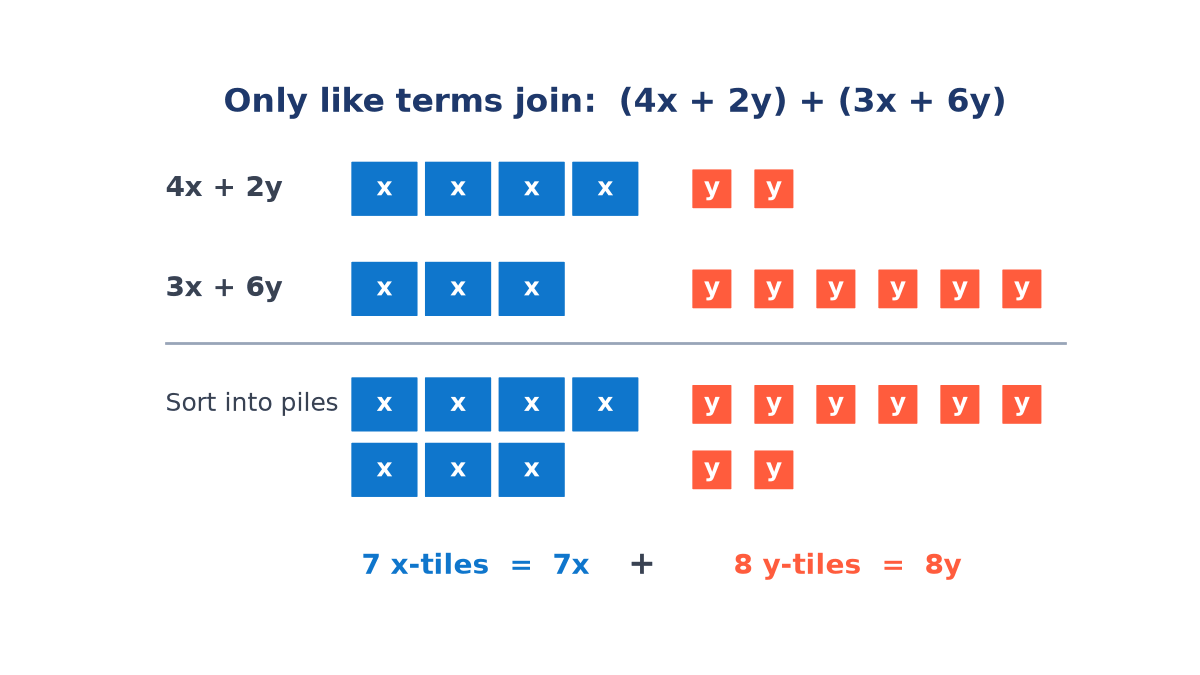
A good way to picture this is with tiles. Let a large blue tile stand for and a small orange tile stand for . You can count blue tiles with blue tiles, and orange with orange, but a blue tile and an orange tile never merge into a new kind of tile.
The horizontal method
Horizontal simply means you write everything along one line.
Add and
The middle step shows you why the answer is : the was taken outside, and and were added.
And that really is the whole method. Gather the like terms, then add the numbers in front of them.
The next sum has two letters in it.
Add and
This time there were two piles. The terms made and the terms made . Those two can't join, so the answer is .
A longer example with a minus sign inside
Add and . Each term carries the sign written in front of it, so is a negative term and is a negative number.
When you move a term to sit beside its partners, its sign travels with it, like a school bag that goes wherever the student goes. That is why stays negative in the second line.
A line worth checking
Here is one more sum along a line. Try it before you read the working.
Add and
Gather the terms first: , so they give . A common slip is to write here, so count carefully. The plain numbers give .
So the answer is .
Checking each line like this is a good habit, especially in your own work.
The vertical method
Vertical means you write one expression under the other. The chapter files this next sum under the vertical method, so we'll do it that way.
Add and . Set them out in two columns, one for and one for .
| Row | column | column |
|---|---|---|
| First expression, | ||
| Second expression, | ||
| Add each column |
In the column, . In the column, .
Like terms sat in the same column, and each column was added on its own. The answer is ; the two parts can't join, so both stay.
The nice thing about columns is that every term is in the column and every term is in the column, so no term can drift into the wrong pile.
Which method to use
Both methods give the same answer, so pick whichever is easier to hold in your head.
| Horizontal: best for short expressions. One line is quicker to write, and there is little to lose track of. | Vertical: best when there are several like terms to line up. The columns do the matching for you. |
Long expressions are easy to muddle, and that's when columns earn their keep by holding every term in its place.
Subtracting
Subtraction follows the same rule: only like terms can be taken away from each other.
Subtract from
Read the order with care. "Subtract from " means you start at , and the expression you are taking away is written second. Swap them and you get , which is , not .
Order matters in subtraction in a way it never does in addition.
A subtraction where the answer has a minus sign
Subtract from . Start at , which is .
A negative answer is perfectly normal in algebra. It simply means you took away more than you started with.
Taking away a whole bracket
Look at . The multiplies the to give , and it also multiplies the to give . So .
Written in general, that is , which is how the chapter prints it.
It says that whatever sits outside a bracket multiplies every term inside it: not just the first term, but every one. This is called the distributive rule.
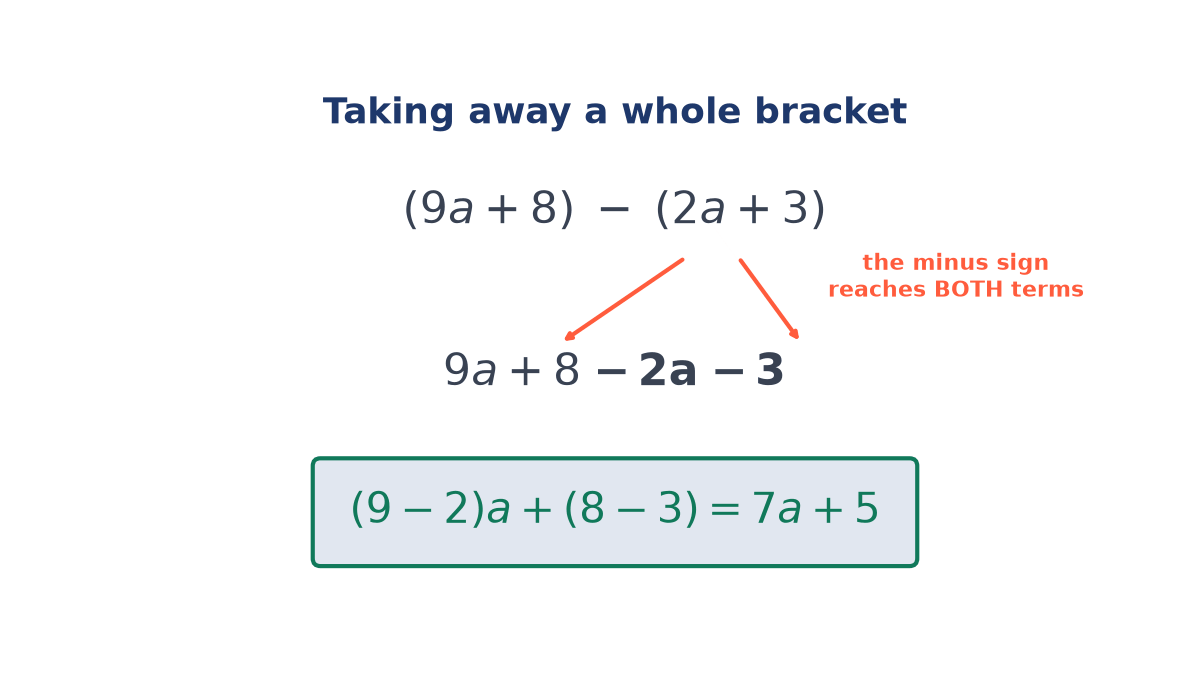
Now here's the key idea. A minus sign in front of a bracket is really a sitting outside it.
That multiplies every term inside, just like any other number outside a bracket, and times a positive term gives a negative one. So is : every sign inside flips over.
This is the trickiest step in the whole topic, so build a safe habit: always write the brackets in first.
Subtract from
Look at step two. The turned into when the bracket came off.
Forget that flip and you'd add the instead: , giving , which is wrong.
A bracket with a minus sign already inside
Subtract from . This time the bracket holds a minus sign, and it flips to a plus.
Taking away a negative amount is the same as adding it, so became .
Remember. Take away a whole bracket and every sign inside it changes. A plus becomes a minus, and a minus becomes a plus.
Letters that stand for whole expressions
A capital letter can stand for a whole expression. might mean , all of it, like a nickname for a long name.
The chapter asks you to find and . We'll use these two: and .
Put the expression in place of each capital letter, keeping the brackets while you do it. Putting an expression in place of a letter like this is called substitution.
Find
The outside the second bracket reached both terms inside, and the minus sign flipped both of them.
The next one needs two small sums first. In the letters give lots of and lots of .
In they give lots of and lot of .
Find
Did you spot it? The answer is just doubled.
That's no accident. The second bracket held , and taking away adds back. So there is one from the first bracket and one more from the second, and two lots of make .
Meanwhile the first bracket gave and the second gave . A term and the same term with a minus sign make nothing, so the two lots of cancelled out.
This works for any and any you choose, which is rather neat.
Subtracting in columns
Now take away from .
The bottom row is the whole expression you are taking away, which is the same as a bracket with a minus sign in front. So change the sign of every term in that row, then add down.
| Row | column | column |
|---|---|---|
| Start with | ||
| Take away , signs changed | ||
| Add each column |
In the column, . In the column, .
The answer is .
Changing the signs first is the very same flip as before; the columns simply keep it tidy.
Practice
Try these, and remember to write the brackets in first on every subtraction.
- Add and .
- Add and .
- Add and . Use the vertical method.
- Subtract from .
- Subtract from .
- Subtract from .
- Add and .
- With and , find .
Remember. Gather like terms, add or subtract their numbers, and leave unlike terms alone. Off comes the bracket, over go the signs.
Common mistakes
- Joining unlike terms, for example writing . The answer stays .
- Changing only the first sign when a bracket is taken away: is , not .
- Reading "subtract from " as . The expression after "from" is written first.
- Leaving a sign behind when terms are moved about. A term and its sign always travel together.
- Forgetting that a letter on its own, such as , has co-efficient .
- In the vertical method, putting a term in the wrong column, or forgetting to change the signs of the bottom row before adding down.
Key terms
- Expression
- Terms joined by plus or minus signs, such as .
- Term
- One part of an expression, together with the sign in front of it.
- Co-efficient
- The number in front of a term; in it is .
- Like terms
- Terms that count the same letter, such as and .
- Unlike terms
- Terms that count different letters, such as and .
- Distributive rule
- : the number outside a bracket multiplies every term inside.
- Substitution
- Putting an expression or number in place of a letter.
Answers
These are the answers to the Practice questions, each checked by working the sum in full.
- , because the terms cancel.
The same answers, with the working in brief:
Answers
| Question | Answer | Question | Answer |
|---|---|---|---|
| , since | , since and | ||
| , since and | , since and | ||
| , since and | , since and | ||
| , since | , since and |