Terms, factors and co-efficients are taught in the Early Years course Introduction to Algebra, so here we'll use them without teaching them again.
As What an algebraic expression is sets out, an algebraic expression is terms joined by plus or minus signs, such as .
The letters in a term are properly called variables, but we'll simply call them letters.
There's just one new number to meet today: the degree.
The degree tells you how "big" an expression grows when its letters grow. It is the first thing you look at when you name an expression: linear expressions have degree , quadratic ones degree , cubic ones degree . You will use it when you solve equations, draw graphs and divide polynomials in later classes.
The degree of a monomial
A power counts how many times a letter is multiplied; in the power is .
A monomial is an expression with only one term, and every power in it must be a whole number (, , and so on).
So is not a monomial, because the letter sits under a division line, and that is not a whole-number power. is not a monomial either, since a root sign means the power .
, on the other hand, is a monomial: one term, with both powers whole numbers.
That rule matters, because it is why every degree you'll meet here is a whole number.
Now look at . The letter appears twice and the letter appears once, so the term means : three letters multiplied together.
Count those letters and you get . So the degree of is .
Degree of
Adding the powers does that counting for you, and honestly, that is the whole rule.
Now take , where neither letter shows a power. A letter on its own means the power , so means , one multiplied once. Both powers are .
Degree of
Take . The powers are , and .
Degree of
Take . The powers are , and .
Degree of
Here's something students often trip on: the number in front never changes the degree. In the is the co-efficient of . It isn't a letter, so it adds nothing, and the degree of is still .
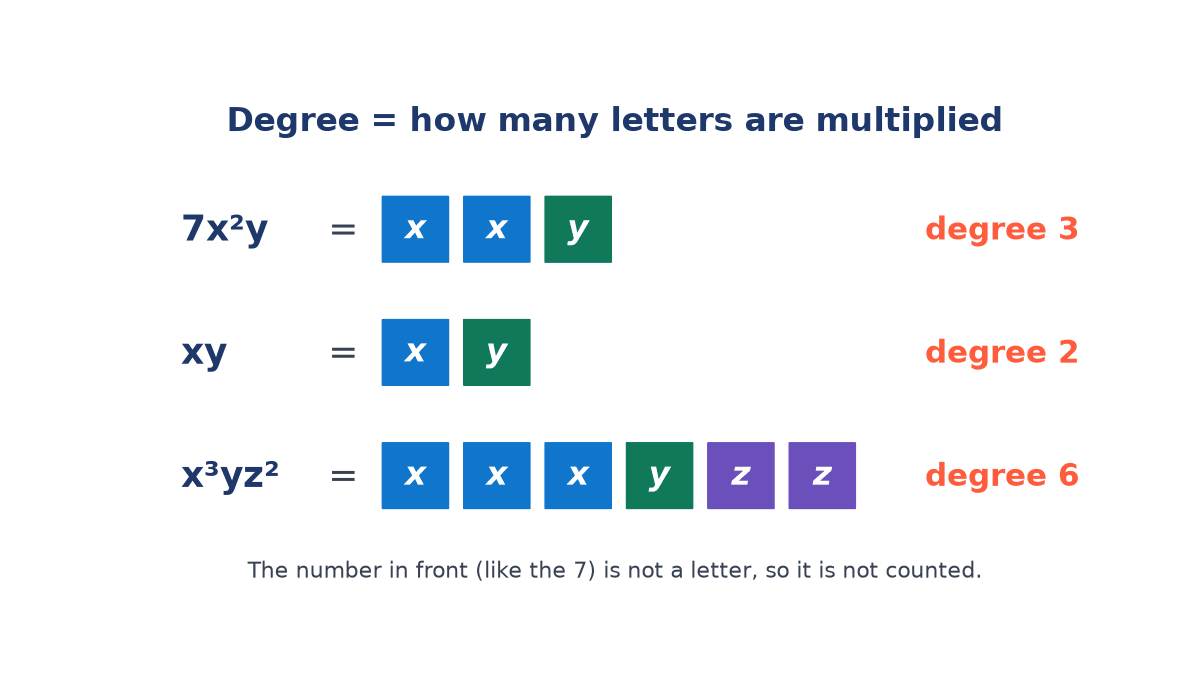
One more worked example. Find the degree of . Step 1: ignore the , which is the co-efficient. Step 2: the powers are , and . Step 3: add them.
So the degree is . The minus sign in front changes nothing either, because it belongs to the number.
Remember. To find the degree of a monomial, add the powers of its letters. Leave the number in front out.
Why the degree of is
A plain number holds no letters at all. Surprisingly, you can still write one with a letter in it. First look at .
Count the powers of downwards, where each step down divides by : , and .
One more step gives , and that step is , which is . So (as long as is some number other than ).
Now , because . The only power in sight is , so the degree of is . Every plain number works the same way.
Why the degree of is undefined
Zero, as usual, behaves differently. Look at , and at as well.
You may write with any power you like and the answer stays each time. But a degree has to be one fixed number for a term, and here every number works equally well, so there's no way to choose.
That is why the degree of is undefined.
Remember. The degree of is . The degree of is undefined.
| Monomial | Powers | Degree |
|---|---|---|
| , , | ||
| , | ||
| , | ||
| , , | ||
| none | ||
| every power gives | undefined |
The degree of a polynomial
A polynomial is an expression containing one or more monomials, so even a single monomial such as counts as a polynomial.
Two monomials make a binomial and three make a trinomial; you met those names with the types of expressions.
Take the polynomial . Its terms are joined by signs, and each term has its own degree, so work those out first.
| Term | Powers | Degree |
|---|---|---|
| , | ||
| , | ||
| , | ||
| none |
Now just pick the greatest of those four degrees.
Greatest of the four term degrees
So the degree of that polynomial is . In general, the greatest degree among the terms is the degree of the polynomial.
Why the greatest, and not, say, the total? Try making every letter large at the same time. Put and into the four terms.
| Term | Value at and |
|---|---|
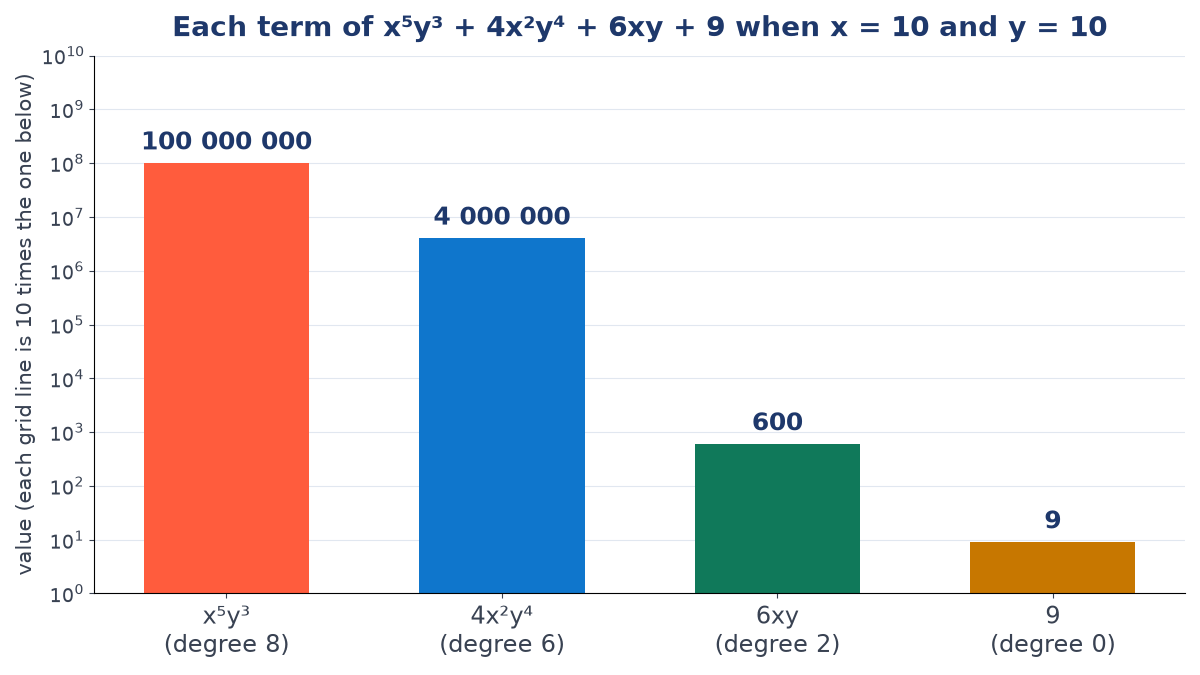
The degree term is times the next one; it towers over the other three like a tall building over small shops. Make both letters larger still and that gap only grows.
Be careful, though: change only one letter and this can fail. Hold at and let grow to . The first term is then and the second is , so the degree term is the larger one there.
That's because the degree adds up all the powers of a term, which makes it the right measure when the letters grow together.
The terms may be written in any order without changing the degree. You are hunting for the biggest one, not the first one.
Remember. Find the degree of every term. The largest of them is the degree of the polynomial.
Two more polynomials
Example A. Find the degree of . The terms have degrees , and . The greatest is , so this is a polynomial of degree . Notice the biggest term was written last.
Example B. Find the degree of .
| Term | Powers | Degree |
|---|---|---|
| , | ||
| , , | ||
| none |
The greatest of , and is . So the degree is . The minus sign in front of the second term does not matter.
One caution: join any like terms first. In the two terms cancel, leaving . Its degree is , not .
Practice
- Find the degree of .
- Find the degree of .
- Find the degree of .
- Find the degree of .
- Is a monomial? Give your reason.
- Find the degree of .
- Find the degree of .
| Question | Answer | Question | Answer |
|---|---|---|---|
| no, the letter is under a division line, so its power is not a whole number | |||
| term degrees are , and , so the answer is | |||
| , and the is ignored | term degrees are , and , so the answer is | ||
| , because a plain number has no letters |
Common mistakes
- Counting the co-efficient. The degree of is , not .
- Forgetting that a bare letter has power . The degree of is , not .
- Multiplying the powers instead of adding them. has degree , not .
- Adding the degrees of all the terms of a polynomial. Take the greatest one instead.
- Taking the degree of the first term written. The largest term may be anywhere.
- Saying the degree of is . It is undefined; only non-zero numbers have degree .
Key terms
- Power
- The small raised number that counts how many times a letter is multiplied.
- Monomial
- An expression with one term, in which every power is a whole number.
- Degree of a monomial
- The sum of the powers of its letters.
- Polynomial
- An expression containing one or more monomials.
- Degree of a polynomial
- The greatest degree among its terms.
- Co-efficient
- The number in front of the letters; it never changes the degree.
- Constant
- A plain number; a non-zero constant has degree .
Answers
Show answers
- : .
- : .
- : ; the is ignored.
- : degree , because it is a non-zero plain number.
- No. is ; the letter is under a division line, so its power is not a whole number.
- Term degrees , and ; the degree is .
- Term degrees , and ; the degree is .