Formulas are everywhere: the perimeter of a rectangle, the cost of several notebooks, the distance travelled in a given time. Each formula is written with letters so that it works for every case. The moment you have an actual rectangle or an actual journey, you put its numbers in place of the letters and work out the answer. That step is called substitution, and it is one of the most used skills in all of algebra.
A letter in algebra stands for a number, and substitution simply means putting that number back in.
The chapter says it in older words: replacing numerical values in the place of literal numbers. (Literal numbers is just an old name for the letters.)
A letter used this way is a variable, which you met in the Early Years course "Introduction to Algebra".
Remember. To substitute is to swap each letter for the number it stands for.
Why this matters
An expression is letters and numbers joined by signs like , and , with no equals sign in it.
An expression like is not an answer; it is a recipe for finding one. It says: take and multiply it by .
You can't follow that recipe while is still a letter. Give a value, though, and the rule can run, turning the expression into one plain number.
That is the beauty of it. Write once and it works for , for , and for any value you choose.
One letter, one step
Find the value of when
You wrote where used to be, and then you did the multiplying.
Notice that the multiplication sign is hiding in . Writing brings it back into view. Miss it and you might write by mistake, which happens more often than you'd think.
One letter, two steps
Find the value of when
Here became , then gave , and finally gave .
Multiplying is always done before adding. That order is fixed, so that everyone reading your working gets the same answer.
Suppose you added first: is , and is . That answer is wrong.
The trap: is not
This one catches a lot of students, so read slowly. means . It does not mean . The small counts how many values are multiplied together.
is called a power, and it's the small raised number that makes it one.
Find the value of when
Find the value of when
Same letter, same value, and two very different answers.
| Expression | What it means | Value when |
|---|---|---|
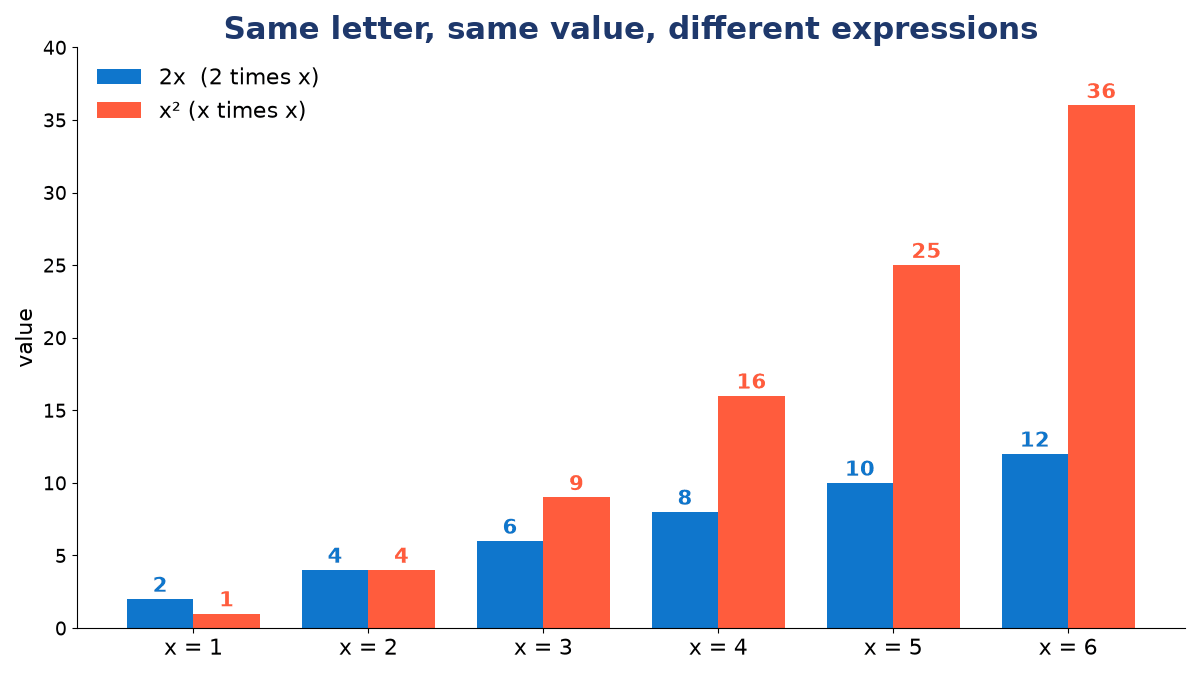
The chart shows why the two must never be confused. At they happen to agree, because and are both . For every larger value, is bigger, and the gap keeps growing.
Remember. A small raised number tells you how many of the letter are multiplied together. A number in front tells you what to multiply the letter by.
When a power sits inside a longer expression, you work it out first.
Find the value of when
The power came first: gave , and only then did the go on.
Find the value of when
Only the is squared, not the . If the whole of were meant to be squared, it would be written , and that is .
More than one letter
Find the value of when and
Both multiplications came first, and then the two results were added.
An expression can hold two letters or more, each with its own value. Swap them all in, then simplify, which means working it out until one number is left.
Find the value of when and
A formula: the perimeter of a rectangle
The perimeter of a rectangle is , where is the length and is the breadth. Find when cm and cm.
So the perimeter is 22 cm. Notice the bracket was worked out first, then the multiplying.
When the value is negative
When the value is negative, the minus sign is very easy to lose. Brackets keep it where it belongs.
Find the value of when
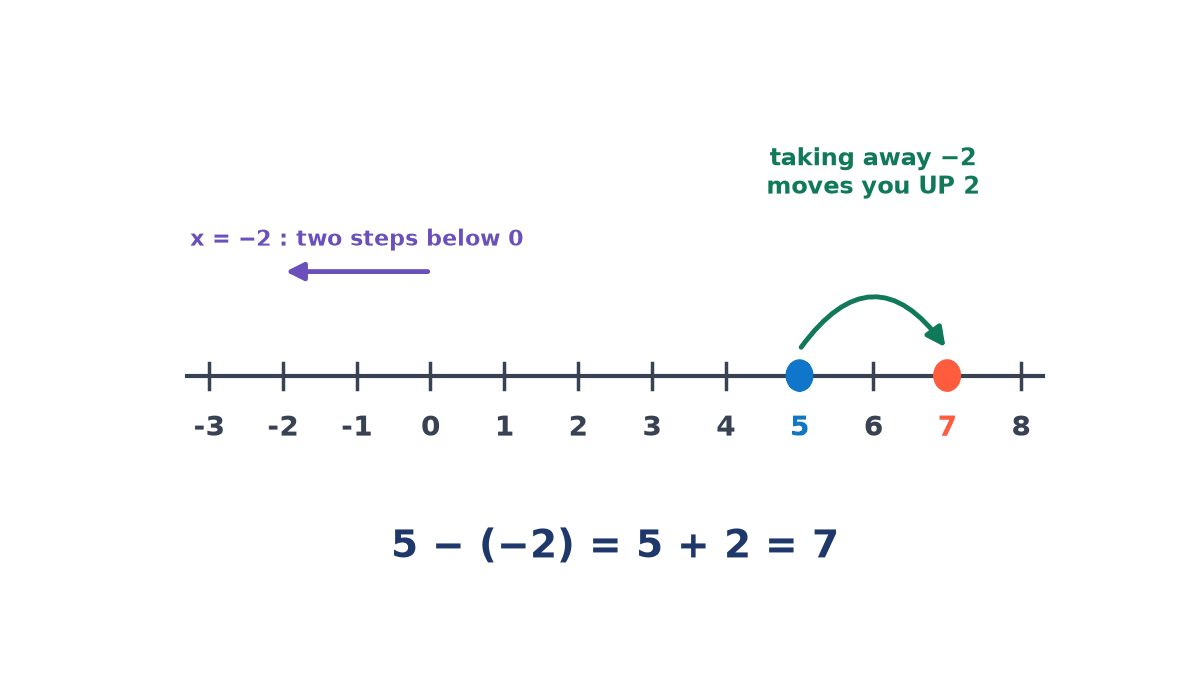
Write in the place of , brackets and all. The expression takes away from .
Taking away means moving down the number line, and adding means moving up. Now sits two steps below zero, and taking away something below zero pushes you back up. That is why is and not .
Without brackets you'd be writing two minus signs side by side, which is easy to misread. The brackets hold the minus sign firmly onto its own number.
Find the value of when and
Find the value of when and
A negative number times a negative number is positive, so . Without the brackets, would be read as , which is a different number.
Remember. Always put brackets round a negative value when you substitute it.
The safe order
Substitute first, simplify second. Trying to do both at once is exactly how the hidden multiplication sign gets lost, and turns into .
- Copy the expression out.
- Replace each letter with its value. Use brackets round any negative value.
- Put back the multiplication signs that were hidden.
- Simplify: brackets first, then powers, then multiplying, then adding and taking away.
- Check that no letter is left. A letter left behind means you missed one.
Step five is well worth the few seconds it takes, because a letter is easy to miss in a long expression.
Practice
- Find the value of when .
- Find the value of when .
- Find the value of when .
- Find the value of when and .
- Find the value of when .
- Find the value of when .
| Question | Answer | Question | Answer |
|---|---|---|---|
| when | when , | ||
| when | when | ||
| when | when |
Common mistakes
- Writing the digits side by side. with is , not .
- Reading as . With , but .
- Adding before multiplying. with is , not .
- Dropping the brackets round a negative value. with is , not .
- Squaring the number in front. with is , not .
- Leaving a letter behind. In both letters need their values before you simplify.
Key terms
- Variable
- A letter that stands for a number, such as .
- Literal number
- An older name for a letter used in place of a number.
- Expression
- Letters and numbers joined by signs such as and , with no equals sign.
- Substitute
- Swap each letter for the number it stands for.
- Simplify
- Work the expression out until one number is left.
- Power
- A number or letter with a small raised number, such as , meaning .
- Formula
- A rule written with letters, such as , that works for every value.