What this lesson is about
Multiplying expressions is the step that turns a formula with brackets into one you can work with. You use it to find the area of a rectangle whose sides are written in letters, to open up brackets in an equation before solving it, and later to factorise quadratics in Class 9 and 10. The rules are the ones you already use for numbers; only the numbers have been replaced by letters.
You already know how to add and take away expressions, so now it's time to multiply them.
First, a quick refresher. An expression is a piece of algebra made of numbers and letters, such as .
A term is one piece of an expression, as Introduction to Algebra sets out: a number on its own, a letter on its own, or numbers and letters joined by multiplying or dividing. A plus or a minus sign is what separates one term from the next. has two terms.
A factor is one of the things being multiplied. In , the factors are and .
Like terms have exactly the same letters: and are like terms, but and are not.
You met term, factor and like terms in the Early Years course Introduction to Algebra, so treat the lines above as a reminder.
Relax, nothing new is being invented here. A letter stands for a number you don't know yet, so letters follow exactly the same multiplication rules as numbers.
The product is simply the answer you get when you multiply.
There are three kinds of multiplication to learn. Here's a first look at each one; the rest of the page shows why each is true.
The names for these expressions
The three kinds are named after the parts you multiply, so here are the names you'll need.
| Name | What it is | Example |
|---|---|---|
| Monomial | One term. Every power of a letter is a whole number that is not negative. | |
| Binomial | Two monomials. | |
| Trinomial | Three monomials. | |
| Polynomial | One or more monomials. | and |
| Multinomial | One or more terms. |
One monomial is enough to make a polynomial, so is a monomial and a polynomial at the same time.
A multinomial only asks for terms, and its powers may be anything at all. So is a multinomial, but not a polynomial, because the power is negative.
Remember. Every polynomial is a multinomial. Not every multinomial is a polynomial.
Multiplying one term by one term
and are monomials: each has one term, and no power is negative.
Remember that really means ; the multiplication sign is just hidden to save writing. So means .
You may multiply numbers in any order, since and both give . A letter stands for a number, so letters may be moved around too. Bring the numbers together, and the letters together.
Multiply by
Remember. Multiply the numbers first. Write the letters after the number.
When the same letter is in both parts
means , and means . The small raised number is called the power, and it tells you how many of that letter are multiplied together.
Multiply by and you have two , then three more : five multiplied together. Since , .
You add the powers because you are counting factors. You are not multiplying the powers, however tempting that looks.
A letter with no power written has power , so means .
Multiply by
Remember. Add the powers of a repeated letter. , so .
A monomial with a minus sign
Signs follow the number rules: a negative times a positive is negative. Multiply by .
The has power , so . The appears only once, so it is simply written after the .
Multiplying one term by a whole expression
Now the second part has more than one term. has two terms, so it is a binomial.
Let's test the rule with plain numbers first. is , which is . Now share the out instead: . The two answers match.
This rule is written as . It works because lots of means lots of , plus lots of . Think of buying a few plates of idli-vada: you get that many idlis and that many vadas.
Multiply by
gives , because the powers of add and .
Remember. Every term inside the bracket must be multiplied. Miss one and the answer is wrong.
One term by a three-term expression
The rule stretches to any number of terms in the bracket. Multiply by .
Three terms inside the bracket give three terms in the answer. Keep each sign glued to the term that follows it.
Multiplying a whole expression by a whole expression
Now both parts have more than one term, and every term of the first must be multiplied by every term of the second.
This is exactly where marks get lost in exams, because one pair gets missed.
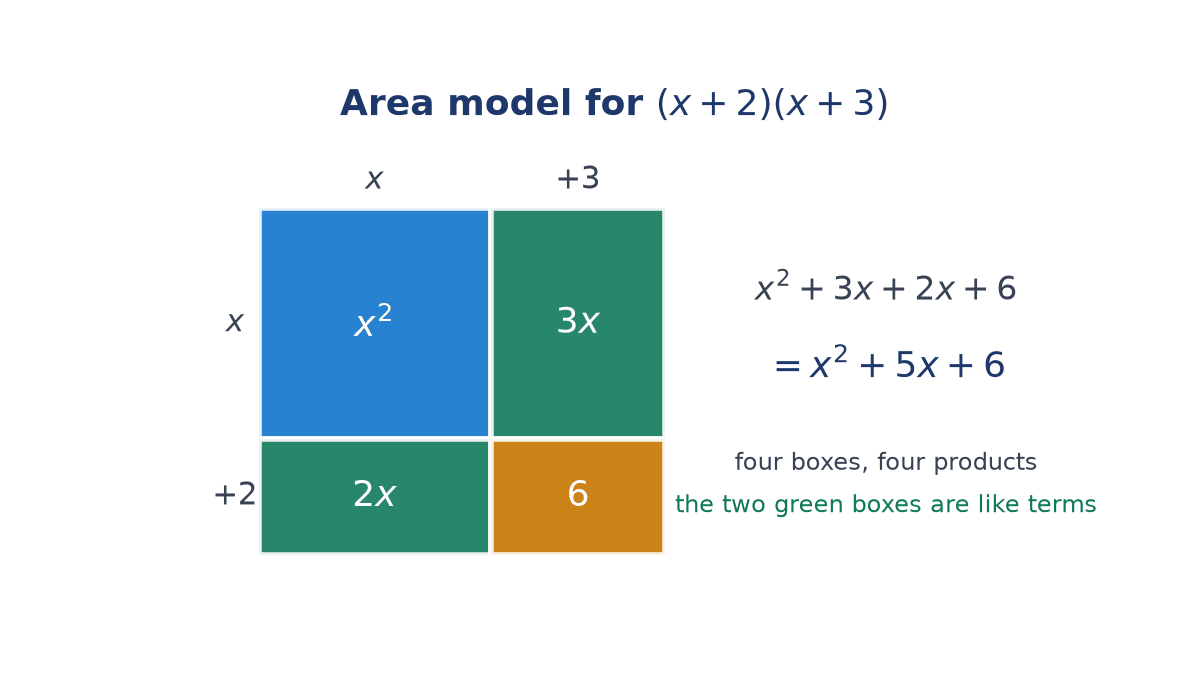
A grid stops that from happening. Put one expression across the top and the other down the side.
Two terms across the top and two down the side make boxes. Each box holds one product, so nothing can hide.
Find the product
and are like terms, and , so together they make . The answer has three terms, so it is a trinomial.
A product with a minus sign
Find . Treat as a term with its sign. The four products are , , and .
The like terms and combine to , because .
Two worked simplifications
In both of these, open the brackets first and then collect the like terms.
Simplify
and are like terms with opposite signs. Take away from and nothing is left, so they vanish.
and are like terms as well, and together they make .
Simplify
and are like terms, so they make . and have no partner, so they stay just as they are.
The order of work
- Multiply every term by every term.
- Multiply the numbers first.
- Then write the letters after the number.
- Add the powers of any letter that appears twice.
- Collect the like terms at the end.
Remember. Collect like terms last. Do all the multiplying first.
Practice
| 1) | 4) | 7) |
| 2) | 5) | 8) |
| 3) | 6) | 9) |
| Question | Answer | Question | Answer |
|---|---|---|---|
Now try three longer ones. Open the brackets, then collect, just as before.
- Simplify
- Simplify
- Find the product
| Question | Answer | Question | Answer |
|---|---|---|---|
| Simplify | Find the product | ||
| Simplify |
Common mistakes
- Multiplying the powers instead of adding them: is , not .
- Multiplying only the first term in the bracket: is , not .
- Missing a pair when both parts have two terms. Use the grid so that all four products are written down.
- Losing a minus sign. In , the product is .
- Adding unlike terms: and cannot be combined, because the letter parts differ.
- Collecting like terms before all the multiplying is finished.
Key terms
- Term
- A number, a letter, or numbers and letters joined by multiplying or dividing; terms are separated by plus and minus signs.
- Like terms
- Terms with exactly the same letters raised to the same powers, such as and .
- Power
- The small raised number that tells how many times a letter is multiplied by itself.
- Product
- The answer to a multiplication.
- Monomial
- An expression of one term in which every power of a letter is a whole number.
- Binomial
- An expression of two monomials, such as .
- Distributive law
- The rule : a factor outside a bracket multiplies every term inside.