In winter the news may say that the temperature in Leh fell to degrees. A lift in a mall may show floor for the car park. A bank passbook may show money going out. All of these use numbers that sit below zero. Together with the counting numbers and zero, they make a family called the integers.
Some numbers are smaller than nothing at all. Think of a very cold day, or a floor below the ground. Numbers like these carry a minus sign. On this page you will learn what they are called and how to put them in order.
Why numbers go below zero
Counting goes up from . Zero is the point you start from. But some things go past zero. Water freezes at degrees. A day can be colder than that. Counting numbers cannot say how cold. So maths keeps numbers on the other side of zero. Each one is written with a minus sign in front.
The set of integers
All those numbers make one family. In maths a family of numbers like this is called a set. The set of them is called the integers. It is written with the letter , like this.
Remember. The set of integers is .
Read that line like this. is the name of the set. The curly brackets hold the numbers in it. Zero sits in the middle of them. The numbers below zero are on its left. The numbers above zero are on its right.
There are dots at both ends of the list. They are not a mistake. They mean the list carries on. Go right and , , come next. Go left and , , come next. Neither end ever stops. So there is no biggest integer. There is no smallest one either.
Positive, negative and zero
A number below zero is called a negative number. It is written with a minus sign in front. A number above zero is called a positive number. So the minus sign tells you which side a number is on.
| Kind | Some of them | Where they sit |
|---|---|---|
| Positive integers | , , , | to the right of zero |
| Negative integers | , , , | to the left of zero |
| Zero | in the middle |
Zero is not above zero. It is not below zero either. So it is neither positive nor negative. It is the point the two sides start from. Think of it as the ground floor.
The minus sign in front is part of the number. is one number on its own. It is not a sum waiting to be done. Here the minus sign does not mean take away. It means the number is below zero. You can read as minus three. You can also read it as three below zero.
The number line
A number line is a straight line with the integers marked on it. Zero is marked in the middle. The positive integers go to the right of zero. The negative integers go to the left. The marks are the same distance apart. Every gap is the same size, so every step is worth . That is true wherever you are on the line.
So the marks read , , , , , from left to right. Move to the right and the number goes up. Move to the left and it goes down.
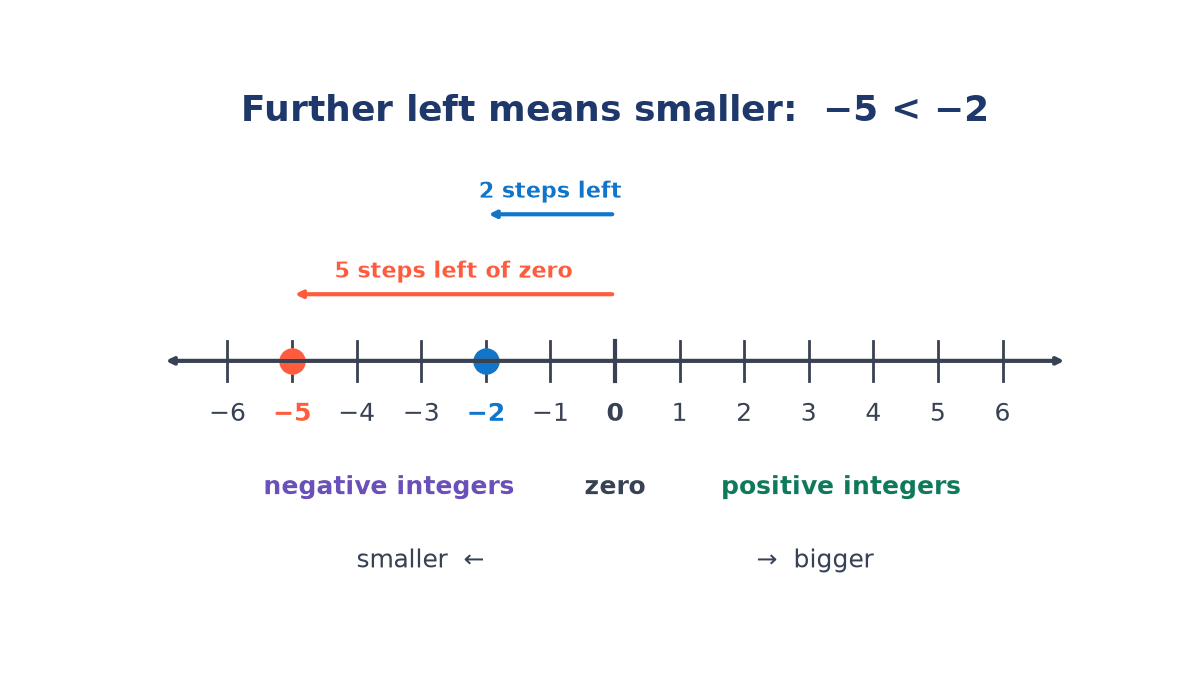
The picture below shows a number line from to . The arrowheads at both ends remind you that the line goes on for ever in both directions, just like the dots in the set .
| A move on the line | What happens to the number |
|---|---|
| One step to the right | it goes up by |
| One step to the left | it goes down by |
| Two steps to the right | it goes up by |
| Two steps to the left | it goes down by |
Put your finger on a mark and try it. Here are two starting points.
| Start at | One step right lands on | One step left lands on |
|---|---|---|
Remember. The negative integers are on the left. Zero is in the middle. The positive integers are on the right.
Which integer is smaller
The number line puts every integer in order. The order runs from left to right. The number further left is the smaller one. The number further right is the bigger one. That rule works for every pair.
It helps to count the steps from zero. To do that, forget the minus sign. Then count the marks back to zero. is five steps. is two steps.
This next one looks wrong at first. is smaller than . After all, is bigger than . So look at the line again. is five steps left of zero. is only two steps left. is further left. That makes the smaller number.
| Integer | Steps from zero | Which side |
|---|---|---|
| left | ||
| left |
The bigger the number after the minus sign, the further left it sits. Further left means smaller. So a big-looking negative number is a small number.
Remember. Further left on the line means smaller. So is smaller than .
A thermometer works the same way
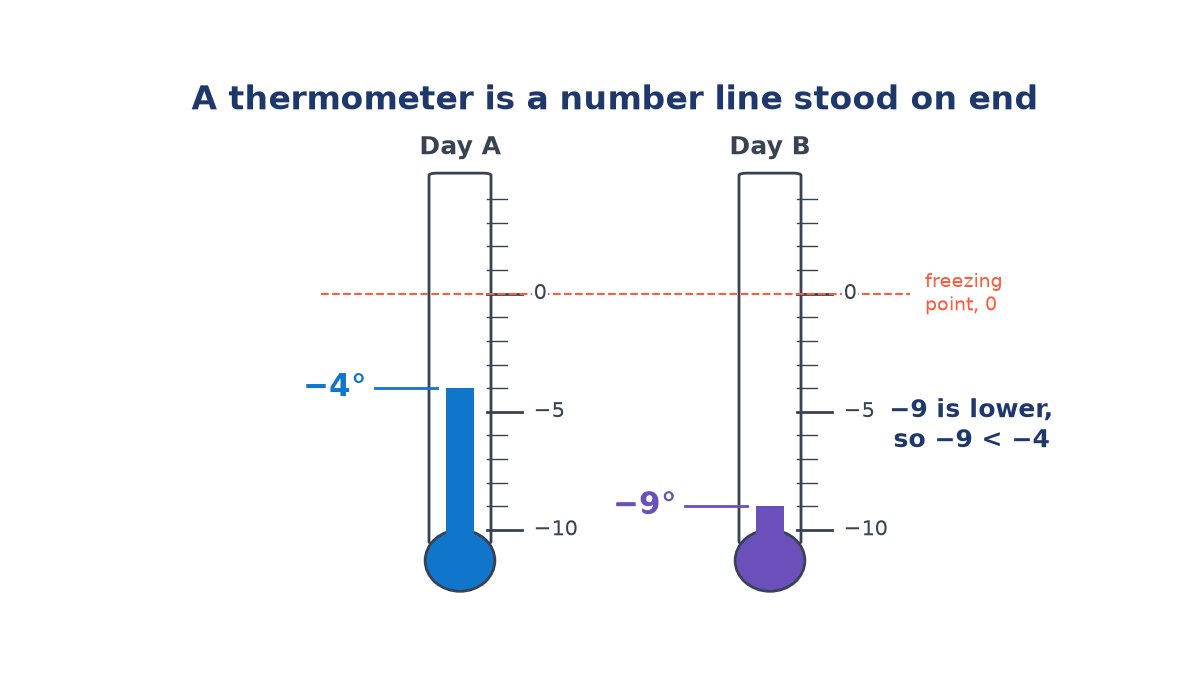
A thermometer is a number line stood on end. Zero is the freezing point. Warm days are above zero. Cold days are below it. A day at degrees is colder than a day at degrees. Colder means lower down the thermometer. Lower means smaller. So is smaller than .
Floors below the ground
Some buildings have floors below the ground. The ground floor is floor . One floor down is floor . Three floors down is floor . Floor is lower than floor . So is smaller than .
Comparing any two integers
Each rule below is just the line read from left to right.
- A positive integer is always bigger than a negative one. It sits on the other side of zero.
- Zero is bigger than every negative integer. Every negative integer sits to its left.
- Zero is smaller than every positive integer. Every positive integer sits to its right.
- Take two negative integers. The one further from zero is the smaller one.
- Take two positive integers. The one further from zero is the bigger one.
| The pair | The smaller one | Why |
|---|---|---|
| and | it sits to the left of zero | |
| and | zero is bigger than any negative number | |
| and | it is further to the left | |
| and | it is nearer to zero on the right |
Worked examples
Put , , , in order, smallest first.
First pick out the negative numbers: and . They come before zero. is further from zero, so it comes first. Then comes zero, and then the positive number .
Start at and move five steps to the left. Where do you land?
Count the steps one at a time: , , , , . You land on . Notice that you crossed zero on the way. Two of the steps took you down to zero, and the other three took you below it.
A diver is metres below the sea. A bird is metres above it. Write both as integers.
Take sea level as zero. Below the sea is negative, so the diver is at . Above the sea is positive, so the bird is at . The diver is lower, so .
Your turn
Which of the two is smaller
Copy each pair into your book. Write down the smaller number of the two. Picture the line if a pair is hard.
| 1) | 5) |
| 2) | 6) |
| 3) | 7) |
| 4) | 8) |
Answer these in words
Show answers
- Put these in order, smallest first: , , , , .
- Put these in order, smallest first: , , .
- Which integer is one step to the left of ?
- Which integer is one step to the right of ?
- Which is colder, degrees or degrees?
- A lift is on floor . It goes down two floors. Which floor is it on now?
- Write down the three integers that come just before on the line.
- Which is the smallest number here: , , , ?
- Which is bigger, or ?
Common mistakes
- Thinking is bigger than because is bigger than . With negative numbers, the bigger the number after the sign, the smaller the integer.
- Calling zero positive or negative. Zero is neither.
- Reading the minus sign in as "take away". Here it tells you the number is below zero.
- Counting the starting mark as a step when moving along the line.
- Leaving out zero when putting integers in order.
- Drawing the marks on a number line at uneven gaps. Every step must be the same size.
Key terms
- Integer
- Any of the numbers
- Set
- A family of numbers taken together; the set of integers is called .
- Positive integer
- An integer above zero, to the right of zero on the line.
- Negative integer
- An integer below zero, written with a minus sign and placed to the left of zero.
- Zero
- The middle of the number line; neither positive nor negative.
- Number line
- A straight line with the integers marked at equal steps.
- Smaller and bigger
- On the number line, further left is smaller and further right is bigger.
Answers
Answers to the pairs
| Question | Answer | Question | Answer |
|---|---|---|---|
Answers to the questions in words
- degrees is colder.
- Floor .
- is bigger.