The temperature in Leh is degrees in the afternoon and degrees at night. How much did it drop? A shopkeeper owes ₹7 and the debt is cancelled. How much better off is he? Both questions are subtractions with integers. You will learn to do them on a number line, and you will see why taking away a negative number turns into adding.
Subtracting means taking one number away from another.
Integers are the whole numbers. They go up from zero. They go down past zero too. Half numbers are not integers.
Numbers below zero are called negative numbers. You write a minus sign in front of them, like . Numbers above zero are called positive.
With integers the number you take away can be negative. That is the only new part here.
Taking away moves you left
Picture a number line. It is a straight line with the numbers written along it in order. Small ones sit on the left. Big ones sit on the right.
Adding moves you to the right. Taking away moves you to the left.
The integers carry on both ways:
Start at and take away . You move three steps left. You land on . So .
You can start below zero too. Start at and take away . You move three steps left again. You land on . So .
You can also cross zero on the way. Start at and take away . Two steps left take you to . Four more take you to . So .
Read the words in the right order
A question might be written like this: Subtract from .
The number after the word from is the one you start with. So you start at . You write . The answer is .
Remember. Subtract from means . The number after from comes first.
It is easy to write this the wrong way round. is . But is . The two are not the same. Check the order every time.
Why taking away a negative adds
Sometimes you take away a negative number. Then two minus signs sit side by side. Take away from and you write .
Here is why they turn into a plus. Face along the number line. Adding walks you to the right. Taking away turns you round first. So you walk to the left.
A minus sign in front of a number means the other way. Walking means seven steps right. Walking means the same seven steps, but the other way. So you turn round.
Taking away turns you twice. Two turns leave you facing right again. So you walk seven steps right.
This is not the same as . There the two minus signs are apart. Each one is a walk to the left, and the answer is . Here the minus sign sits straight in front of a negative number. That is what turns you round twice.
Money gives the same answer. Think of as a debt: seven rupees you owe someone. Take that debt away and you no longer owe it. So you are seven rupees better off. You end up with more.
A pattern shows it too. Watch the number you take away go down by one each line, while the answer goes up by one:
The pattern only keeps going if taking away gives one more, just like adding .
Remember. Taking away a negative is the same as adding. .
Worked examples
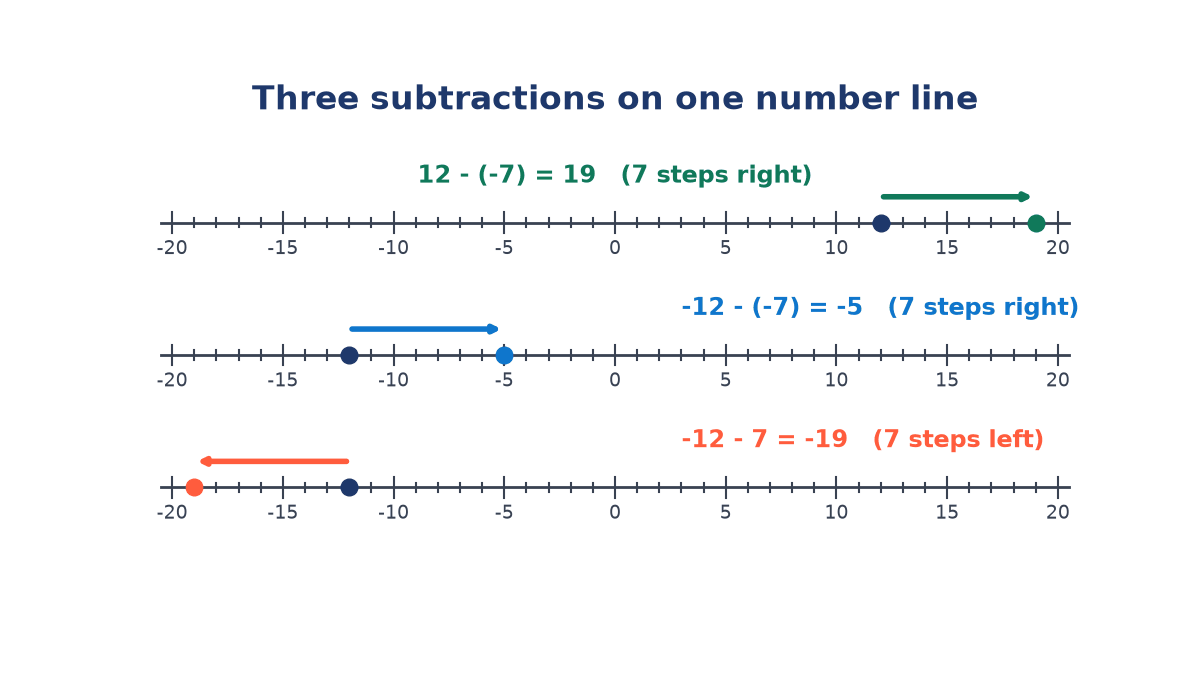
Subtract from
Start at . You take away , so you add . Move seven steps right.
Subtract from
Subtract from
Start at this time. You still add . Move seven steps right from . Seven is less than twelve, so you do not reach zero. The answer stays negative.
Subtract from
Subtract from
Here you take away a plain . The two minus signs are not together here. The first one belongs to the . Only the second one means take away. So start at and move seven steps left.
Subtract from
Subtract from
Start at . Taking away means adding , so walk right. Six steps bring you to . Nine more bring you to .
The temperature in Leh
The drop is the afternoon reading take away the night reading. Subtract from .
The temperature dropped by degrees. Count it on a thermometer: four degrees down to zero, then six more.
| What you are taking away | What to do | Example |
|---|---|---|
| The number you take away is negative | Turn it into adding | |
| The number you take away is positive | Take it away as usual, and move left |
The sign on the number you start at does not change what you do. It only changes where you start.
Look at the order once more. Subtract from gives . The wrong way round is . That gives . Swapping the two numbers gives the same distance. But you walk it the other way. So you get the same number with the other sign.
Your turn
Work these out on a number line. Say the start number out loud first. That is the one that catches people out. Saying it fixes it in your head before you begin.
When the numbers get big, you do not have to count every step. Work out where you start. Work out which way you are going. Then do the take-away or the adding in your head. The number line is there to tell you which way to go.
- Subtract from .
- Subtract from .
- Subtract from .
- Subtract from .
- Subtract from .
- Subtract from .
Each answer below shows the sum written the right way round. It also shows the number you land on.
| Question | Answer | Question | Answer |
|---|---|---|---|
Now try these. Some have two minus signs together. Some do not. Look at each one before you start.
| 1) | 4) | 7) |
| 2) | 5) | 8) |
| 3) | 6) | 9) |
| Question | Answer | Question | Answer | Question | Answer |
|---|---|---|---|---|---|
Remember. Taking away a positive number moves you left. Taking away a negative number moves you right.
Common mistakes
- Writing "subtract from " as . The number after "from" always comes first.
- Turning every pair of minus signs into a plus. Only a minus sign straight in front of a negative number does that: , not .
- Walking the wrong way. Taking away a negative walks right; taking away a positive walks left.
- Dropping the sign of the answer when you cross zero, as in .
- Thinking a number take away itself is anything but zero, even when it is negative: .
Key terms
- Integer
- A whole number, zero, or a whole number below zero, such as , or .
- Negative number
- A number below zero, written with a minus sign in front.
- Positive number
- A number above zero.
- Number line
- A straight line with the integers marked in order, small on the left and big on the right.
- Subtraction
- Taking one number away from another; on a number line it is a walk to the left.
- Debt
- Money you owe, which can be thought of as a negative amount.
Answers
First set:
Second set: