Integers turn up whenever something can go below zero: a temperature of degrees in Leh, a bank balance that has gone overdrawn, or a lift that goes down three floors. Multiplying integers answers questions like "the temperature fell degrees every hour for hours; how much did it change?" The size of the answer comes from your times tables. The only new thing is the sign, and you are going to see exactly where the sign rule comes from.
Integers are the whole numbers. They are the ones above zero, the ones below zero, and zero itself: There are no halves or bits among them.
A number with a minus in front, like , is called a negative number. It sits below . A number with no minus, like , is called a positive number. It sits above .
You have already added integers, and you know that . Multiplying comes next. The rule for the sign is short, and it is not magic. Here is the rule, and here is why it is true.
Multiplying is adding again and again
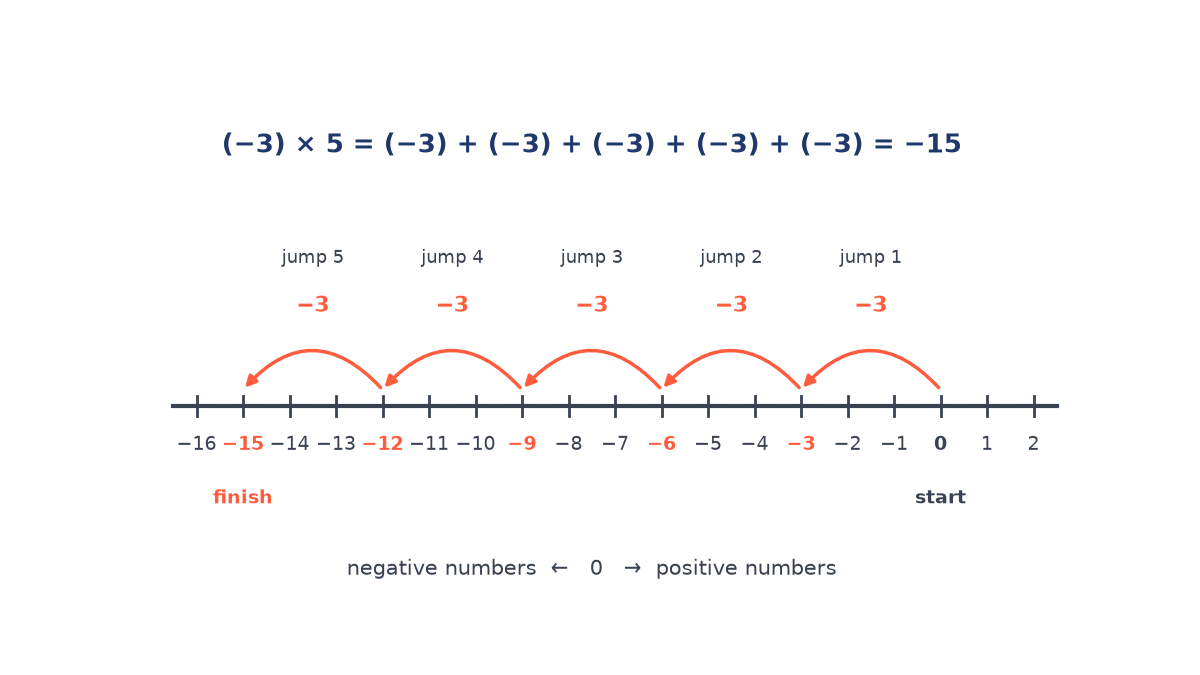
means added five times. That is . You can add a negative number again and again too. means added five times.
Think of a number line. It is the numbers written out in a row. Zero sits in the middle. The positive numbers go to the right of it. The negative numbers go to the left.
Start at on that line. Each step takes you down . After five steps you are at . So a negative number times a positive one gives a negative answer.
gives too. Picture three rows of five counters. Now picture five rows of three counters. Both hold the same number of counters. So turning a multiplication round does not change the answer.
Why two negative numbers give a positive answer
Adding again and again cannot help you here. You cannot add a number times. So look at a pattern instead.
Keep the first number as . Let the second number drop by each line.
The second number drops by each line
Read the answers down the list. They go up by each line. Here is why. Each new line takes away one lot of . Taking away a lot of makes the answer go up by . That is true on every line. The numbers do not change their habits when you pass . So the climb of carries on below zero.
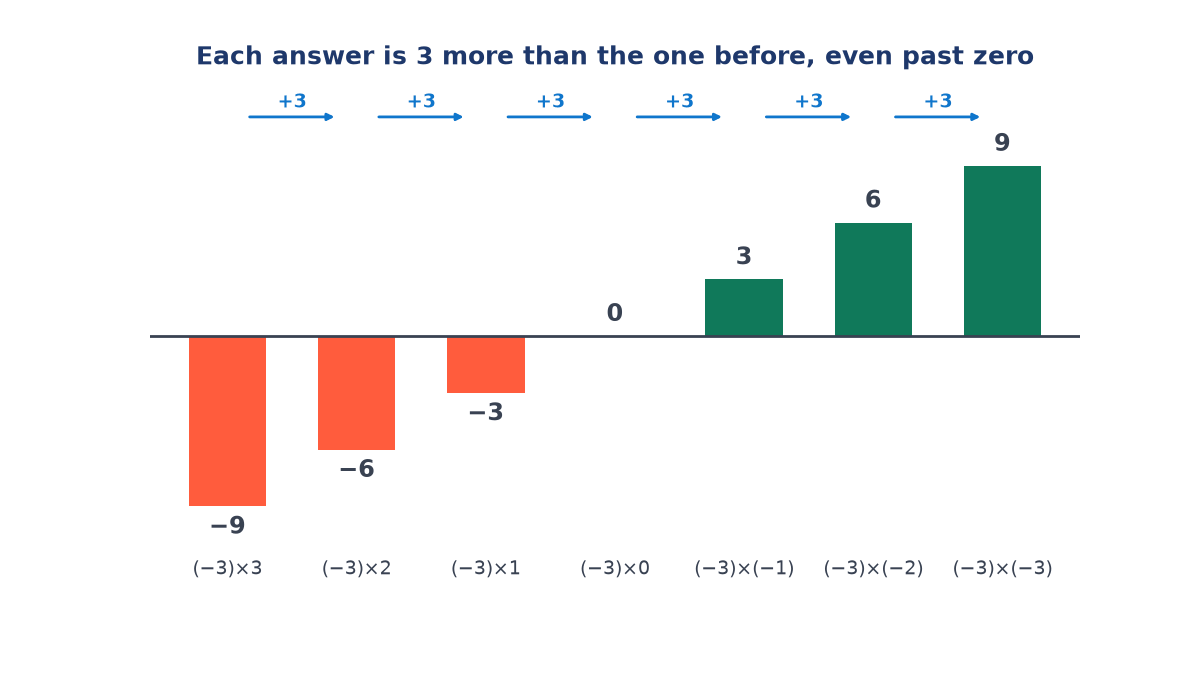
So the line after has to be . That is how you get . Any other answer breaks the climb of . This is why two negative numbers give a positive answer. You do not have to take the rule on trust. The pattern makes it the only choice.
Zero is the odd one out. It is neither positive nor negative. Any number multiplied by zero gives zero. The rule below is for the numbers on either side of zero.
The sign of a number is the minus in front of it, or no minus at all. So has a minus sign, and has none.
Remember. When you multiply two integers, look at the two signs. When the two signs are the same, the answer is positive. When the two signs are different, the answer is negative.
The four cases
| First number | Second number | The two signs | Answer | Example |
|---|---|---|---|---|
| positive | positive | the same | positive | |
| negative | negative | the same | positive | |
| negative | positive | different | negative | |
| positive | negative | different | negative |
Look down the example column. Ignore the minus signs for a moment. Every answer is . Only the sign changes from row to row.
How to work one out
The numerical value of a number is how big it is. You ignore the sign in front of it. So the numerical value of is . The numerical value of is as well.
The table shows the same in every row. Only the sign changes. So you can do the two jobs one at a time. First multiply the numerical values. Then look at the two signs. Take the sign of the answer from the rule.
The two signs are different here. So the answer is negative.
The two signs are the same here. So the answer is positive.
More worked examples
The signs are different, so the answer is negative.
The signs are the same, so the answer is positive.
Three numbers:
Multiply two at a time. Take the first pair, then bring in the third number.
The first pair has the same signs, so it gives . Then and have different signs, so the final answer is negative.
A problem in words
The temperature in a hill town falls by degrees every hour for hours. A fall of is written . The total change is
so the temperature ends degrees lower than it started.
Practice
Work these out. Find the sign first if that helps you.
| 1) | 4) | 7) |
| 2) | 5) | 8) |
| 3) | 6) | 9) |
Answers
| Question | Answer | Question | Answer | Question | Answer |
|---|---|---|---|---|---|
Common mistakes
- Using the adding rule by mistake. , but .
- Thinking two negatives always give a positive, even when adding. The "same signs give positive" rule is for multiplying only.
- Dropping the brackets. Write , not , so the signs are easy to read.
- Getting the size wrong while worrying about the sign. Do the two jobs one at a time: size first, then sign.
- Giving zero a sign. , which is neither positive nor negative.
Key terms
- Integer
- A whole number that may be positive, negative or zero.
- Positive number
- A number above zero, such as .
- Negative number
- A number below zero, written with a minus sign, such as .
- Number line
- The numbers set out in a row, with zero in the middle, positives to the right and negatives to the left.
- Sign
- The minus in front of a number, or no minus at all.
- Numerical value
- How big a number is when you ignore its sign; for it is .
Answers
Show answers
- (same signs, positive)
- (different signs, negative)
- (different signs, negative)
- (same signs, positive)
- (different signs, negative)
- (same signs, positive)
- (different signs, negative)
- (same signs, positive)
- (different signs, negative)