What we are going to do
Integers are everywhere once you look for them. The temperature in Shimla on a winter night can be degrees. A lift can go to basement level . A shopkeeper who spends more than he earns in a day has a loss, which is a negative amount.
Whenever two of these amounts are put together, you are adding integers. We will do it on a number line first. Then you will see two short rules that work for any integers at all.
What integers are
Integers are the numbers you count with, like , and .
Zero is an integer too.
So are the same numbers below zero.
A number below zero has a minus sign in front of it.
There are no halves or bits of numbers among the integers.
A set is a collection of numbers gathered together.
You write the numbers of a set inside curly brackets.
Mathematicians use the letter as a short name for the set of integers.
The set looks like this: .
The dots at each end mean the list carries on for ever.
The number line
A number line puts the integers in order from left to right.
The order runs , , , , , , , .
Zero sits between the two sides.
Numbers to the right of zero are positive.
Numbers to the left of zero are negative.
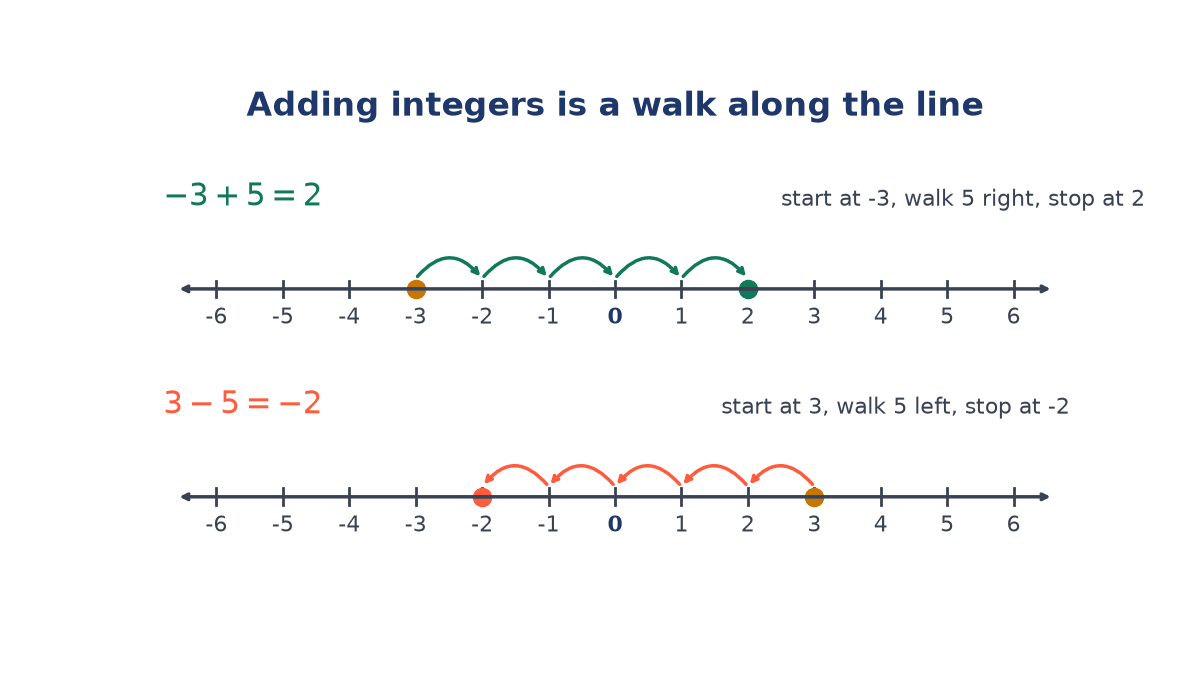
Adding is a walk along this line.
A plus sign tells you to walk right.
A minus sign tells you to walk left.
The number tells you how many steps to take.
The place where you stop is the answer.
Magnitude
Magnitude is a word for the size of a number.
You look at the number and ignore its sign.
The magnitude of is .
The magnitude of is as well.
So and have the same magnitude.
They sit the same distance from zero.
One is on the left and one is on the right.
The magnitude tells you how far you walk.
The sign tells you which way.
The four rules
There are four rules.
Each one is a short walk on the line.
Both signs positive:
Start at .
Walk steps to the right.
You stop at .
Both walks go the same way, so they add up.
Both signs negative:
Start at zero and walk steps left.
Now walk more steps left.
Both walks go the same way again.
So you add and to get steps.
Every step went left, so the answer is .
In this sum the two minus signs do not undo each other.
Each one is one more walk to the left.
Taking away a negative number, as in , is a different thing.
That case comes in the subtraction lesson.
The bracket holds the two step counts.
You walked left and then left, so the bracket is .
The minus sign in front of the bracket is the way you walked.
Different signs:
Start at .
Walk steps to the right.
The first steps bring you back to zero.
You still have steps to take.
Those steps take you past zero, so you stop at .
You walked right and left, so the bracket is .
The walk to the right was the longer one.
So the sign in front of the bracket is a plus.
Different signs:
Start at .
Walk steps to the left.
The first steps bring you to zero.
Two steps are left over.
They carry you past zero to .
You walked right and left, so the bracket is again.
This time the walk to the left was the longer one.
So the sign in front of the bracket is a minus.
The two notes
Remember. When both signs are the same, add the two magnitudes. Then keep that sign.
Remember. When the signs are different, take the smaller magnitude from the larger one. Then keep the sign of the larger one.
Your book words the first note in another way.
It says to keep the sign of the number with the greater magnitude.
When both signs are the same, that is just the sign they share.
The first note works because both walks go the same way.
Neither walk undoes the other, so the two lengths join into one.
The second note works because the two walks pull against each other.
The shorter walk undoes part of the longer one.
What is left over is how much longer the one walk was.
The sign comes from whichever walk was longer.
That is the way you were still going when you stopped.
Worked examples
Here are the same four rules with bigger numbers.
| Sum | Answer | What happens |
|---|---|---|
| Same signs, so add and . | ||
| Same signs, so add and keep the minus. | ||
| Different signs, so take from . | ||
| Different signs, so take from . The was the walk left, so the answer is negative. |
Look at the last two rows.
The digits in the answer are the same each time.
Only the sign is different.
The sign comes from whichever walk was longer.
More worked examples
Here are a few more, each with every step shown.
The signs are different, so you take the smaller magnitude from the larger: . The walk left was longer, so the answer is negative.
Both walks go left, so the lengths join: steps left.
The two walks are the same length and go opposite ways. They undo each other exactly, so the answer is . A number and its opposite always add to zero.
A story sum. Early in the morning the temperature in Leh is degrees. By noon it has risen by degrees. What is the noon temperature?
The rise was the longer walk, so the noon temperature is degrees, above zero.
A longer sum
Some sums have more than two numbers.
You can take the steps in any order you like.
You still finish in the same place.
So gather the positive numbers into one group.
Gather the negative numbers into another group.
The positive numbers make .
The negative numbers make .
You walk steps right and steps left.
The left walk is longer, so you finish left of zero.
, so the answer is .
One sum, two ways
Here is the same sum done two ways.
Both ways give the same answer.
Way one: group the signs
The positive numbers make .
The negative numbers make .
Take from to get .
The second way pairs each positive number with a negative one.
Way two: take them in pairs
Each pair is one walk right and one walk left, taken together.
The pairs keep the numbers small, which is easier to do in your head.
Pick the way you find easier.
The walk on the line is the same either way.
One more long sum:
The positive numbers make and the negative numbers make . The walk left is longer by , so the answer is .
Practice
Work these out, then check your answers below.
| 1) | 6) |
| 2) | 7) |
| 3) | 8) |
| 4) | 9) |
| 5) | 10) |
| Question | Answer | Question | Answer |
|---|---|---|---|
In question you land back on zero.
You walk steps right and steps left.
The two walks were the same length, so they undo each other.
Common mistakes
- Thinking two minus signs always make a plus. In both walks go left, so the answer is , not .
- Taking the sign of the first number instead of the number with the larger magnitude: is , not .
- Adding the magnitudes when the signs are different. In you take away, which gives , not .
- Dropping a number when grouping a long sum. Tick each number as you move it into the positive or negative group.
- Believing that is bigger than because 7 is bigger than 2. On the number line is further left, so it is smaller.
Key terms
- Integer
- A whole number, zero, or the negative of a whole number. The set is written .
- Positive integer
- An integer to the right of zero on the number line.
- Negative integer
- An integer to the left of zero, written with a minus sign.
- Number line
- A line on which the integers are marked in order from left to right.
- Magnitude
- The size of a number when its sign is ignored; how far it is from zero.
- Opposite
- The integer the same distance from zero on the other side, such as and . The two add to zero.
Answers
Show answers
- (same signs: add)