Division shares a quantity into equal parts. With integers the quantity can be below zero: a loss of ₹15 shared equally over 5 days, or a temperature that falls degrees in equal steps. Let us see how to divide such numbers, and how to be sure of the sign of the answer.
You already count with , , and zero. Now think about the numbers below zero. You write a minus sign in front of them, like and . Those are called negative numbers. Numbers above zero are called positive numbers. Put them all together and you have the integers.
The integers carry on both ways:
Now we divide them. Since you already know how to multiply them, there is honestly very little new to learn here.
Dividing undoes multiplying
Every division that works out exactly comes from a multiplication. Take .
Now turn it round. You started at and multiplied by . To get back to , you divide by . So .
You can go back the other way too. Divide by and you land on . So .
One multiplication gives two divisions
This is why dividing needs no new sign rules. The signs work the same way as they do in multiplying.
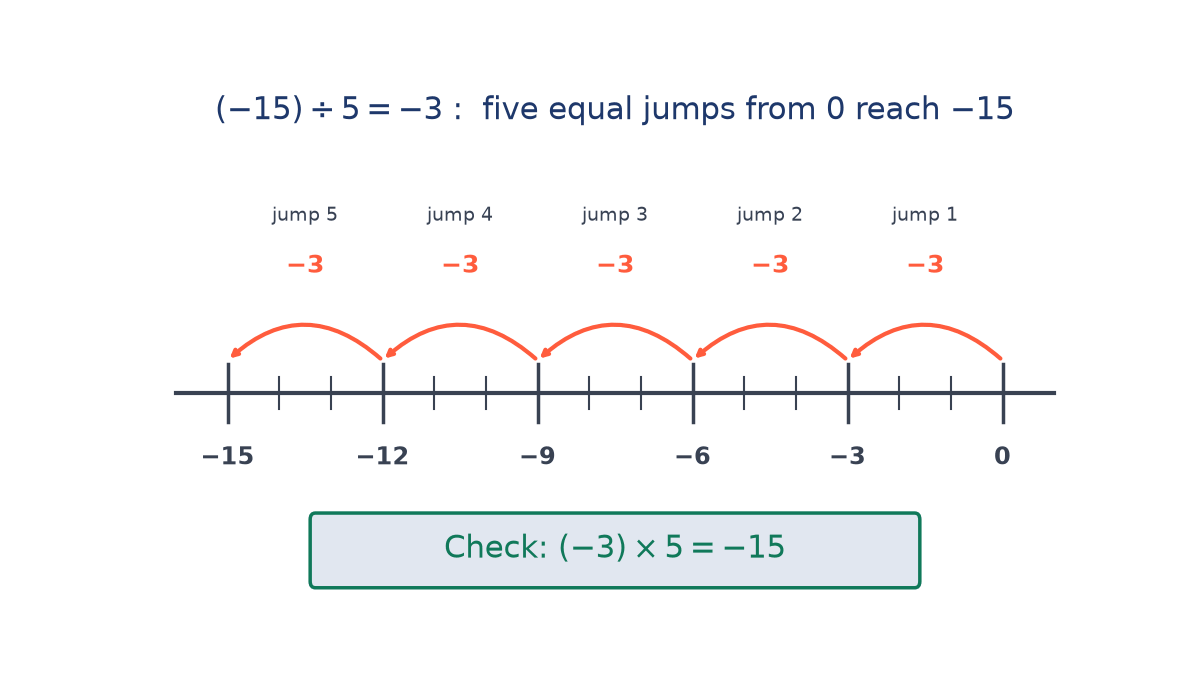
A number line makes this easy to see. Dividing by asks: if you make five equal jumps from and land on , how big is each jump? Each jump is steps to the left, which is .
The rule for signs
The little mark in front of a number is called its sign. A minus sign looks like this: . A number with no mark in front of it has a plus sign. You just do not write that one down.
Multiplying can go two ways. Two signs the same give a positive answer. Two signs different give a negative answer.
So , and as well. But , and .
Dividing works in exactly the same way. This is true when one number goes into the other exactly.
Remember. Two signs the same give a positive answer. Two signs different give a negative answer. This works for dividing too, just as it does for multiplying.
| Division | The two signs | Answer |
|---|---|---|
| the same | ||
| the same | ||
| different | ||
| different |
Why two signs the same give a positive answer
Take . Ask what number times gives . Try . You get . That is right. So the answer is , and it is positive. Try it with any other pair of numbers and the same thing happens. The question you ask always has the same shape.
Why two signs different give a negative answer
Take . Ask what number times gives . Try . You get . That is right. So the answer is , and it is negative. Try it with any other pair of numbers and the same thing happens again. The question you ask always has the same shape.
Each check is a multiplication you already know. That is why the two rules match.
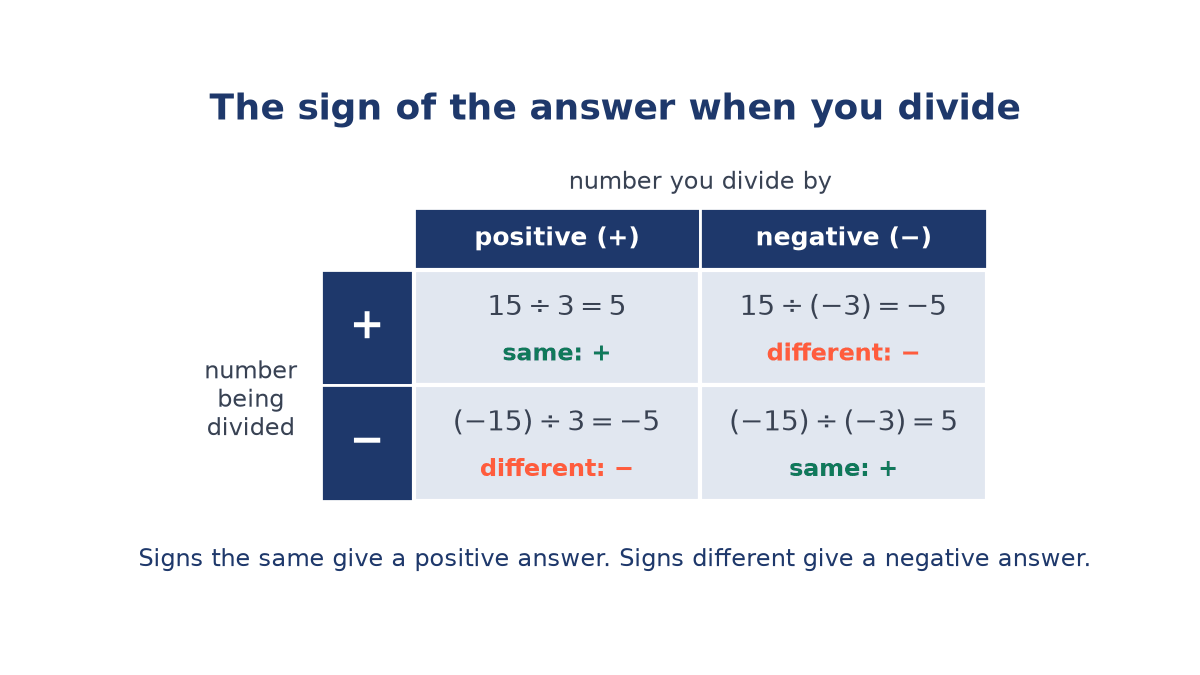
All four together
The first two have signs the same, so the answers are positive. The last two have different signs, so the answers are negative.
How to do one
- Look at the two signs.
- Work out the sign of the answer.
- Cover up the minus signs. Divide the two numbers as you would in any other division.
- Write the sign in front of the answer.
The sign and the numbers are two separate jobs. You can do them one at a time.
Worked examples
Divide by . Both signs are the same, so the answer is positive.
Both numbers positive
Divide by . Both signs are the same again, so the answer is positive.
Both numbers negative
Divide by . The signs are different, so the answer is negative.
A negative divided by a positive
Divide by . The signs are different again, so the answer is negative.
A positive divided by a negative
The last step in each one is the check. It is the multiplication you started from. Multiply your answer back and see where you land. If you land on the number you started with, your answer is right. Dividing is just multiplying undone.
Harder examples
A bigger division
Divide by . The signs are different, so the answer is negative. Now cover the signs: .
Two divisions in a row
Work out . Work from left to right, one division at a time.
The first pair had signs the same, so it gave a positive . The second pair had signs different, so the final answer is negative.
A problem in words
The temperature in a hill town fell by degrees in hours, by the same amount each hour. A fall is a change of . So the change each hour is
The temperature dropped degrees every hour.
Dividing by zero
There is one division you can never do. You cannot divide by .
Here is why. Dividing asks a question. asks what number times gives . The answer is . Now try . It asks what number times gives . Nothing does. Every number times gives .
So there is no answer to find. We say it is not defined.
Do not mix this up with . That one is fine. It asks what number times gives , and the answer is . Sharing nothing between five people gives each of them nothing.
Remember. Zero shared out is fine: . Zero as the number you share BETWEEN is not allowed. You can never divide by .
Your turn
Work these out. Sort out the sign first. Then divide the numbers.
| 1) | 6) | 11) |
| 2) | 7) | 12) |
| 3) | 8) | 13) |
| 4) | 9) | |
| 5) | 10) |
Remember. If you can multiply integers, you can divide them. The sign rule is the same one.
Common mistakes
- Thinking two negatives give a negative. In division, as in multiplication, , a positive number.
- Dividing the numbers correctly but forgetting to write the minus sign in front of the answer.
- Swapping the order. is not the same as .
- Writing an answer for a division by . It is not defined.
- Saying has no answer. Zero divided by any non-zero number is .
Key terms
- Integer
- A whole number that is positive, negative or zero.
- Sign
- The mark in front of a number that shows whether it is above or below zero.
- Dividend
- The number being divided, such as in .
- Divisor
- The number you divide by, such as in .
- Quotient
- The answer to a division.
- Not defined
- Having no answer at all, as with any division by .
Answers
Each answer was checked by multiplying back.
The same answers as a table:
| Question | Answer | Question | Answer |
|---|---|---|---|