Algebra begins with a simple step: turning a sentence into symbols. A shopkeeper who says "three more than yesterday" or a teacher who says "half the class" is already talking algebra. Once you can write such sentences in symbols, you can work with them, test them with numbers, and later solve equations. So listen for the key words, and pay just as much attention to the order you write things in.
Getting started
Imagine a box of sweets with the lid shut. You want to talk about how many are inside. But you cannot count them.
A box of sweets
So give that number a name. Call it . The letter is not a sweet. It is the number of sweets. If the box holds sweets, then is . If it holds , then is . The letter simply waits.
Now picture a bag you have not weighed. Call its weight . You can still say true things about it. Two such bags weigh . Now put kg into the bag. The bag is heavier than before. It weighs . You did all that with no scales.
Some symbols never change. The number is always . A symbol with one fixed value is called a constant.
Remember. The same letter can stand for a different number in a different question. Today is . Tomorrow might be . A symbol that can take various number values is called a variable. Another name for it is a literal.
From words to symbols
A symbol is a short mark that stands for something longer. The mark is a symbol. It stands for the word add. A letter is a symbol too. It stands for a number.
A question often comes to you as a sentence in words. Your job is to write it in symbols. The symbols say the same thing in less room.
Each of these sentences hides a word that tells you what to do. A few hide two. Find them all first. They tell you whether to add, take away, multiply or divide. Then sort out the order.
| Word in the sentence | What it tells you to do | Where you start |
|---|---|---|
| sum | add | either number |
| more than | add | the number after than |
| added to | add | either number |
| subtraction of | take away | the number after from |
| decreased by | take away | the number before decreased |
| less than | take away | the number after than |
| product | multiply | either number |
| times | multiply | either number |
| divided by | divide | the number before divided |
| half of | divide by | the number after of |
A bar model is a good way to picture these phrases. The long bar stands for , the unknown number of sweets. Adding makes the bar longer; taking away cuts a piece off; halving splits it into two equal parts.
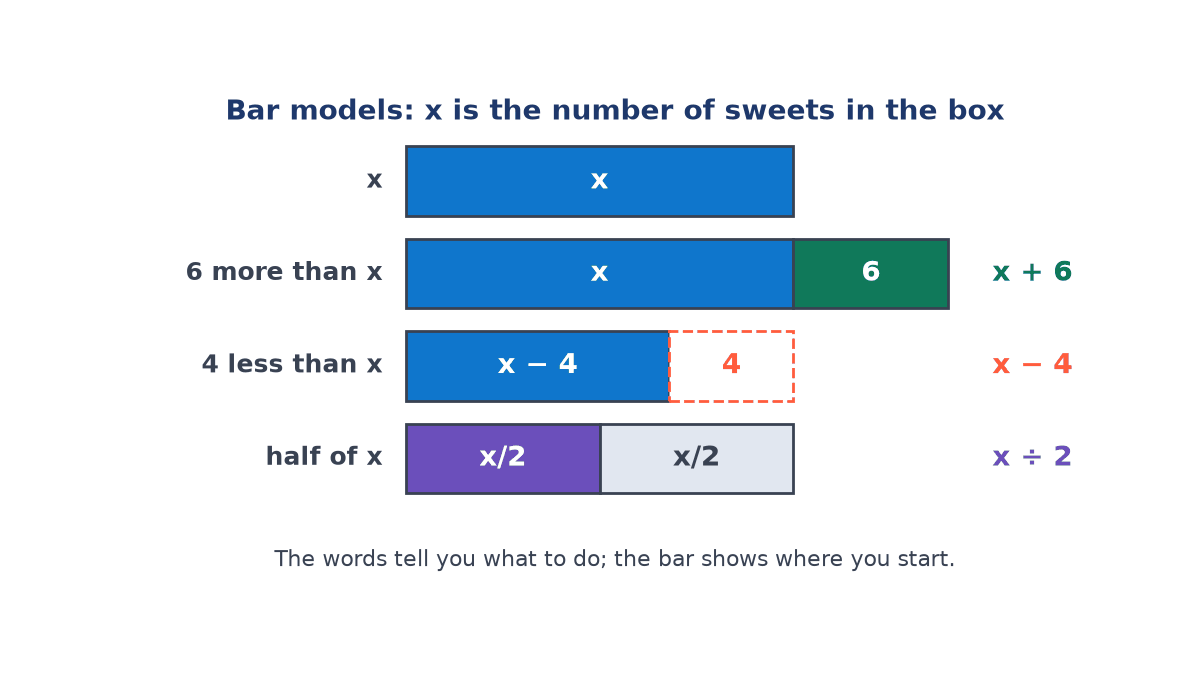
Words that mean add
The word sum means add. So the sum of and is .
More than also means add. Six more than starts at and goes up by . You write .
Added to means add as well. With adding, the order does not matter.
Here is why. Put sweets on the table. Then put more beside them. Count them all. Now clear them away and start again. This time put sweets down first. Then put more beside them. Count again. You get both times. Moving them round does not change how many there are. That is why and give the same answer.
A letter can take various number values. So you can always test your symbols by putting a number in. Say is . Then is . Seven sweets and six more make thirteen. That matches.
Words that mean take away
Three groups of words mean take away. They are subtraction of, decreased by, and less than.
Order matters now, and it matters a lot. Say the box holds sweets and you eat . Five take away two leaves . Now try it the other way round. You have sweets. Someone asks you to take away. You cannot do it. There are not enough. So and are not the same thing. That is why you must get the first number right.
Remember. Say the sentence slowly. Ask which number you start with. Write that number first. The other one goes after the minus sign.
Take the subtraction of from . The word from tells you where you begin. You begin at . You take off it. So you write .
Finding the order
Now take decreased by . Decreased means made smaller. The thing being made smaller is . So you start at and take off. You write .
This one is easy to get the wrong way round. It is tempting to write , because is the last thing you read. But that would mean you start at . The sentence starts at .
Four less than sounds as if comes first. Ask yourself: less than what? The sentence says less than . So is the number you start at. You go below it. Picture a stair with written on it. Four less than means step down four stairs. You write .
Now compare that with decreased by . There the sentence names the thing being made smaller. That is the . So you have two small tests. The word after than is where you start. The word before decreased is where you start.
Here is one more like it. The subtraction of from begins at . You take off it. So you write .
Words that mean multiply
Product and times both mean multiply.
The product of and means . You write it as . The multiplication sign is left out.
There is a good reason for dropping that sign. The sign looks very like the letter . Written side by side they are hard to tell apart. So maths leaves the sign out between a number and a letter.
The number goes in front of the letter. You write , not . Everyone writes it the same way, so everyone can read it.
So times is . Test it with a number. Say is . Then is , which is .
When there are two letters
Sometimes there are two numbers you do not know. Then you need two letters. Call the first one and the second one . They are different letters because they are different numbers.
Now take times added to times . Five times is . Three times is . Added to means add. So you write .
Words that mean divide
Dividing means sharing into equal piles. Take the box of sweets and share them between children. Each child gets half of what was in the box. You write that as .
The number being shared out sits on top. The number of piles sits underneath. The line does the same job as the divide sign. So means the same as .
Divided by and half of both mean divide. So divide by gives .
Forty divided by gives . Here is the number being shared out. So goes on top.
Order matters in division too. and are not the same. Ask which number is being shared out. That one goes on top.
Test that with a number. Say is . Then is , which is .
Half of a number means divide it by . So half of is .
This next one needs two steps. Four less than half of means you halve first. Then you take away from what you get.
Halving first, then taking away
Try it with a number. Say is . Half of is . Then take from , which leaves .
Longer sentences
Real questions often join two operations. Work them out in the order the sentence describes, and use brackets when a whole amount is being multiplied.
Five more than three times
Test with : .
Twice the sum of and
The brackets matter. Without them, would double only . Test with : , but .
Two more than one-third of
One-third of is , so the answer is . With this is .
times subtracted from
You start at and take away, so you write . With this is .
The product of and
Two letters side by side mean multiply, so you write . With and this is .
The eleven sentences together
| In words | In symbols | Why |
|---|---|---|
| The sum of and | Sum means add. | |
| The subtraction of from | You start at . | |
| The product of and | Product means multiply. | |
| Divide by | is shared out. | |
| more than | Start at , add . | |
| decreased by | Start at , take off. | |
| times | Times means multiply. | |
| divided by | is shared out. | |
| times added to times | Two products, then add. | |
| The subtraction of from | You start at . | |
| less than half of | Halve first, then take . |
Reading symbols back into words
Going the other way is just as useful. You look at symbols and say them in words. It shows you have really understood.
| Question | Answer | Question | Answer |
|---|---|---|---|
Practice
These are your turn to try. For each one, first find the key word, then decide which number you start with, and only then write the symbols. When you finish, put a small number in place of the letter and check that your symbols give the same result as the sentence.
Write each sentence in symbols. Say it slowly first. Ask which number you start with.
Check your work here. Every answer is also written out in the Answers section at the end.
| Question | Answer | Question | Answer |
|---|---|---|---|
Remember. The word tells you what to do. The order tells you which number comes first. Get both right and your symbols are right.
Common mistakes
- Writing for "4 less than ". The number after "than" is where you start, so it is .
- Writing for "5 decreased by ". The thing being decreased is .
- Writing instead of . The number goes in front.
- Turning a division upside down: " divided by " is , not .
- Leaving out brackets, so that "twice the sum of and " becomes .
Key terms
- Symbol
- A short mark that stands for something longer, such as or a letter.
- Variable (literal)
- A symbol that can take various number values.
- Constant
- A symbol with one fixed value, such as .
- Sum
- The answer when you add.
- Product
- The answer when you multiply.
- Expression
- Numbers and letters joined by operation signs, such as .