Algebra lets you work with numbers you do not know yet. Before you can add or take away such numbers, you must know which ones belong together. So we learn to sort: which terms are like terms, which are unlike, and how to tell them apart at a glance. You will use it in every algebra lesson that follows.
Picture a small box with sweets inside. The lid is shut. You cannot see in. You do not know how many sweets are there.
You can still talk about that number. Give it a short name. Call it . Now stands for the number of sweets in the box.
Tomorrow the box may hold a different number. The name still works. means whatever is in the box that day.
A letter used this way has a name. It is called a variable. A variable is a symbol that can stand for many different numbers.
A plain number is not like that. is always . A fixed value like that is called a constant.
The two parts of a term
A term is one small piece of maths. It can be a number on its own, like . It can be a letter on its own, like . It can be numbers and letters multiplied together, like . It can be them divided too, like .
Most terms have two parts. One part is a number. One part is a letter. In the number part is and the letter part is .
The number part has a name. It is called the co-efficient. In the co-efficient is .
The letter part has a name too. It is called the literal part. Watch that part closely. It tells you what the term is counting. That is what decides whether two terms will join.
Like terms
Two terms are like terms when their literal parts are the same. The numbers in front can be different. That does not matter.
Think about fruit for a moment. apples and apples are the same kind of thing. You can push them into one pile. The pile holds apples.
Now look at and . means two lots of . means three lots of . Both are counting s. So they are like terms.
is still a number. Two lots of and three lots of are lots of the same number. So they pile up the way apples do. is a different number. Lots of will not join lots of .
and are like terms as well. means one lot of . You could write , but nobody does. The is left out because one lot is the ordinary case. So is counting s too.
Remember. Like terms have another name. Some books call them similar terms. The two names mean the same thing.
Unlike terms
Two terms are unlike terms when their literal parts are not the same.
Go back to the fruit. apples and bananas are not the same kind of thing. You can put them in one bowl. You still cannot call the bowl five apples. You cannot call it five bananas either.
and are the same story. One term counts s. The other counts s. They are unlike terms.
and are unlike terms too. The is just two. Two of what? It does not say. But counts s. Two on its own and two s are not the same kind of thing. So they cannot join.
Terms with two letters
Some terms have two letters. In the literal part is . That is not the same as on its own. counts s. counts s. So and are unlike terms.
The order of the letters does not matter. means , and means . Those are the same number. So and are like terms. Many teachers ask you to write the letters in alphabetical order, so that a match is easy to see.
Powers count as part of the literal part too. means . That is not the same as . So and are unlike terms.
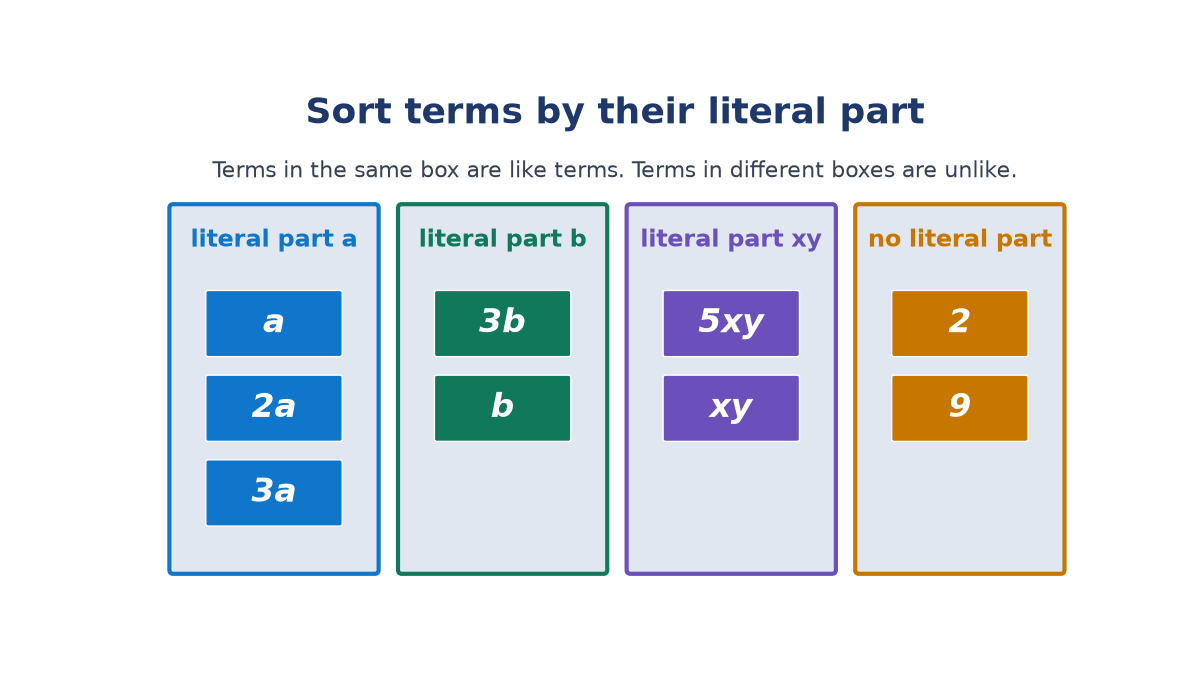
The four examples side by side
| Pair of terms | Like or unlike | Why |
|---|---|---|
| and | Like | Both literal parts are |
| and | Like | Both literal parts are |
| and | Unlike | One literal part is , the other is |
| and | Unlike | One of them has no literal part |
Remember. The literal part decides, because it says what is being counted. The number in front only says how many. So the number in front never decides.
Checking a pair of terms
Are and like terms? Cover the numbers with your finger. Then look at what is left.
Two terms, one test
More worked examples
Example 1. Are and like terms?
Step 1: Cover the numbers. leaves . The term has no number shown, which means , so it also leaves . Step 2: Both literal parts are . So they are like terms.
Example 2. Are and like terms?
Step 1: The literal part of is . The literal part of is . Step 2: and are different. So they are unlike terms, even though both start with .
Example 3. Sort the terms of .
Step 1: List each term with its literal part: has , has , has , has none, has , has none.
Step 2: Group the matches. The group is and . The group is and . The plain numbers are and . That gives three groups of like terms.
Why this matters
Like terms can be joined into one term. and both count s. Put them together and you get .
Unlike terms cannot be joined. and count different things. The pile has no single name. So has to stay as it is.
That is why you sort the terms first. You find the ones that match. You join those, and you leave the rest alone. The next lesson does that work.
Practice
Say whether each pair is like or unlike. Look at the literal parts only.
| 1) | 5) |
| 2) | 6) |
| 3) | 7) |
| 4) | 8) |
| Question | Answer | Question | Answer |
|---|---|---|---|
Common mistakes
- Looking at the numbers in front. and share a but are unlike; and have different numbers but are like.
- Thinking a letter on its own has no number. means , so and are like terms.
- Treating and as a match because both contain . The whole literal part must be the same.
- Treating and as like terms. The powers are part of the literal part.
- Pairing a plain number with a letter term, such as with .
Key terms
- Variable
- A letter or symbol that can stand for many different numbers.
- Constant
- A fixed value, such as , that never changes.
- Term
- One piece of an expression: a number, a letter, or numbers and letters multiplied or divided.
- Co-efficient
- The number part of a term; in it is .
- Literal part
- The letter part of a term; it says what is being counted.
- Like terms
- Terms with the same literal part, also called similar terms.
- Unlike terms
- Terms whose literal parts are not the same.
Answers
Show answers
- and : like, both literal parts are .
- and : unlike, one literal part is , the other is .
- and : like, both literal parts are .
- and : unlike, has no literal part.
- and : like, both literal parts are .
- and : unlike, has no literal part.
- and : like, both literal parts are .
- and : unlike, one literal part is , the other is .