In the last lesson you learned to sort terms into like and unlike. Now you put that sorting to work. Adding and taking away like terms is how long algebra expressions are made short and tidy. You will use it when you solve equations, work out perimeters with letters, and simplify formulas in later classes.
Think of a closed box of sweets. You have not counted them yet.
A letter can stand for a number. It can stand for different numbers at different times.
Call the number of sweets in one box . One box may hold sweets. The next box may hold .
You never need to know that number here. You only need to count boxes.
Two boxes hold sweets. Three boxes hold sweets.
Now put all of those boxes on the table. You have five boxes. So you have sweets.
You did not open a single box. You still knew the answer.
Terms and expressions
A piece of maths written with letters and numbers is called an expression.
Here is one: .
Each part that is added or taken away is a term. So has two terms. They are and .
The letter part of a term is the letter or letters in it. You leave the number in front out. In the letter part is .
Some terms have two letters. One box holds sweets, so boxes hold sweets. You write that as .
So means times . In the letter part is .
Remember. An expression is made of terms. A term has a number in front and a letter part.
What a like term is
Terms with the same letter part are like terms. They are also called similar terms.
So and are like terms. Both are built from .
and are like terms too. The letter part of each one is .
But and are not like terms. One counts , the other counts .
A plain number and a letter are unlike as well. So and are unlike terms.
A plain number has no letter part at all. The term has one. So the two cannot be joined.
This matters because you can only add things of one kind. You cannot add boxes of sweets to bags of rice. You can only say how many you have of each.
Remember. Like terms have the same letter part. Only like terms can be joined.
Adding like terms
Two s and three more s make five s. So is .
2a + 3a
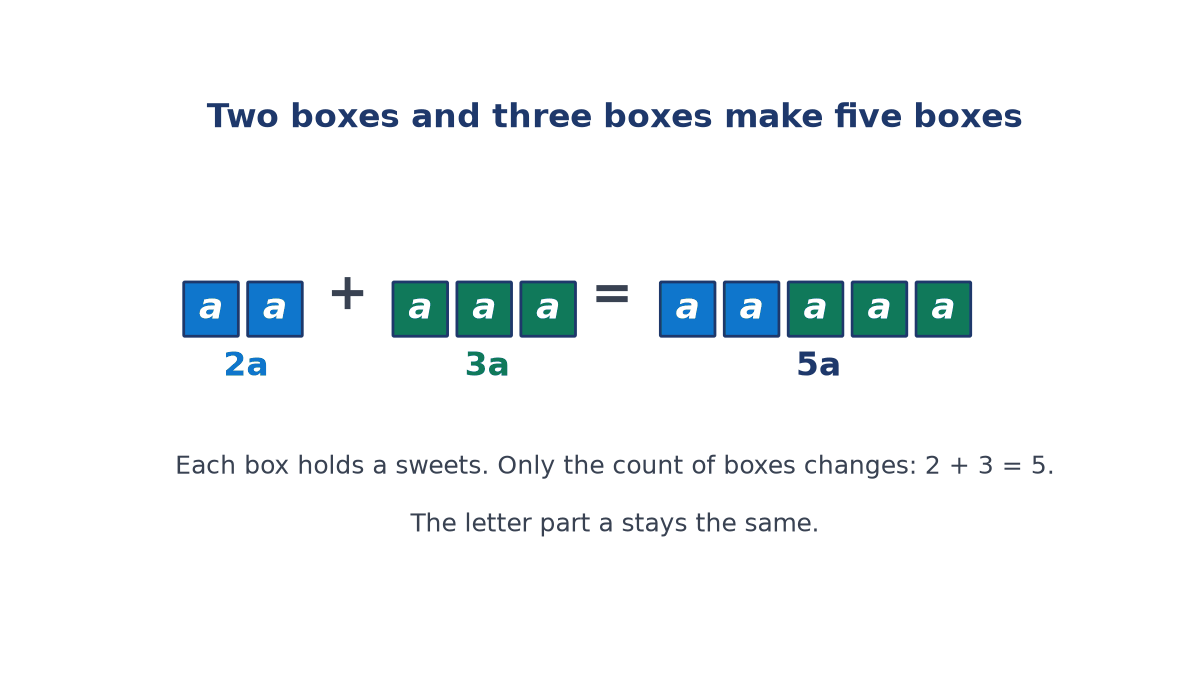
Look at what changed. Only the number in front changed. The letter part stayed as .
That is the whole idea. You are counting how many s you have. You are not changing what is.
The number in front
In there are two parts multiplied together. They are and .
The is called the co-efficient of . In the is the co-efficient of .
For now you only need the number in front, because that is the number you add or take away.
A letter on its own has a co-efficient of . One box is still one box. So means , and means .
a + a
Here are more sums of like terms. Each one adds the numbers and keeps the letter part.
| Sum | Answer |
|---|---|
In the last row the letter part is . It is longer, but the idea does not change. Three s and four s make seven s.
Remember. You cannot add and . The letter parts are different, so leave them as they are.
Taking away like terms
Taking away works the same way.
Start with seven s. Take three s away. Four s are left.
7x - 3x
Again the letter part did not move. You only worked out .
The order matters when you take away. In a written subtraction, start with the term on the left. Then remove the term on the right.
So is . But is not .
Start with four s and take nine away. You go below zero. That answer is .
When nothing is left
Sometimes you take away everything you had.
5a - 5a
Five s taken from five s leaves none.
Write , and not . Zero boxes hold nothing, whatever is inside a box. So zero of anything is just zero.
When the answer goes below zero
Sometimes you take away more than you started with.
3a - 7a
You know that is . So the answer is .
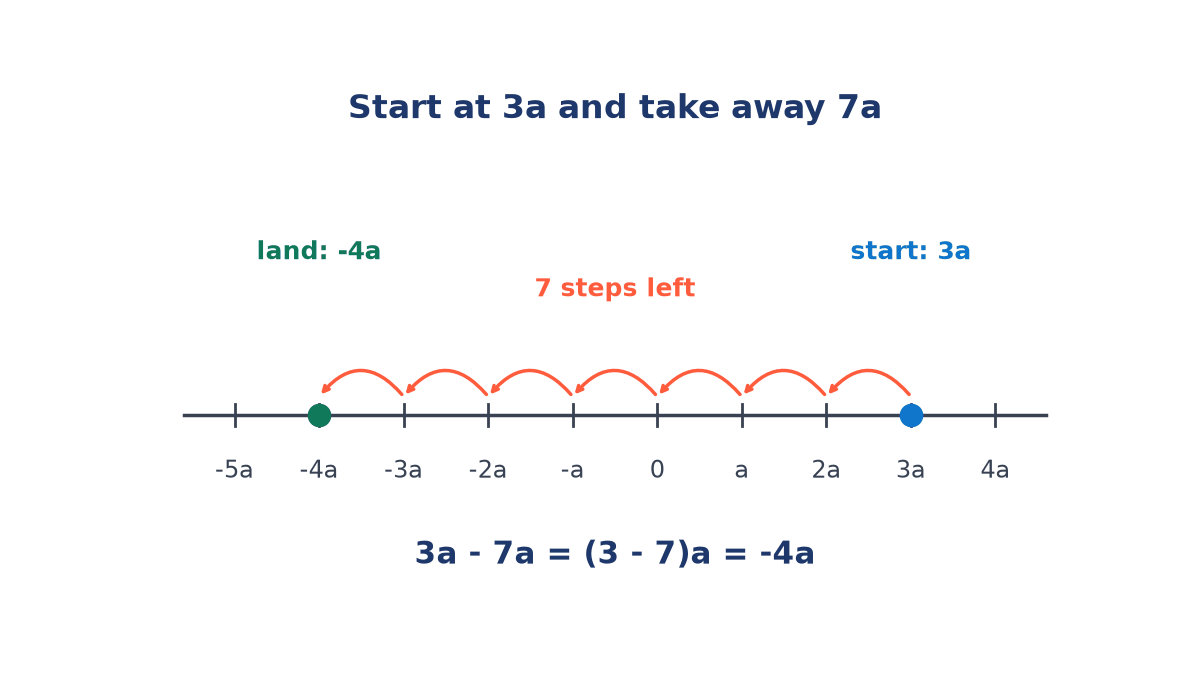
You are still counting s. Only the count went below zero. So the minus sign sits with the count. The has not changed.
You had three s. You had to give away seven. So you gave away the three you had, and you still owe four more.
All eight together
Here are eight of these, including the ones worked out above. Cover the answers and try them first.
| Take away | Answer |
|---|---|
An answer can have two terms
It is easy to think every answer must be one term. It does not have to be.
The expression cannot be made shorter.
You do not know what and stand for. They may well be different numbers. So you cannot count them together.
The shortest true answer keeps both terms. Making it shorter would make it wrong.
Leaving two terms is not a failure. It is the right answer.
Remember. If the letter parts are different, the terms stay apart. An answer with two terms is still a finished answer.
The order of the work
- Look at the letter part of each term.
- Check whether the two letter parts are the same.
- If they are the same, add or take away the numbers in front.
- Keep the letter part exactly as it was.
- If they are different, leave both terms as they are.
Longer expressions
Real expressions often have more than two terms. Use the same order of work, one group at a time. Each term keeps the sign written in front of it.
Example 1. Simplify
Step 1: The letter parts are , and . Step 2: and are like terms. has no partner. Step 3: Join the terms and leave alone.
Example 2. Simplify
The terms are and . The terms are and . Notice that the minus sign travels with .
Example 3. Simplify
There are three groups: terms, terms, and a plain number.
The answer has three terms. None of them can be joined, so it is finished.
Practice
Make each expression as short as you can.
Two of them cannot be made shorter. Their answers are the same as the questions.
| 1) | 6) | 11) |
| 2) | 7) | 12) |
| 3) | 8) | 13) |
| 4) | 9) | 14) |
| 5) | 10) |
Check your work below.
| Question | Answer | Question | Answer |
|---|---|---|---|
Remember. Add or take away the numbers in front. Keep the letter part unchanged. Leave unlike terms alone.
Common mistakes
- Adding the letters as well as the numbers. is , not or .
- Joining unlike terms. is not ; it stays as it is.
- Forgetting the hidden . is , not .
- Writing instead of when everything is taken away.
- Swapping the order in a take-away. is , not .
- Losing a minus sign when terms are moved around. The sign in front of a term moves with it.
Key terms
- Expression
- A piece of maths written with letters and numbers, such as .
- Term
- Each part of an expression that is added or taken away.
- Letter part
- The letter or letters in a term, leaving out the number in front.
- Co-efficient
- The number in front of the letter part; in it is .
- Like terms
- Terms with the same letter part, also called similar terms.
- Simplify
- Make an expression as short as it can go by joining like terms.
Answers
Show answers
- cannot be made shorter; the letter parts differ.
- cannot be made shorter; has no letter part.