Algebra is arithmetic with some of the numbers not yet known. Before you can add, multiply or simplify algebraic expressions, you need names for their parts, just as you need the words "digit" and "place" before you can talk about decimals. Here are three such names: term, factor and co-efficient. You will use them in every algebra chapter that follows, from simplifying expressions to solving equations.
A letter can stand for a number
Think of a box of sweets. The lid is shut. You cannot count them. You still want to talk about that number. So give it a letter. Call it .
Now stands for the sweets in the box. The letter is not a code. It is not short for a word. It holds the place of a number. You do not know that number yet. Open the box and count . Then is .
Here is one more. You pick up a bag of rice. No one has weighed it. Call its weight . You can talk about now. You do not need the scales first. Later the scales may say . Then is .
A letter like this is called a variable. It can stand for one number today and a different one tomorrow. Any letter will do. People often use , and because they are not short for anything. The letter is only a place for a number to sit.
Now look at the box itself. It has one lid. That is , and it stays whatever is inside. A number that never changes is called a constant. So and are constants. Now let us see what you can build from these two parts.
Remember. A letter stands for a number. It waits for that number to be filled in.
What a term is
A term is one single amount. It can be a constant on its own. So is a term. It can be a letter on its own. So is a term. It can be both, joined by multiplying. So is a term. It means . Dividing counts as well.
Why do and stay inside a term? They build one amount out of the parts. Whatever is, is one number. Dividing does the same job. Whatever is, is still one number.
Plus and minus do a different job. They join one amount to another. So they show you where a term ends. In there are two terms. They are and .
| Term | What it is made of |
|---|---|
| A constant on its own. | |
| A variable on its own. | |
| The constant times the variable . | |
| The variable divided by . |
Remember. Multiplying and dividing stay inside a term. Plus and minus split one term from the next.
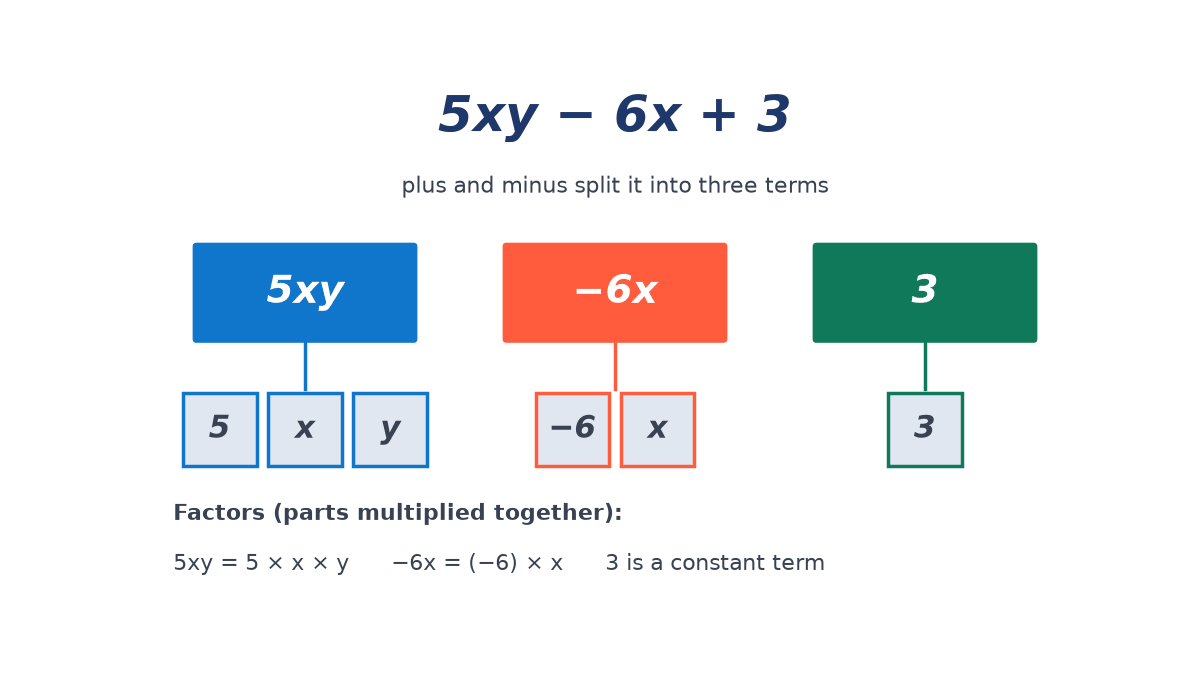
Worked example: terms in a longer expression
List the terms of .
Read from left to right and cut at every or . Each minus stays with the term after it.
So there are three terms: , and . The first two contain variables. The last is a constant term.
Worked example: a term with division
How many terms are in ?
The division line in stays inside its term, because it builds one amount. Cut only at the and the . The terms are , and . That makes three.
Count the terms
How many terms are in each one? Count the parts split by and .
| 1) | 3) |
| 2) | 4) |
| Question | Answer | Question | Answer |
|---|---|---|---|
Factors
Multiply things together and you get a product. So is a product. It means . Each part that goes in is a factor. So , and are the factors of .
You do this with plain numbers too. . So and are factors of . Letters work the same way. A factor can be a number or a letter. Both of them count.
A factor can also carry a minus sign. The minus stays with its own number. So in the factors are and .
Splitting the product into its factors
Remember. A factor is a part that is multiplied in.
Find the factors
Write down the factors of each product.
| 1) | 3) |
| 2) | 4) |
| Question | Answer | Question | Answer |
|---|---|---|---|
Co-efficients
Start with . It means . That is five lots of . The tells you how many. The tells you what you are counting.
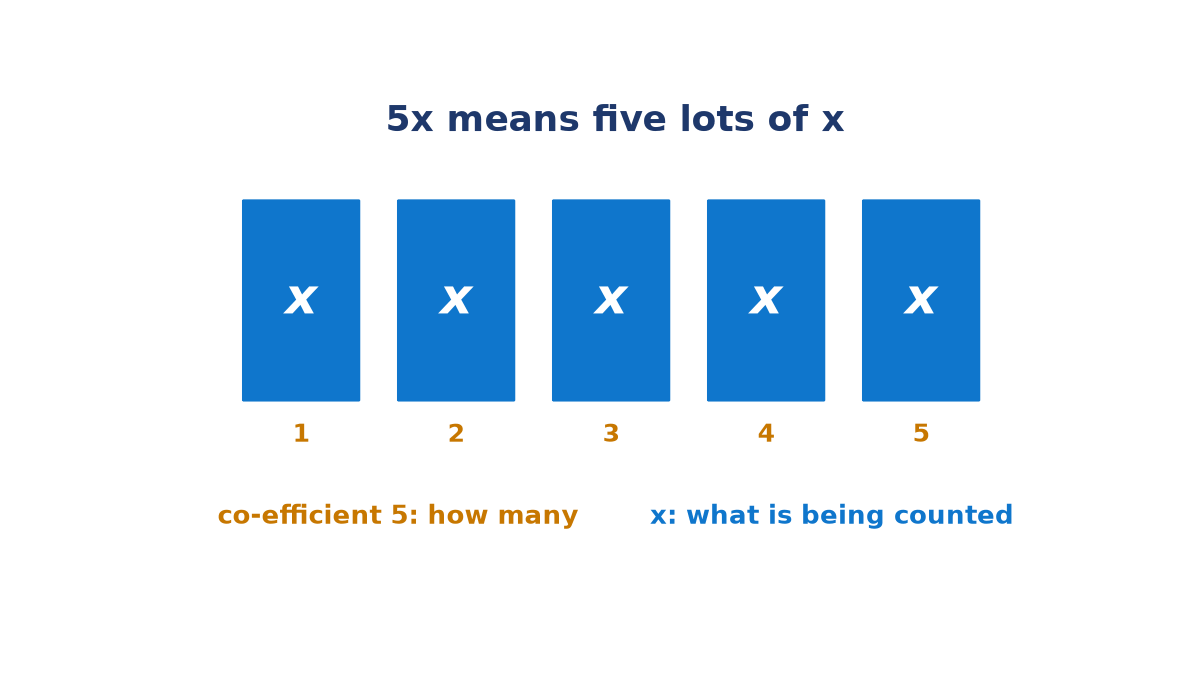
Now give those two parts a name. The factors of are and . Cover the with your finger. What is left is . So is the co-efficient of .
Now take . Cover the . What is left is . So is the co-efficient of . The minus sign goes with the .
This rule works both ways round. Cover the in instead. What is left is . So is the co-efficient of . That sounds odd. Here is why it happens. A term is only parts multiplied together. Cover any part and the rest is still a product. So the rule cannot tell a number from a letter. It knows parts, and nothing more.
In everyday work people mean less than that. The number is the part that tells you how many. That is the part people usually want. So when someone asks for the co-efficient, they mean the number in front. In it is . In it is .
| Question | Answer |
|---|---|
| Is a term? | Yes. Its parts are joined by multiplying. |
| What are its factors? | , and . |
| What is the co-efficient of ? | , with its minus sign. |
| What is the co-efficient of ? | . The rule allows this too. |
Remember. Cover one factor and the rest is a product. The factor you covered is the co-efficient of that product. In everyday use people mean the number in front. Take its sign with it.
Worked example: hidden co-efficients
Some terms seem to have no number in front. Look at . It means one lot of , so , and the co-efficient of is . We simply do not write the .
In the same way, . So the co-efficient of in is .
And in , the number in front is , because . So the co-efficient of is .
Find the co-efficient
Write the number in front of each one. That is the co-efficient of the rest.
| 1) | 3) |
| 2) | 4) |
| Question | Answer | Question | Answer |
|---|---|---|---|
Now the other way round
Cover the number in front. Write down what is left. That is the co-efficient of the number you covered.
| 1) | 2) | 3) |
| Question | Answer | Question | Answer | Question | Answer |
|---|---|---|---|---|---|
All three words together
- A term is one amount, held together by multiplying or dividing.
- A factor is a part that is multiplied to make a product.
- A co-efficient is one factor, named for the product of the other factors. In everyday use it means the number in front.
Name these three parts when you meet a piece of algebra. Later rules are written with these same three words. Once you can name the parts, you can read the rule.
Common mistakes
- Splitting a term at a multiplication. is one term, not three.
- Leaving the minus sign behind. In , the second term is , and its co-efficient is .
- Saying has no co-efficient. Its co-efficient is , and the co-efficient in is .
- Thinking a letter is short for a word, such as for "weight". The letter only holds the place of a number.
- Forgetting that a number on its own, such as , is a term too.
Key terms
- Variable
- A letter that stands for a number, which may change.
- Constant
- A number that never changes, such as or .
- Term
- One single amount, made of constants and variables joined by multiplying or dividing.
- Expression
- One or more terms joined by plus and minus, such as .
- Product
- The result of multiplying things together.
- Factor
- A part that is multiplied to make a product.
- Co-efficient
- One factor, named for the product of the others; in everyday use, the number in front.
Answers
Count the terms
- : term.
- : terms, and .
- : term.
- : terms, , and .
Find the factors
- :
- :
- :
- :
Find the co-efficient
- :
- :
- :
- :
Now the other way round
- : is the co-efficient of .
- : is the co-efficient of .
- : is the co-efficient of .