Welcome to your first step into algebra. Algebra lets you write about numbers even when you do not know them yet, by using letters. You meet it in rules like "the perimeter of a square is four times its side", in the fare chart of a bus, and in almost every chapter of mathematics that comes after this one. It all begins with two simple ideas: the variable and the constant.
Someone gives you a closed box of sweets. Nobody has counted them. You cannot say how many are inside.
There is a number in that box. It is a definite number. You just do not know it yet.
You still want to talk about it. So you give that number a short name. You can call it .
Remember. is not the box. is the number of sweets in the box.
Why a name helps
A name lets you work before you count. If you dropped more sweets in, the box would hold sweets.
You did not open the box. You still wrote down the new amount. That is what letters are for.
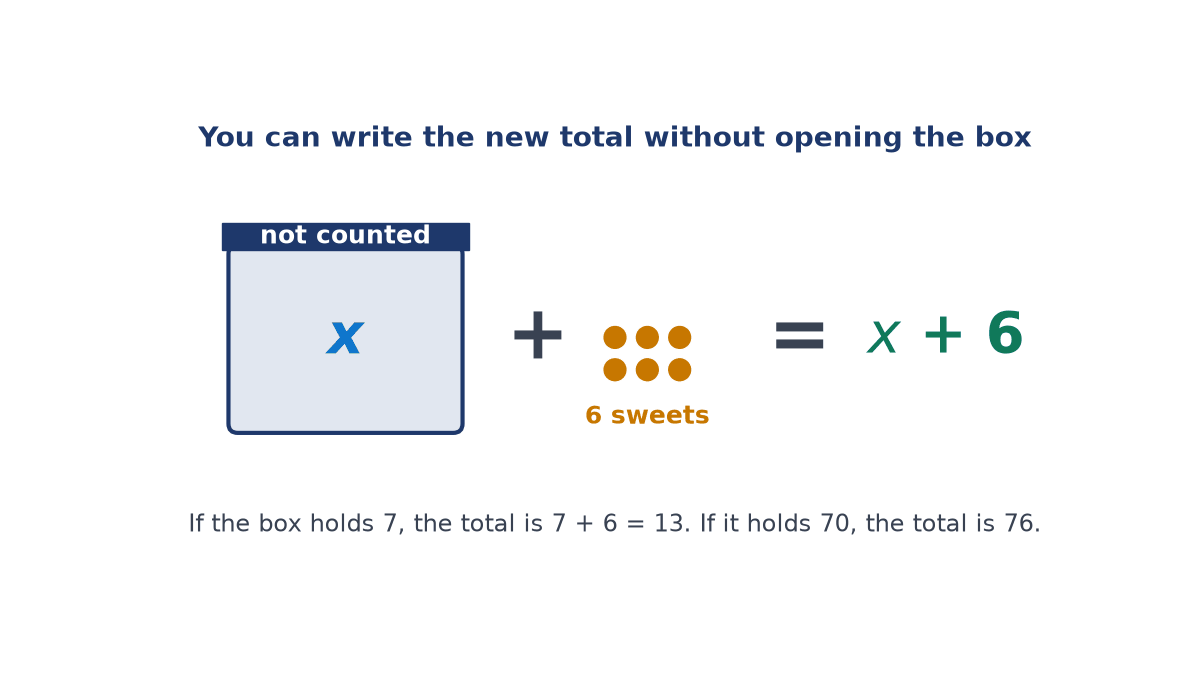
You can take sweets away in the same way. If you eat of them, the box holds sweets. Later, when you open the box and find , you can work out the numbers.
Putting a number in place of the letter like this is called substituting.
A variable
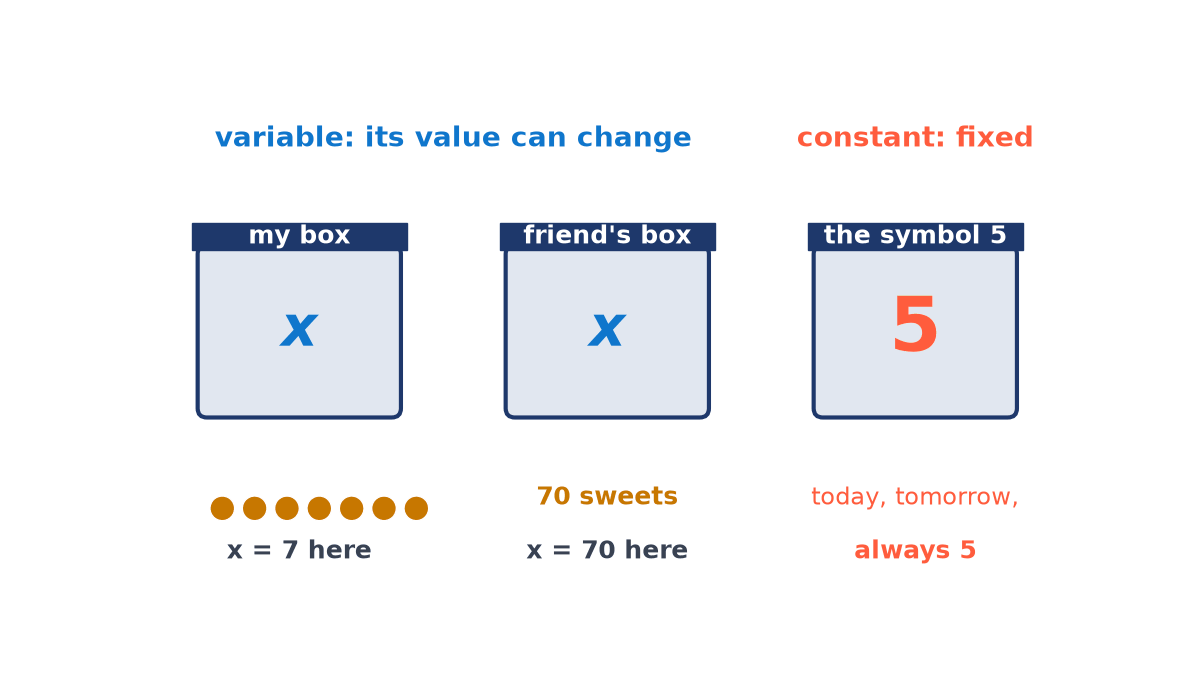
One day you open the box. You count sweets. So stands for in that box.
Your friend has a box too. Hers holds sweets. In her box stands for .
The same letter fits both boxes. The letter did not change. The number it stands for changed.
The number a symbol stands for is called its value. So had the value , then the value .
A symbol like this is called a variable. This chapter also calls it a literal. It is one idea with two names.
Remember. A variable is a symbol which can take various numerical values. It can stand for different numbers at different times. The chapter writes variable (or) literal. Examples: , , , , , .
A constant
Your box has printed on the lid. Someone printed it there. You cannot rub a bit off it.
That does not tell you how many sweets are inside. It is today. It is tomorrow.
Nobody can make it . Its value is fixed. A symbol like this is called a constant.
A symbol is any mark you write to stand for a number. A letter is one kind. A written number like is another kind.
Remember. A constant is a symbol which has a fixed value. It always stands for the same number. Examples: , , .
is a number too. It sits below . So does . Each one is locked to one value, so both are constants.
The two side by side
| Symbol | Which one | Why |
|---|---|---|
| Constant | It is always | |
| Variable | It can be in one box and in another | |
| Constant | It is always | |
| Variable | It could be in one question and in the next |
A letter can hide a number you know
A letter is not always a mystery. You may know the number and still use a letter.
Say your school bag weighs kilograms. You can write for its weight.
Now one short letter does the work. Two bags like yours weigh . You wrote that without saying once.
Tomorrow you may take a book out. The bag will weigh something else. Only the number stands for changes.
So is a variable. It just happens to be today. If the weight could never change, would be a constant.
And a number nobody knows
Some numbers nobody has found yet. Nobody has weighed the bag. Nobody has counted the box.
A letter still lets you write about that number. You can add to it and take from it.
Algebra is the part of maths where you work with numbers you have not been told yet. Letters are what let you do it.
Remember. A variable can take many values. A constant keeps one fixed value.
Variables and constants working together
Most expressions in algebra mix the two. Look at the cost of pens that sell for ₹ each. If you buy pens, you pay rupees. Here is a variable, because you might buy any number of pens. The is a constant, because the price does not change.
| Pens bought, | Cost, |
|---|---|
Now look at . The letter is the variable. The numbers and are constants. When , the expression is worth . When changes, the value changes, but the and the stay just as they are.
A square with side has perimeter . The side can be any length, so is a variable. A square always has four sides, so is a constant.
Your turn
Variable or constant?
Write variable or constant for each one. Ask yourself one question. Can this symbol stand for a different number another day?
| 1) | 5) | 9) |
| 2) | 6) | 10) |
| 3) | 7) | 11) |
| 4) | 8) | 12) |
| Question | Answer | Question | Answer |
|---|---|---|---|
Common mistakes
- Thinking a letter stands for an object. is the number of sweets, not the sweets or the box.
- Thinking a letter is always a mystery. A variable may stand for a number you already know today.
- Calling a negative number a variable. is fixed, so it is a constant.
- Forgetting that is a constant. It always has the value zero.
- Reading as fifty-something. It means .
Key terms
- Variable
- A symbol which can take various numerical values, such as , or . Also called a literal.
- Constant
- A symbol which has a fixed value, such as , or .
- Value
- The number a symbol stands for.
- Symbol
- Any mark written to stand for a number, such as a letter or a numeral.
- Substitute
- Put a number in place of a letter, as in when .
- Algebra
- The part of mathematics that works with numbers through letters.
Answers
Show answers
- : variable
- : constant
- : variable
- : constant
- : variable
- : constant
- : variable
- : constant
- : variable
- : constant
- : variable
- : constant
Every letter here can stand for a different number on another day, so each letter is a variable. Every written number always means the same amount, so each number is a constant.