Why two numbers?
On a number line, one number is enough to say where a point is. On a flat surface like a page or a floor, one number is not enough. You need two. In this lesson we set up two number lines at right angles, called the axes. With them, any position on a flat surface becomes an ordered pair of numbers. Then we will see how the signs of those two numbers tell you where the point is.
Two lines at right angles
Draw a horizontal number line and call it the -axis. Through its zero, draw a vertical number line and call it the -axis. Their crossing point is the origin, written , with coordinates .
Along the -axis, distances to the right of are positive and to the left negative. Along the -axis, up is positive and down is negative. We use the same unit on both axes.
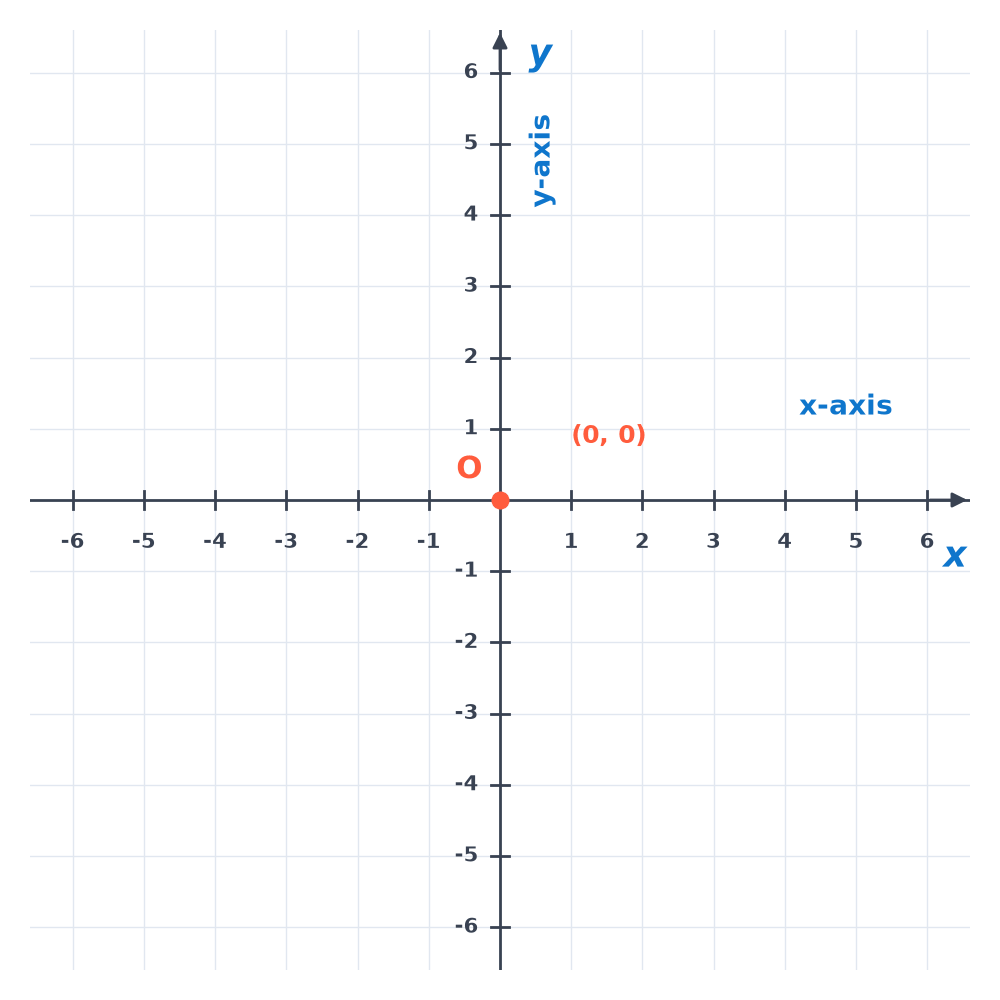
The flat surface holding both axes is called the Cartesian plane. You will also hear it called the coordinate plane or the -plane. It is named after Descartes, who in 1637 set out the idea that two numbers can fix a point. But the thinking in grids is much older. The streets of the Sindhu-Sarasvatī cities were laid out north to south and east to west at regular spacing. And it was Brahmagupta's work on zero and negative numbers in the seventh century that makes the negative halves of the axes possible at all.
Coordinates of a point
Take any point in the plane. Drop a perpendicular from to the -axis; the number where it lands is the -coordinate of . Drop a perpendicular to the -axis; that number is the -coordinate. Together they are written , and always comes first.
Another way to say the same thing: is the signed distance of from the -axis, and is the signed distance of from the -axis. Mind the order. and are different points, and they are the same only when the two numbers are equal.
Points that sit on an axis always have one coordinate equal to zero.
- On the -axis: . For example is units right of ; is units left.
- On the -axis: . For example is units above ; is units below.
The four quadrants
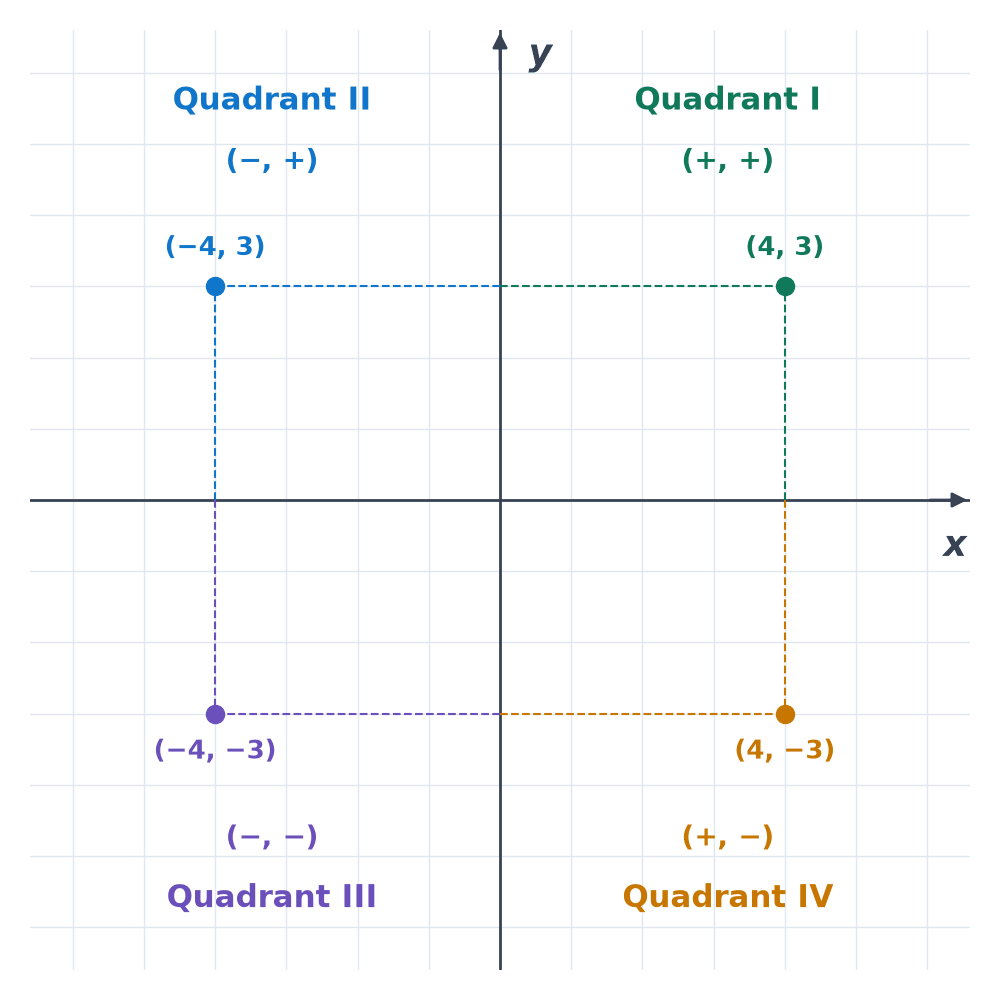
The axes cut the plane into four regions, called quadrants. We number them anticlockwise, starting from the top right.
| Quadrant | Example | ||
|---|---|---|---|
| I | positive | positive | |
| II | negative | positive | |
| III | negative | negative | |
| IV | positive | negative |
One small point that often appears in tests: a point on an axis belongs to no quadrant at all.
Example 1. In which quadrant, or on which axis, does each point lie? , , , , , .
: II. : IV. : on the -axis, below . : I. : III. : on the -axis, left of .
Example 2. A point has -coordinate . What can be said about it?
We know it lies on the vertical line units to the left of the -axis. But its -coordinate is not given, so it could be in Quadrant II (if ), in Quadrant III (if ), or on the -axis at .
Reading a floor plan
Here is a place where coordinates are really useful. They make the plan of a room exact. Put the origin at one corner of the room, run the -axis along one wall and the -axis along the wall at right angles to it, and let unit foot.
Example 3. A room has corners , , and . A door occupies the part of the bottom wall from to . A bed has feet at , , and .
- Room: ft by ft.
- Door width: ft. It starts ft from the left wall (the -axis).
- Bed: ft wide and ft long, standing against the left wall with a ft gap.
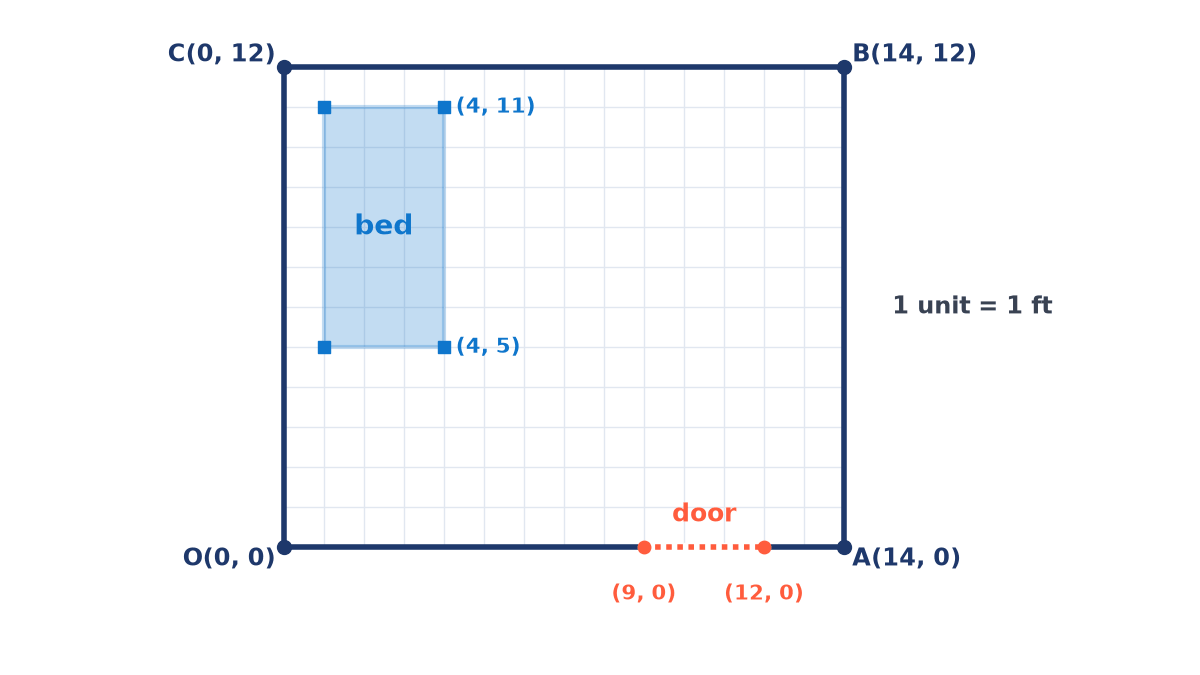
Notice that a plan like this shows only the floor. Something at a height, such as a window in a wall, has no place on it. Every point on the floor is fixed by two numbers, and a height would need a third.
Practice
- Write the quadrant or axis for each point: , , , , , .
- What are the coordinates of the origin? What is the -coordinate of every point on the -axis?
- Name a point in Quadrant III whose -coordinate is , and a point on the -axis units below the origin.
- lies in Quadrant II. In which quadrant does lie? What about ?
- A rectangular table has three feet at , and . Where is the fourth foot? What are the table's length and width?
- A room is ft by ft with a corner at the origin and sides along the axes. A ft by ft desk is placed exactly in the centre with its longer side parallel to the -axis. Give the coordinates of its four corners.
Answers
Show answers
- IV, III, -axis (above ), II, -axis (right of ), I.
- . Zero.
- For example ; and .
- , , so has positive and negative : Quadrant IV. has positive and negative : also Quadrant IV.
- The fourth foot is . Length , width .
- The centre is . Half-length along , half-width along : corners , , , .