Derive the distance formula from the Baudhāyana–Pythagoras theorem, use it for points in any quadrant, test triangles, find unknown points, and see why reflection in an axis keeps every length.
Once every point has an address (x,y), a natural question follows: how far apart are two addresses? When two points sit on a line parallel to an axis, the answer is simple subtraction. When the line between them is slanted, we need one more idea, and it is one you already know: the Baudhāyana–Pythagoras theorem. This lesson turns that theorem into the distance formula, and then checks what happens to distances when a shape is reflected in an axis.
Distances along the grid lines
Points on a horizontal line
If two points have the same y-coordinate, such as (x1,y) and (x2,y), they lie on a line parallel to the x-axis. Moving from one to the other changes only the x-coordinate, so the distance is the size of that change:
distance=∣x2−x1∣.
The bars mean "absolute value": we drop any minus sign, because a length is never negative.
Points on a vertical line
In the same way, (x,y1) and (x,y2) lie on a line parallel to the y-axis, and the distance between them is ∣y2−y1∣. In the floor plan of Reiaan's room, this is how we measure the bathroom door B₁B₂, which runs along the y-axis; the room door and the wardrobe's front edge W₁W₂ lie along the x-axis, so they use the rule for horizontal lines.
Worked example 1: straight along a grid line
Find the distance between (a) (−4,3) and (5,3), and (b) (2,−6) and (2,1).
(a) The y-coordinates are equal, so the distance is ∣5−(−4)∣=∣9∣=9 units.
(b) The x-coordinates are equal, so the distance is ∣1−(−6)∣=∣7∣=7 units. Subtracting the other way gives ∣−6−1∣=∣−7∣=7 as well, so the order does not matter.
Distances along a slant
Splitting the journey into two moves
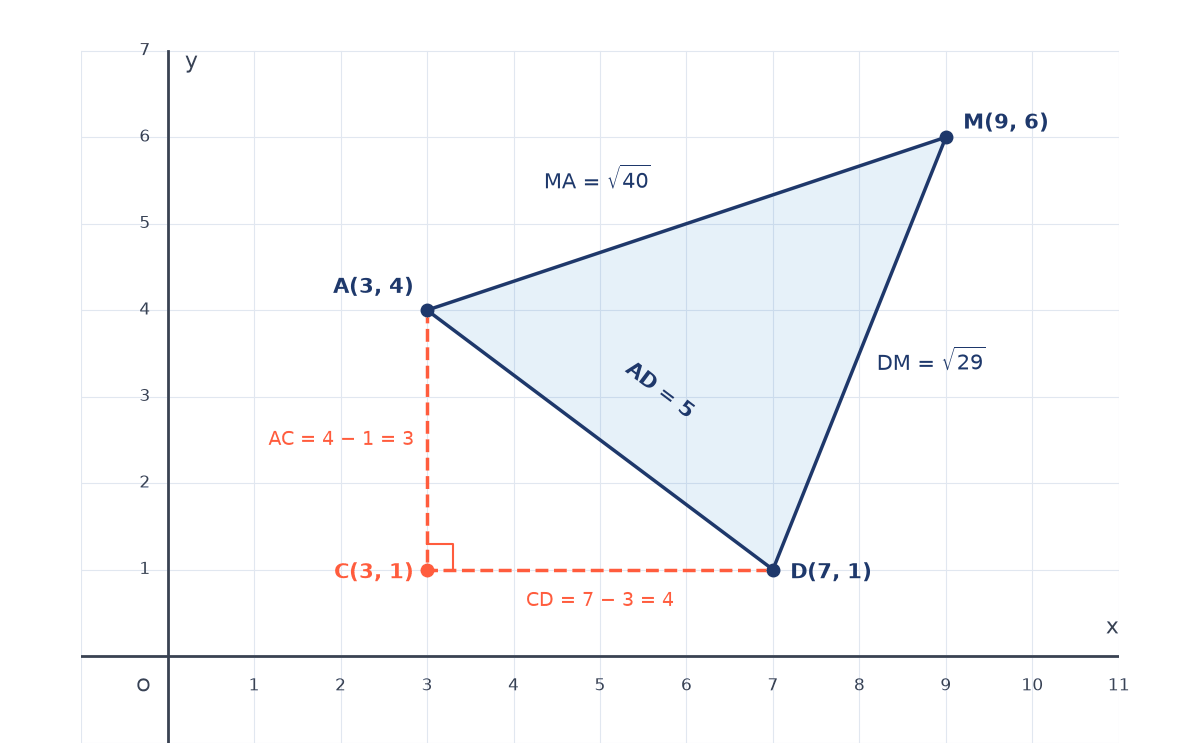
The book looks at triangle ADM with A(3,4), D(7,1) and M(9,6), an acute-angled triangle in the first quadrant. None of its sides is parallel to an axis. How long is AD?
Its Think and Reflect prompts point the way. Going from A(3,4) to D(7,1):
along the x-axis we move from 3 to 7, a distance of 7−3=4 units;
along the y-axis we move from 4 down to 1, a distance of 4−1=3 units.
Yes, these two moves give us AD. Mark the point C(3,1), straight below A and level with D. AC is vertical and CD is horizontal, so the angle at C is a right angle, and AD is the hypotenuse of the right-angled triangle ACD.
The shift from A to D is 4 across and 3 down. These are the legs of a right-angled triangle, so AD = √(4² + 3²) = 5. The other sides are DM = √29 and MA = √40.
By the Baudhāyana–Pythagoras theorem,
AD=CD2+AC2=42+32=16+9=25=5 units.
The other two sides
From D(7,1) to M(9,6) the shifts are 9−7=2 across and 6−1=5 up:
DM=22+52=4+25=29 units.
From M(9,6) to A(3,4) the shifts are 9−3=6 across and 6−4=2 in height:
MA=62+22=36+4=40=210 units.
The distance formula
The same steps work for any two points A(x1,y1) and D(x2,y2). Take the helper point F(x1,y2). Then AF is vertical with length ∣y2−y1∣, FD is horizontal with length ∣x2−x1∣, and the angle at F is a right angle. The theorem gives
AD=(x2−x1)2+(y2−y1)2.
Why the signs do not matter. The differences x2−x1 and y2−y1 might be negative, depending on which way we travel. But a number and its negative have the same square; for example (−3)2=32=9. So the formula gives the same answer whichever point we call the first, and whether the shifts are left or right, up or down. The squares simply measure the size of each shift.
If the two points happen to be on a horizontal line, then y2−y1=0 and the formula becomes (x2−x1)2=∣x2−x1∣, the rule we started with. So the formula covers every case.
Worked example 2: a whole-number distance
Find the distance between P(1,2) and Q(7,10).
PQ=(7−1)2+(10−2)2=62+82=36+64=100=10 units.
Worked example 3: points in different quadrants
Find the distance between G(−4,5) in Quadrant II and H(2,−3) in Quadrant IV.
The shift across is 2−(−4)=6 and the shift in height is −3−5=−8. Take care with the double minus in the first one.
GH=62+(−8)2=36+64=100=10 units.
The negative shift of −8 gives the same square as a shift of 8, just as we expected.
Worked example 4: what kind of triangle?
Show that K(1,1), L(4,5) and N(8,2) form an isosceles right-angled triangle.
Two sides are equal (KL=LN=5), so the triangle is isosceles. Also KL2+LN2=25+25=50=KN2. By the converse of the Baudhāyana–Pythagoras theorem, the angle at L, opposite the longest side KN, is a right angle.
Worked example 5: finding an unknown point
Find the point on the x-axis that is equally far from U(2,5) and V(−2,3).
A point on the x-axis has the form T(x,0). We need TU=TV. Both are lengths, so it is the same to ask for TU2=TV2:
So T =(2,0). Check: TU=0+25=5 and TV=16+9=5. Equal, as required.
Distances and reflection
Reflecting triangle ADM in the y-axis
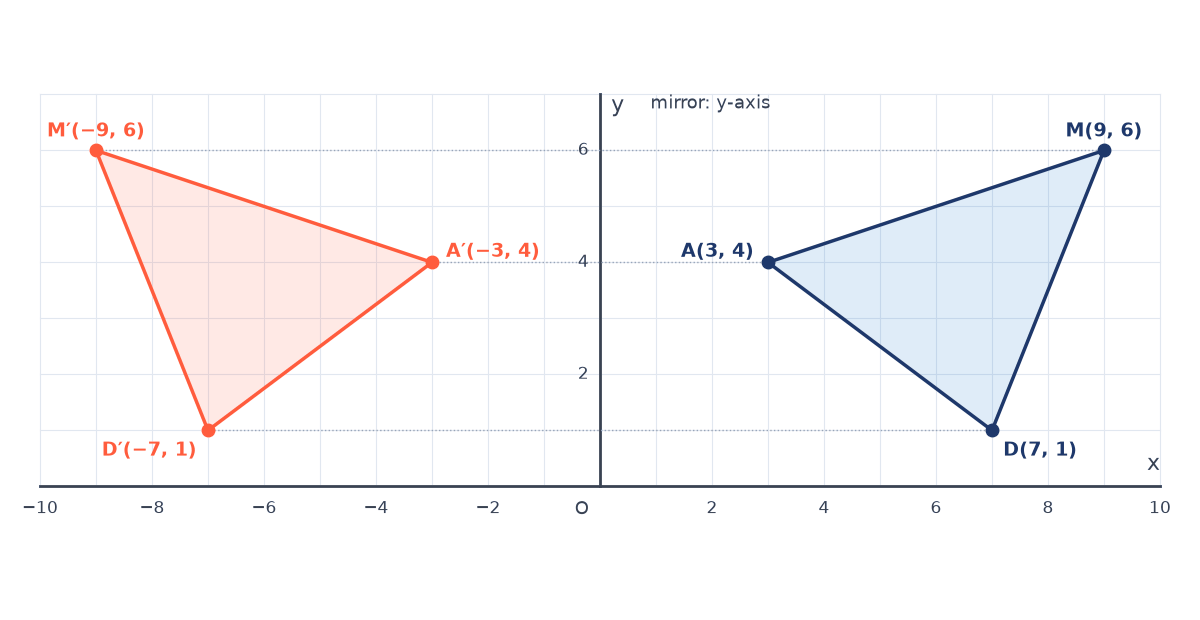
Reflecting a point in the y-axis keeps its height and moves it to the same distance on the other side of the axis, so (x,y) becomes (−x,y). The triangle ADM becomes A′D′M′ with
A′(−3,4),D′(−7,1),M′(−9,6).
The helper point C(3,1) becomes C′(−3,1). Now all x-coordinates are negative, which is a good test of the formula.
Reflection in the y-axis changes the sign of each x-coordinate and keeps each y-coordinate. Matching points are joined by dotted horizontal lines.
For A′D′: the shift across is C′D′=−3−(−7)=4 and the shift in height is A′C′=4−1=3, so
These are exactly the side lengths of ADM. Reflection has kept every length the same.
Why the lengths cannot change
Take any two points (x1,y1) and (x2,y2). Their images are (−x1,y1) and (−x2,y2). The new shift across is −x2−(−x1)=−(x2−x1), which is the old shift with its sign changed, and the shift in height is unchanged. Squaring removes the sign change, so the distance formula gives exactly the same number. This holds for every pair of points, so every length is preserved.
What stays the same, and what changes
The book asks what the reflection keeps and what it alters.
Same: all three side lengths, so the triangle's size and shape are unchanged (its angles and area are unchanged too). The y-coordinates of the vertices are unchanged.
Changed: each x-coordinate has switched sign, the triangle has moved from Quadrant I to Quadrant II, and it is now a mirror image, so going A → D → M turns the opposite way round (clockwise instead of anticlockwise, or the reverse).
Reflecting in the x-axis instead? The same observations hold, with the roles swapped: (x,y) becomes (x,−y), the x-coordinates stay, the y-coordinates switch sign, and the triangle moves from Quadrant I to Quadrant IV. The shift in height changes sign, the shift across does not, and squaring again keeps every length.
Worked example 6: reflecting in the x-axis
Triangle PQR has P(2,1), Q(6,1) and R(6,4). Reflect it in the x-axis and compare the side lengths.
The sides are 4, 3 and 5 in both triangles, so the reflection has preserved all the lengths.
Common mistakes
Adding the coordinates in place of subtracting them. The formula uses differences: x2−x1, not x2+x1.
Losing a sign when subtracting a negative, for example writing 2−(−4)=−2 in place of 6.
Writing a2+b2=a+b. For example, 42+32=5, not 7.
Mixing coordinates, such as subtracting an x-coordinate from a y-coordinate.
Rounding a square root too early. Keep 29 exact until the very end.
Thinking reflection changes lengths because the coordinates change. Only the signs change, and squaring removes them.
Try these
Find the distance between (0,0) and (5,12). Answer: 13 units.
Find the distance between (−3,2) and (3,−6). Answer: 10 units.
Find the distance between (1,−1) and (1,7). Answer: 8 units.
Find the distance between (−2,−3) and (4,5). Answer: 10 units.
Is the triangle with vertices (0,0), (3,4) and (−4,3) isosceles? Answer: Yes; two sides are 5 and the third is 50 (it is also right-angled at the origin).
Reflect the triangle (−5,2), (−1,2), (−1,5) in the y-axis and give its side lengths. Answer:(5,2), (1,2), (1,5); sides 4, 3 and 5, the same as before.
Key terms
Distance formula
The length of the segment joining (x1,y1) and (x2,y2) is (x2−x1)2+(y2−y1)2.
Absolute value
The size of a number without its sign, written ∣a∣; for example ∣−7∣=7.
Baudhāyana–Pythagoras theorem
In a right-angled triangle, the square on the hypotenuse equals the sum of the squares on the other two sides.
Hypotenuse
The side opposite the right angle; the longest side of a right-angled triangle.
Shift
The change in a coordinate when moving from one point to another, such as x2−x1 across.
Reflection in the y-axis
The mirror move that sends (x,y) to (−x,y).
Reflection in the x-axis
The mirror move that sends (x,y) to (x,−y).
Common questions
Does it matter which point I call (x1,y1)?
No. Swapping the points changes the sign of both differences, and squaring removes the signs, so the distance is the same.
Why do we need a right-angled triangle?
The Baudhāyana–Pythagoras theorem only works for right-angled triangles. The horizontal and vertical shifts are always at right angles to each other, so they give us the right-angled triangle we need.
What if the answer is not a whole number?
Leave it as a square root, such as 29, or simplify it, such as 40=210. Give a decimal only if the question asks for one.
Does reflection change the area of a triangle?
No. All three sides keep their lengths, so the reflected triangle is an exact copy of the original, flipped over, and has the same area.
How do I find the distance of a point from the origin?
Use (0,0) as one of the points. The distance of (x,y) from O is x2+y2.
References
National Council of Educational Research and Training. Ganita Manjari: Textbook of Mathematics, Grade 9 (Part I). NCERT, New Delhi.
Sharma, R. D. Mathematics for Class 9. Dhanpat Rai Publications.
Heath, T. L. (trans.) The Thirteen Books of Euclid's Elements. Dover Publications.