How to use this set
Here are twelve questions on the coordinate plane. Please sketch every figure, even a rough one. A quick sketch catches a sign error long before the arithmetic does. And whenever you claim a shape, say which distances you compared and why they settle the matter.
Section A, Locating points
- Write the quadrant or axis of each point: , , , , .
- A point has -coordinate . Describe all the points like this. In which quadrants can lie?
- The points , , and are joined in order. Without plotting, say which pairs of points are mirror images in an axis, and name the axis each time. Then say what shape is, and give your reason.
- Plot , , and . What shape do they form, and what are its side lengths?
Section B, Distances
- Find the perimeter of the triangle with vertices , and .
- Show that , and are the vertices of an equilateral triangle.
- Are the points , and on one straight line?
- A point is equidistant from and and lies on the -axis. Find .
Section C, Midpoints and circles
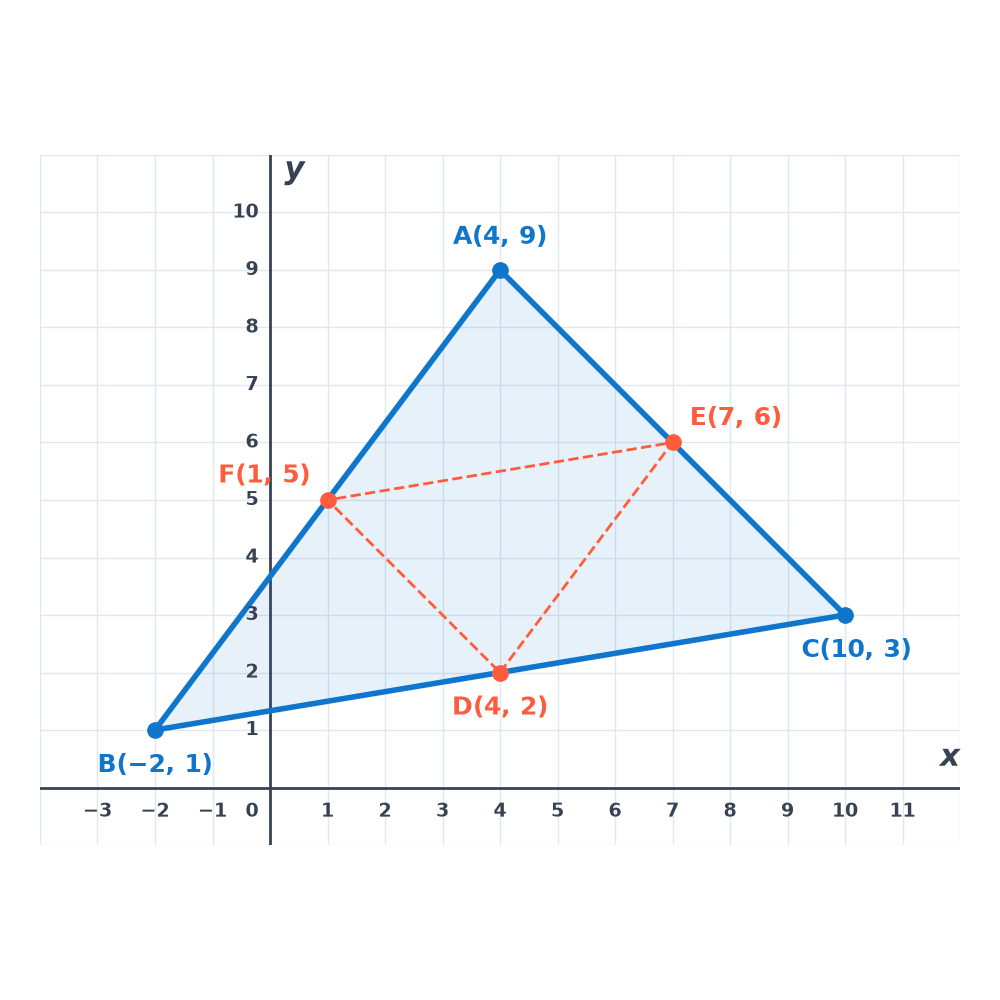
- Find the midpoint of each side of the triangle , , .
- The midpoints of the sides of a triangle are , and . Find the vertices. (Hint: the vertex opposite is found by using that and are midpoints of the two sides through it.)
- Check whether , and lie on a circle centred at the origin. If so, find its radius, and decide whether is inside, on or outside it.
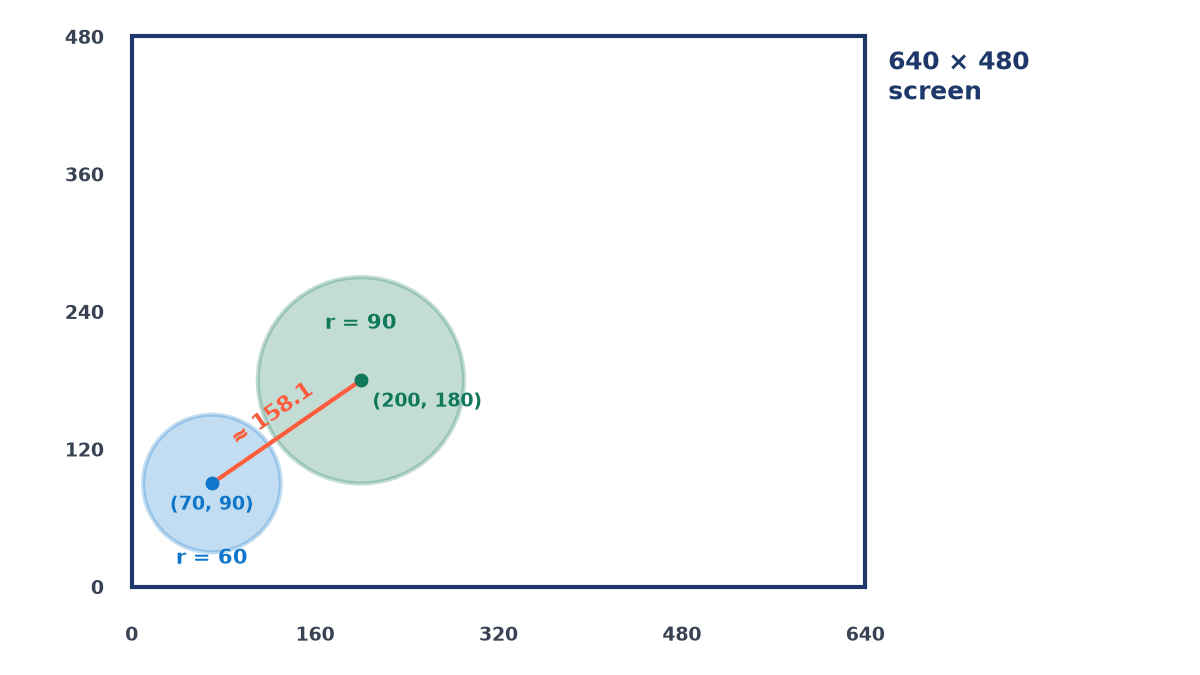
- A screen is pixels wide and high with the origin at its bottom-left corner. A circular icon of radius is centred at ; another of radius is centred at . Does either icon run off the edge of the screen? And do the two icons overlap?
Answers
Show answers
- II; -axis (below ); IV; III; -axis (right of ).
- All points on the horizontal line units above the -axis. Quadrant I when , Quadrant II when ; on the -axis when .
- and are mirror images in the -axis; and in the -axis. All four sides are , so is a rhombus; its diagonals and are unequal, so it is not a square.
- A rectangle: horizontal sides , vertical sides .
- Sides , and . Perimeter .
- to : . to : . to : . All equal.
- ; ; . Since , yes.
- Let . , so , , . .
- , , .
- In any triangle the vertex opposite the midpoint satisfies (the segment is parallel to and half of the side through , so , , and the opposite vertex form a parallelogram). . Similarly and . Check: midpoint of is ✓.
- Distances from : , , . Yes, radius . is from : inside.
- First icon: leftmost point , lowest : on screen. Second: , , and the far edges and are within and : on screen. Centres are apart; the radii add to , so the icons do not overlap.