The Cartesian Coordinate System: Axes and Quadrants, Class 9
Learn the x-axis, y-axis and origin, how signs work in the four quadrants, why (x, y) is an ordered pair, and how to read a floor plan with coordinates, with worked examples for Class 9.
How do you tell a friend exactly where something is? "Near the window" is vague. "Three steps from the door and two steps from the wall" is exact. A coordinate system turns that second kind of description into a pair of numbers. This lesson builds the two-dimensional (2-D) Cartesian coordinate system: the axes, the origin, the signs of coordinates, and the four quadrants, and then uses them to read a floor plan.
Thinking in grids is very old. The textbook describes the cities of the Sindhu-Sarasvatī Civilisation, whose streets ran North–South and East–West at regular gaps of about 10 metres. A trader could find a shop by counting blocks in the two directions from the city centre, which is a coordinate system in practice. Baudhāyana later used East–West and North–South lines in his geometric constructions, including the result we now call the Baudhāyana–Pythagoras theorem.
Coordinates on the Earth mattered for navigation. According to the book, Ujjayinī served in the early Siddhāntas as the central meridian from which other places were measured, and Ptolemy later listed latitudes and longitudes of many places, including Ujjayinī. Āryabhaṭa used sines in place of chords, which made coordinates of stars and cities easier to calculate. Brahmagupta treated zero and negative numbers as numbers in their own right. That is exactly what a modern coordinate plane needs: zero sits at the origin, and negative numbers describe the positions left of it and below it.
These ideas travelled. Al-Bīrūnī used Indian methods to find the coordinates of cities, and Omar Khayyām solved algebra problems by thinking of them as positions in a plane. Finally, following related work by Fermat, René Descartes set out the idea that any point of a plane is fixed by two numbers, its distances from two perpendicular lines. His name gives us the word "Cartesian".
The chapter follows Reiaan, who cannot see, as he settles into a new home. His sister Shalini builds him a model of his room on a board, using pins for key points and wool to join them, at a scale of 1 cm for 1 foot. Reiaan can then find every corner with his fingers.
Why the windows cannot be shown. Shalini's map shows only the floor. A window is set into a wall, some height above the floor. A flat floor map records positions across the floor (left–right and front–back) but has no way to show height, so a window has no place on it. Showing height would need a third direction, which is a 3-D coordinate system.
You already know the number line: one line, one number for each point. That is a one-dimensional system. For a flat surface we use two number lines that cross at right angles.
The horizontal line is the x-axis.
The vertical line is the y-axis.
They cross at the origin O, whose coordinates are (0,0).
Equal units are marked along both axes, starting from O. Distances to the right of O and above O count as positive. Distances to the left of O and below O count as negative. The plane that holds the axes is called the Cartesian plane, the coordinate plane, or the xy-plane.
A point on the x-axis has not moved up or down at all, so its second coordinate is 0: it has the form (x,0). If x>0 it is right of O; if x<0 it is left of O. For example, (4.5,0) is 4.5 units to the right of O.
A point on the y-axis has not moved left or right, so its first coordinate is 0: it has the form (0,y). If y>0 it is above O; if y<0 it is below O. For example, (0,−4.5) is 4.5 units below O and (0,4) is 4 units above O.
We often write P(x,y) in place of P=(x,y), especially when labelling a graph.
Write the coordinates of: (a) a point K on the x-axis, 7 units left of O; (b) a point L on the y-axis, 2.5 units above O; (c) the distance between K and the point (3,0).
(a) K is on the x-axis, so its y-coordinate is 0. Left means negative, so K =(−7,0).
(b) L is on the y-axis, so its x-coordinate is 0. Up means positive, so L =(0,2.5).
(c) Both points are on the x-axis, so the distance is the gap between their x-coordinates: 3−(−7)=10 units.
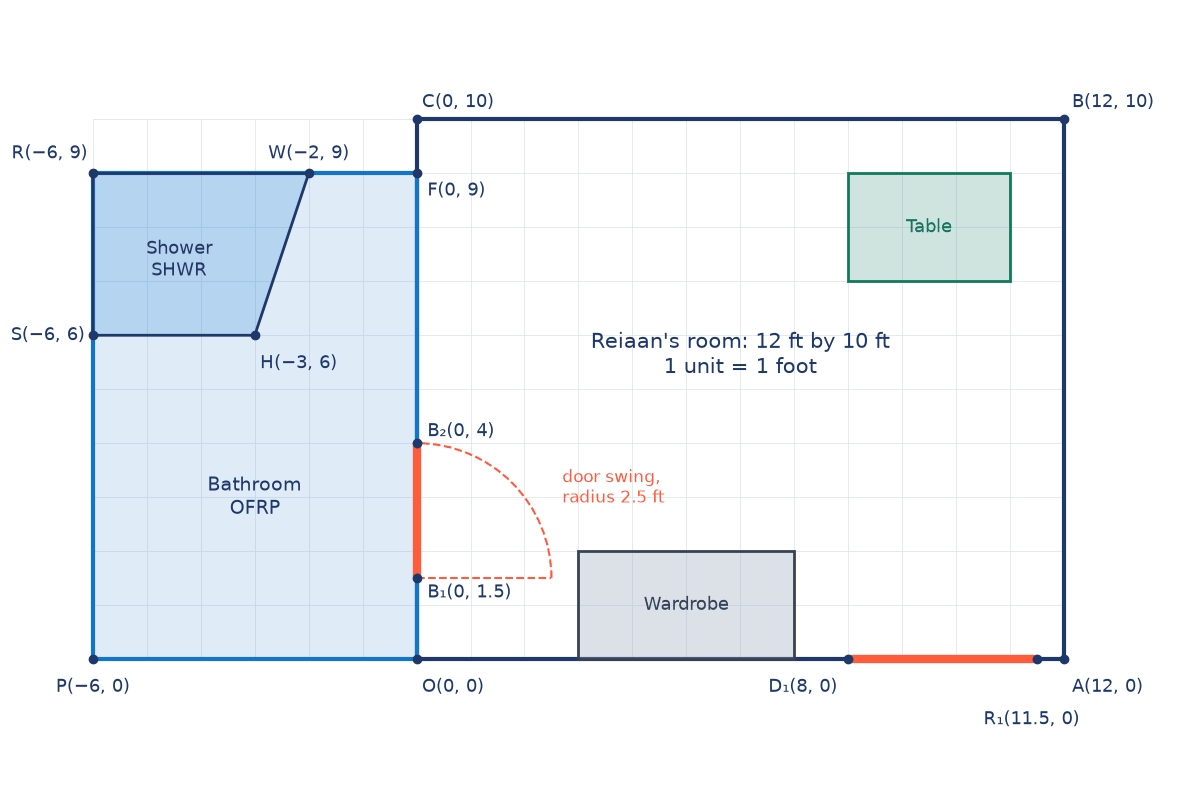
In the book, Reiaan's room is a rectangle OABC with O(0,0), A(12,0), B(12,10) and C(0,10), measured in feet. The left wall lies along the y-axis and the front wall, with the door, lies along the x-axis. The figure below redraws the plan with the points read from the book's sketch.
Reiaan's room (12 ft by 10 ft) with the bathroom on its left. The door D₁R₁ is on the x-axis and the bathroom door B₁B₂ is on the y-axis. The dashed arc shows the bathroom door swinging open.
The room door D₁R₁ lies on the x-axis, so it is 0 feet from the x-axis. On the sketch, D₁ is at the 8 mark, so D₁ =(8,0) and the door begins 8 feet from the left wall. With R₁ =(11.5,0), the door is 11.5−8=3.5 feet wide. Whether this is comfortable, and whether a wheelchair can pass, is something to judge by measuring: compare 3.5 feet with the width of a wheelchair, remembering that the user also needs space for the hands on the wheels.
The bathroom door runs from B₁(0,1.5) to B₂(0,4) along the y-axis, so its width is 4−1.5=2.5 feet. It is narrower than the room door by 1 foot.
Think and Reflect. The book does not give standard door widths; it asks you to find them. Measure the doors at home and at school, and write the widths in feet. A wheelchair user needs a clear opening wider than the chair itself, with room for the hands, so measure a wheelchair too if you can. Then decide which of your school's doors are wide enough, and notice that the 2.5-foot bathroom door here is 1 foot narrower than the room door.
The wardrobe stands on the x-axis from W₁(3,0) to W₂(7,0) and is 2 feet deep, so its back corners are (3,2) and (7,2).
Study table. A rectangular table has feet at (8,9), (11,9) and (11,7). The fourth foot must line up with (8,9) vertically and with (11,7) horizontally, so it is at (8,7). The table is 11−8=3 feet long and 9−7=2 feet wide. It sits in the free back-right corner, clear of the bed and the door. Its height cannot be found: a floor plan shows no heights.
Bathroom door swing. Hinged at B₁, a 2.5-foot door sweeps a quarter circle of radius 2.5 feet and reaches x=2.5 at most. The wardrobe starts at x=3, so the door clears it by half a foot. A door wider than 3 feet, hinged at the same place, would hit the wardrobe, so a wider door would need the wardrobe moved or the hinge changed.
Bathroom. Its corners are O(0,0), F(0,9), R(−6,9) and P(−6,0): a 6 ft by 9 ft rectangle to the left of the y-axis, so its x-coordinates are negative.
Shower area SHWR. S(−6,6), H(−3,6), W(−2,9), R(−6,9). SH and WR are both horizontal, so they are parallel; the other two sides are not parallel. The shape is a trapezium, with right angles at S and R.
The dining room is 18 ft long and 15 ft wide, and its length runs from P(−6,0) to A(12,0). The room door is on the x-axis, so the dining room lies below it. Place a 5 ft by 3 ft table exactly in the middle.
The length checks out: 12−(−6)=18. Going 15 feet down from P and A gives the other corners, (−6,−15) and (12,−15).
The centre is halfway across and halfway down: x =2−6+12=3 and y =20+(−15)=−7.5, so the centre is (3,−7.5).
With the 5-foot side running left–right, the table stretches 2.5 feet each side of x=3 and 1.5 feet each side of y=−7.5. Its feet are at (0.5,−6), (5.5,−6), (5.5,−9) and (0.5,−9).
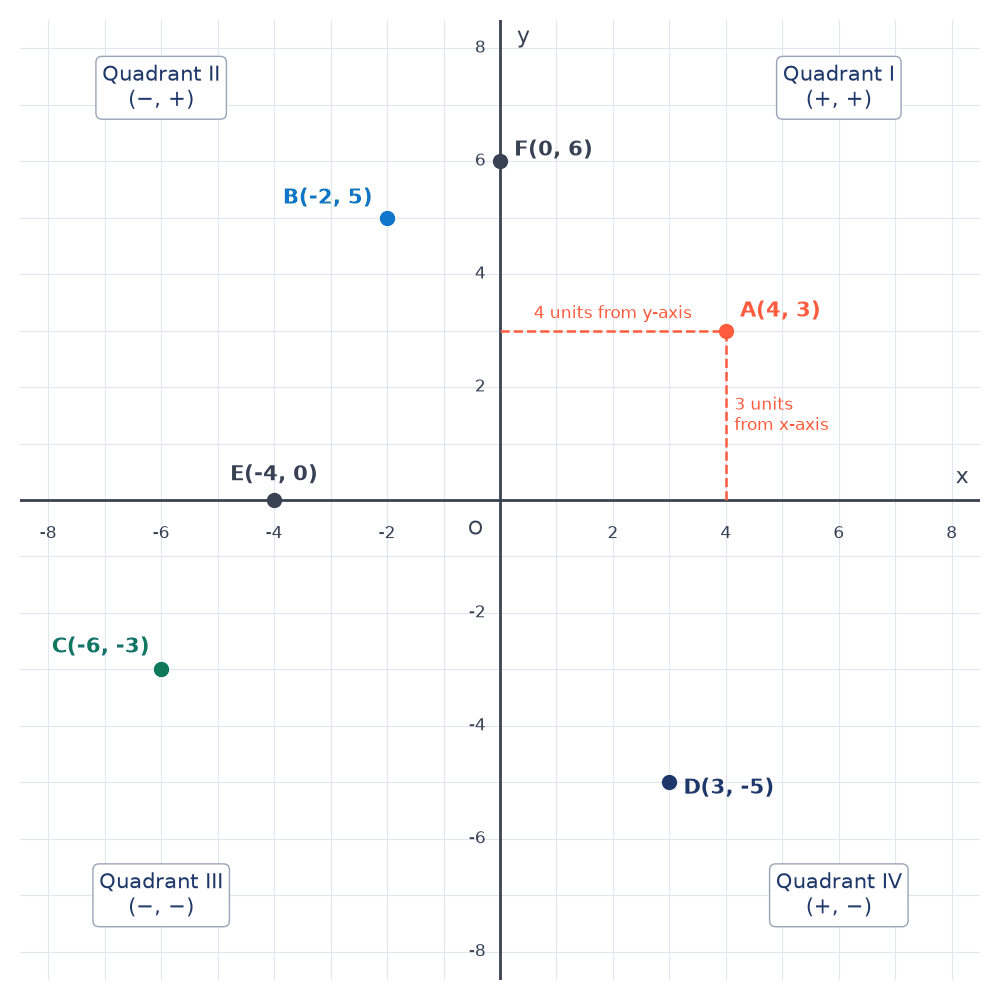
The axes cut the plane into four quadrants, numbered I to IV going anticlockwise from the top right.
Quadrant I: (+,+), right and up.
Quadrant II: (−,+), left and up.
Quadrant III: (−,−), left and down.
Quadrant IV: (+,−), right and down.
A point on an axis belongs to no quadrant. For example, (3,−5) is in Quadrant IV and (−5,3) is in Quadrant II.
The four quadrants and their sign patterns. A(4, 3) is 4 units from the y-axis and 3 units from the x-axis. E and F lie on the axes, so they are in no quadrant.
Say where each point lies: (−6,−3), (4,3), (0,6), (−2,5), (3,−5), (−4,0).
(−6,−3): both negative, so Quadrant III. (4,3): both positive, so Quadrant I. (0,6): x is 0, so it is on the y-axis. (−2,5): signs (−,+), so Quadrant II. (3,−5): signs (+,−), so Quadrant IV. (−4,0): y is 0, so it is on the x-axis. All six are plotted in the figure above.
What is the x-coordinate of a point on the y-axis? Always 0, because such a point is at zero distance from the y-axis.
Is there a similar rule for the x-axis? Yes: every point on the x-axis has y-coordinate 0.
Can Q(y,x) be the same point as P(x,y)? Two points are the same only when their x-coordinates match and their y-coordinates match. For P and Q that means x=y and y=x, which both say x=y. So they coincide exactly when x=y, for example (2,2). If x=y they are different points.
Is it true that (x,y)=(y,x) when x=y, and (x,y)=(y,x) exactly when x=y? Yes, that is precisely what the reasoning in point 3 shows.
This is why (x,y) is called an ordered pair: (2,7) and (7,2) are different places.
A rectangle has corners (−3,−1), (4,−1) and (4,5). Find the fourth corner, the length, the width and the area.
The corners (−3,−1) and (4,−1) share the y-coordinate −1, so they form a horizontal side of length 4−(−3)=7. The corners (4,−1) and (4,5) share the x-coordinate 4, so they form a vertical side of length 5−(−1)=6.
The fourth corner must be straight above (−3,−1) and level with (4,5), so it is (−3,5). The rectangle is 7 units by 6 units, and its area is 7×6=42 square units.
Worked example 5: reading signs without numbers#
If a>0 and b<0, in which quadrants are (a,b), (b,a) and (−a,b)?
(a,b) has signs (+,−), so it is in Quadrant IV. (b,a) has signs (−,+), so it is in Quadrant II. (−a,b): since a is positive, −a is negative, so the signs are (−,−) and it is in Quadrant III.
Without them we could only describe points to the right of and above the origin. Negative numbers let us name points on the left and below, so every point of the plane gets a pair of numbers.
By agreement the horizontal line is the x-axis and the vertical line is the y-axis. Everyone uses the same rule, so a pair such as (3,−5) means the same point to every reader.
Start at O. Move along the x-axis by the first number (right if positive, left if negative), then move parallel to the y-axis by the second number (up if positive, down if negative).