Class 9 Coordinates: End-of-Chapter Exercises Solutions
Step-by-step solutions to all 16 end-of-chapter questions on coordinates in Class 9 Ganita Manjari: quadrants, distances, collinear points, midpoints, trisection, circles and a tilted square.
The end-of-chapter questions of "Orienting Yourself: The Use of Coordinates" practise three skills: reading and placing points in the four quadrants, finding distances with the Baudhāyana–Pythagoras theorem, and using those distances to decide things about shapes, such as whether three points lie on one line, whether a quadrilateral is a square, or whether two circles meet. Several questions also ask you to discover the midpoint rule for yourself. Every solution below is worked in full, step by step.
Facts used again and again:
The origin is O(0,0). A point on the x-axis has the form (x,0); a point on the y-axis has the form (0,y).
Signs in the quadrants: I is (+,+), II is (−,+), III is (−,−), IV is (+,−).
Points with the same y-coordinate lie on a line parallel to the x-axis, and their distance is ∣x2−x1∣. Points with the same x-coordinate lie on a line parallel to the y-axis, and their distance is ∣y2−y1∣.
Distance formula: PQ=(x2−x1)2+(y2−y1)2.
The mirror image of (x,y) in the x-axis is (x,−y); in the y-axis it is (−x,y).
Midpoint of the segment joining (x1,y1) and (x2,y2): (2x1+x2,2y1+y2) (found in Question 9).
Points, axes and quadrants
Question 1
What are the x-coordinate and the y-coordinate of the point where the two axes cross?
The axes cross at the origin O. The origin is at zero distance from the y-axis and zero distance from the x-axis, so both its coordinates are 0.
Answer: The x-coordinate is 0 and the y-coordinate is 0; the point is O(0,0).
Question 2
Point W has x-coordinate −5. Point H lies on the line through W that is parallel to the y-axis. What can you say about the coordinates of H, and in which quadrants can H lie?
A line parallel to the y-axis is a vertical line. Every point on it is at the same distance from the y-axis, so every point on it has the same x-coordinate. The line through W therefore consists of all points with x-coordinate −5.
So H has the form (−5,y), where y can be any number. Its x-coordinate is negative, so H is to the left of the y-axis:
if y>0, H has signs (−,+) and lies in Quadrant II;
if y<0, H has signs (−,−) and lies in Quadrant III;
if y=0, H is the point (−5,0) on the x-axis, which is in no quadrant.
Answer: H =(−5,y) for some number y; H lies in Quadrant II (if y>0) or Quadrant III (if y<0), or on the x-axis at (−5,0) if y=0.
Question 3
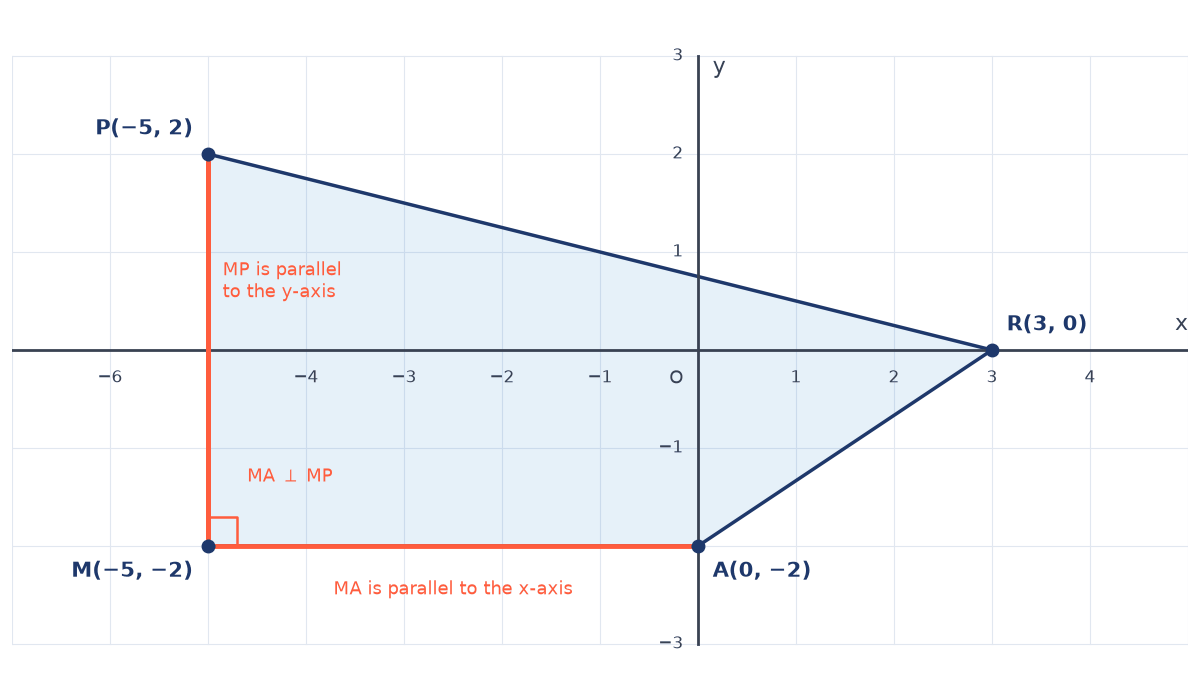
The points R(3,0), A(0,−2), M(−5,−2) and P(−5,2) are joined in this order to make RAMP. Predict (i) two sides that are perpendicular to each other, (ii) one side that is parallel to one of the axes, and (iii) two points that are mirror images of each other in one axis, naming the axis. Then plot the points and check.
(i) The sides are RA, AM, MP and PR. A and M have the same y-coordinate, −2, so AM is horizontal. M and P have the same x-coordinate, −5, so MP is vertical. A horizontal line and a vertical line are always at right angles, so AM ⊥ MP, with the right angle at M.
No other corner is a right angle. We can test each with the converse of the Baudhāyana–Pythagoras theorem, using RA2=13, AM2=25, MP2=16, PR2=68 and the diagonals RM2=68, AP2=41. At R: 13+68=81=41. At A: 13+25=38=68. At P: 16+68=84=68. At M: 25+16=41=AP2, which confirms the right angle there.
(ii) AM lies on the line y=−2, so it is parallel to the x-axis. (MP, on the line x=−5, is parallel to the y-axis, so either answer is correct.)
(iii) M(−5,−2) and P(−5,2) have the same x-coordinate and opposite y-coordinates. Reflecting M in the x-axis changes only the sign of the y-coordinate, which gives P. So M and P are mirror images in the x-axis. The x-axis cuts MP at (−5,0), exactly halfway, since each point is 2 units from it.
RAMP plotted: MA is parallel to the x-axis, MP is parallel to the y-axis, and they meet at a right angle at M. M and P are mirror images in the x-axis.
The plot confirms all three predictions.
Answer: (i) AM and MP are perpendicular (right angle at M). (ii) AM is parallel to the x-axis (also MP is parallel to the y-axis). (iii) M(−5,−2) and P(−5,2) are mirror images in the x-axis.
Question 4
Plot Z(5,−6). Build a right-angled triangle IZN and find the lengths of its three sides. (Different students will get different answers.)
Z is in Quadrant IV. The easiest right-angled triangle uses one horizontal side and one vertical side. Here is one choice:
N(5,0), straight above Z on the x-axis;
I(−3,0), on the x-axis to the left of N.
NZ is vertical (same x-coordinate) and IN is horizontal (same y-coordinate), so the angle at N is a right angle.
Check: 82+62=64+36=100=102, as the Baudhāyana–Pythagoras theorem requires.
Answer: One possible triangle is I(−3,0), Z(5,−6), N(5,0) with the right angle at N; IN =8 units, NZ =6 units, IZ =10 units. Other choices of I and N give other correct answers.
Question 5
What would a coordinate system be like without negative numbers? Could it locate every point of a 2-D plane?
Without negative numbers each coordinate could only be zero or positive. The x-coordinate tells us how far right of the y-axis a point is, and the y-coordinate how far above the x-axis. We would have no way to say "to the left" or "below".
So the system could only describe Quadrant I together with the positive parts of the two axes and the origin. A point such as (−2,3), (−4,−1) or (3,−5) could not be named, so Quadrants II, III and IV would be out of reach.
One way round this is to move the origin to the bottom-left corner of the region we care about, as a computer screen does in Question 15. That works for a limited region, but it can never cover the whole, endless plane: whatever corner we choose, there are points to its left or below it.
Answer: It would only describe points with both coordinates zero or positive (Quadrant I and the positive half-axes). It would not locate all points of the plane; points in Quadrants II, III and IV need negative coordinates.
Collinear points and triangles
Question 6
Do M(−3,−4), A(0,0) and G(6,8) lie on one straight line? Suggest a method that does not need plotting.
Method. Find the three distances between the points. If the two shorter distances add up exactly to the longest, the points lie on one line, with the middle point between the other two. If the sum is larger, the three points form a triangle (the path through the middle point is a detour).
Since MA+AG=5+10=15=MG, the three points lie on one line, with A between M and G.
A second check: from M to A we move 3 right and 4 up; from A to G we move 6 right and 8 up. The second step is exactly twice the first, so both steps go in the same direction.
Answer: Yes, M, A and G are on the same straight line, because MA+AG=5+10=15=MG. Method: compare the sum of the two shorter distances with the longest distance.
Question 7
Use the same method to check whether R(−5,−1), B(−2,−5) and C(4,−12) lie on one straight line. Then plot both sets of points and check.
Is 5+85 equal to 202? Both sides are positive, so we may compare their squares:
(5+85)2=25+1085+85=110+1085.
For this to equal 202 we would need 1085=92, that is 85=9.2, so 85=84.64, which is false. In fact 85>9.2, so 5+85 is a little bigger than 202 (about 14.22 against about 14.21). The two sums are very close, which is why a rough drawing can fool you, but they are not equal.
The step check agrees: from R to B we move 3 right and 4 down; from B to C we move 6 right and 7 down. If the direction were the same, the second step would be exactly twice the first, that is 6 right and 8 down. It is 7 down, so the path bends at B.
When plotted, M, A, G fall on one line through the origin, while R, B, C make a very flat triangle.
Answer: No. RB=5, BC=85, RC=202, and 5+85=202, so R, B and C are not on one straight line (they form a very thin triangle).
Question 8
Using the origin as one vertex, plot the vertices of (i) a right-angled isosceles triangle, and (ii) an isosceles triangle with one vertex in Quadrant III and another in Quadrant IV.
(i) Take O(0,0), K(4,0) and L(0,4). OK lies along the x-axis and OL along the y-axis, so the angle at O is a right angle. OK=4 and OL=4, so two sides are equal. The third side is KL=16+16=32=42.
(ii) Take O(0,0), U(−3,−4) in Quadrant III and V(3,−4) in Quadrant IV. U and V are mirror images in the y-axis, so they are equally far from O:
OU=9+16=5,OV=9+16=5,UV=∣3−(−3)∣=6.
Two equal sides make the triangle isosceles.
Answer: (i) One example: O(0,0), (4,0), (0,4), with legs 4 and 4 and a right angle at O. (ii) One example: O(0,0), (−3,−4), (3,−4), with OU=OV=5. Many other answers are possible.
Midpoints and trisection points
Question 9
For each row, decide whether M is the midpoint of ST, and give a reason. Then find a connection between the coordinates of M, S and T when M is the midpoint.
S
M
T
Midpoint?
Reason
(−3,0)
(0,0)
(3,0)
Yes
All three are on the x-axis; SM=3 and MT=3.
(2,3)
(3,4)
(4,5)
Yes
S to M is 1 right, 1 up; M to T is again 1 right, 1 up. So M is on ST and SM=MT=2.
(0,0)
(0,5)
(0,−10)
No
All are on the y-axis, but M is not between S and T; SM=5, MT=15. The midpoint is (0,−5).
(−8,7)
(0,−2)
(6,−3)
No
S to M is 8 right, 9 down; M to T is 6 right, 1 down. The steps differ, so SM=MT and M is not even on ST. The midpoint is (−1,2).
The connection. In the two "Yes" rows, the x-coordinate of M is exactly halfway between those of S and T, and the same holds for the y-coordinates: 0=2−3+3 and 0=20+0; 3=22+4 and 4=23+5.
Why this always works: going from S to T we move x2−x1 across and y2−y1 up. Going exactly half of each move takes us along the segment to the point halfway, since the two halves are identical steps in the same direction. Half the move across lands at x1+2x2−x1=2x1+x2, and similarly for y. So for S(x1,y1) and T(x2,y2),
M=(2x1+x2,2y1+y2).
Answer: Row 1: Yes. Row 2: Yes. Row 3: No (midpoint is (0,−5)). Row 4: No (midpoint is (−1,2)). Connection: each coordinate of the midpoint is the average of the corresponding coordinates of S and T.
Question 10
M(−7,1) is the midpoint of A(3,−4) and B(x,y). Find B.
By the midpoint rule,
23+x=−7and2−4+y=1.
From the first, 3+x=−14, so x=−17. From the second, −4+y=2, so y=6.
Check: 23+(−17)=2−14=−7 and 2−4+6=1. Correct.
Answer: B =(−17,6).
Question 11
P and Q divide AB into three equal parts, with P nearer to A and Q nearer to B. Explain how to find P and Q using the midpoint idea, and do it for A(4,7) and B(16,−2).
Method. Since AP=PQ=QB, the point P is the midpoint of AQ, and Q is the midpoint of PB. Put these two facts together.
From "Q is the midpoint of PB": Q=2P+B (working with each coordinate separately). From "P is the midpoint of AQ": 2P=A+Q=A+2P+B. Multiplying by 2 gives 4P=2A+P+B, so 3P=2A+B. In the same way 3Q=A+2B. So
Check with midpoints: the midpoint of A(4,7) and Q(12,1) is (8,4)=P, and the midpoint of P(8,4) and B(16,−2) is (12,1)=Q. Also each of AP, PQ, QB is 42+32=5 units long, so the three parts are equal.
Another way to see it: from A to B we move 12 right and 9 down. One third of that move is 4 right and 3 down. Taking that step once from A gives (8,4); taking it twice gives (12,1).
Answer: P is the midpoint of AQ and Q is the midpoint of PB, which gives P=32A+B and Q=3A+2B. For A(4,7), B(16,−2): P =(8,4) and Q =(12,1).
Circles, triangles and squares
Question 12
(i) Show that A(1,−8), B(−4,7) and C(−7,−4) lie on a circle K with centre O(0,0), and find its radius. (ii) Decide whether D(−5,6) and E(0,9) lie inside, on, or outside K.
(i) A circle with centre O is the set of points at one fixed distance from O. Find each distance from O:
All three are equal, so A, B and C lie on the circle with centre O and radius 65≈8.06 units.
(ii) Compare each distance with 65. It is enough to compare the squares with 65.
OD2=25+36=61<65, so D is inside K.
OE2=0+81=81>65, so E is outside K (OE=9).
Answer: (i) OA=OB=OC=65, so they lie on K; the radius is 65≈8.06 units. (ii) D is inside K (OD=61) and E is outside K (OE=9).
Question 13
D(5,1), E(6,5) and F(0,3) are the midpoints of the sides of triangle ABC. Find A, B and C.
The question does not say which midpoint belongs to which side. We take the usual labelling: D is the midpoint of BC, E of CA, and F of AB. Write A=(a1,a2) and so on. The midpoint rule gives, for the x-coordinates,
b1+c1=10,c1+a1=12,a1+b1=0.
Adding all three: 2(a1+b1+c1)=22, so a1+b1+c1=11. Then
a1=11−10=1,b1=11−12=−1,c1=11−0=11.
For the y-coordinates: b2+c2=2, c2+a2=10, a2+b2=6. Adding: a2+b2+c2=9. Then
a2=9−2=7,b2=9−10=−1,c2=9−6=3.
So A =(1,7), B =(−1,−1), C =(11,3).
Check: midpoint of BC =(2−1+11,2−1+3)=(5,1)=D; midpoint of CA =(211+1,23+7)=(6,5)=E; midpoint of AB =(21−1,27−1)=(0,3)=F.
A quick rule falls out of this: each vertex equals the sum of the two midpoints next to it minus the opposite midpoint, for example A=E+F−D. If the midpoints are matched to the sides differently, the same three points A, B, C come out, just with their letters swapped.
Answer: With D, E, F the midpoints of BC, CA, AB: A =(1,7), B =(−1,−1), C =(11,3).
Coordinates in real situations
Question 14
A city has two main roads crossing at its centre, one running North–South and one East–West. All other streets are parallel to these and 200 m apart. There are 10 streets in each direction. (i) Using 1 cm for 200 m, draw a model of the city, showing each street as a single line. (ii) A crossing is named by its N–S street number and then its E–W street number; for example, the 2nd N–S street and the 5th E–W street meet at (2, 5). With this rule, how many crossings can be called (a) (4, 3), and (b) (3, 4)?
(i) Draw 10 vertical lines 1 cm apart for the N–S streets and 10 horizontal lines 1 cm apart for the E–W streets. Number them 1 to 10, the vertical ones from left (west) to right and the horizontal ones from bottom (south) to top, and draw the two main roads more thickly. The grid of 10 lines has 9 gaps, so (taking the main roads to be among the 10 streets) the model is a square of side 9 cm, which stands for 9×200=1800 m.
(ii) Each N–S street crosses each E–W street exactly once, because a vertical line and a horizontal line meet in exactly one point. There are 10×10=100 crossings, and each has its own label.
(a) (4, 3) means the 4th N–S street and the 3rd E–W street. There is only one 4th N–S street and only one 3rd E–W street, and they meet at one point. So exactly one crossing is (4, 3).
(b) In the same way, exactly one crossing is (3, 4): the 3rd N–S street meeting the 4th E–W street.
These are two different crossings. The order in the label matters, just as (4,3) and (3,4) are different points on a graph. This street-naming rule is a coordinate system in everyday use.
Answer: (i) A 10 by 10 grid of lines 1 cm apart (a 9 cm by 9 cm square). (ii) (a) Exactly one crossing is (4, 3). (b) Exactly one crossing is (3, 4), and it is a different crossing from (4, 3).
Question 15
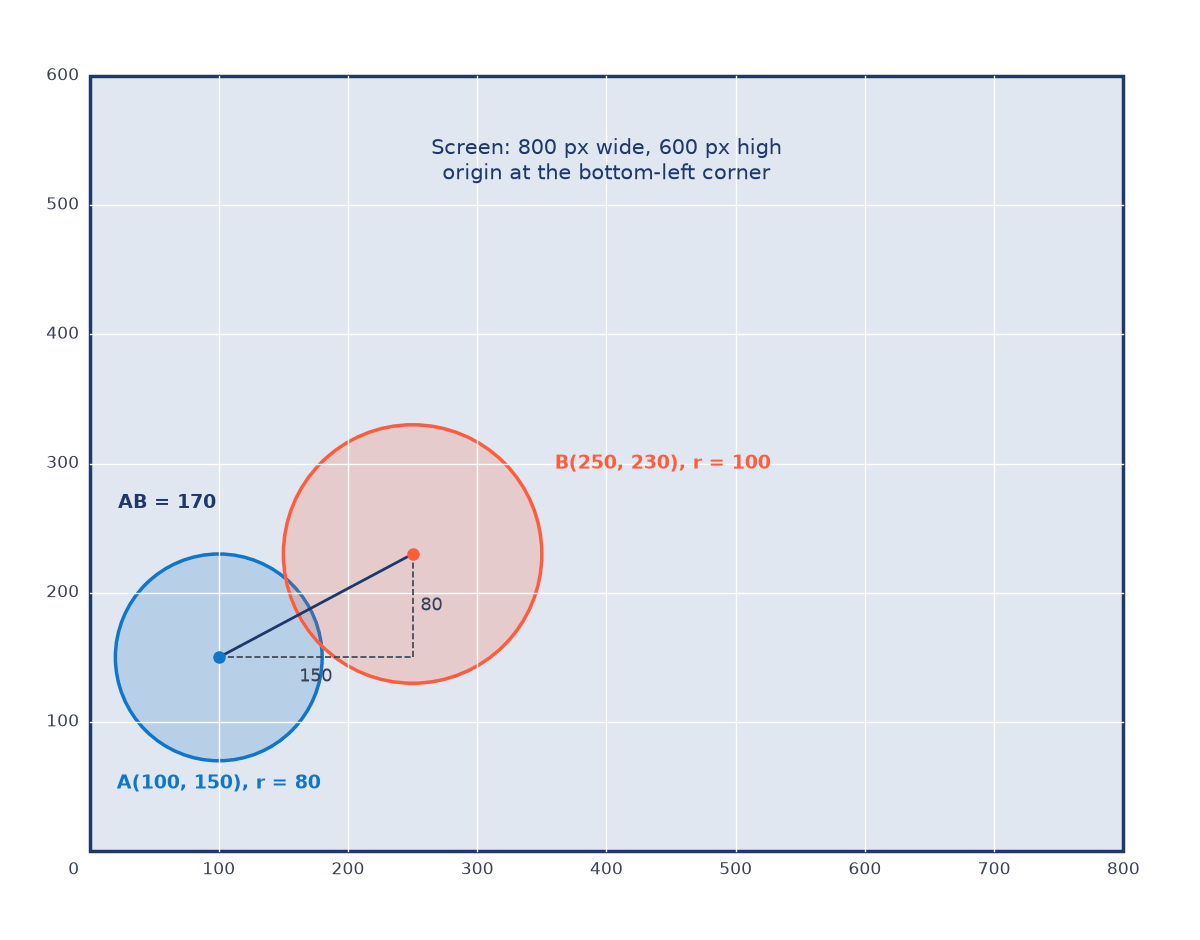
A computer screen is 800 pixels wide and 600 pixels high, with the origin at its bottom-left corner. One circular icon has radius 80 pixels and centre A(100,150). Another has radius 100 pixels and centre B(250,230). Find (i) whether any part of either circle goes off the screen, and (ii) whether the two circles cross each other.
(i) The screen is the rectangle where 0≤x≤800 and 0≤y≤600. A circle reaches exactly one radius left, right, down and up from its centre, so check those four extreme values.
Circle at A, radius 80: x from 100−80=20 to 100+80=180; y from 150−80=70 to 150+80=230. All lie inside the screen.
Circle at B, radius 100: x from 250−100=150 to 250+100=350; y from 230−100=130 to 230+100=330. All lie inside the screen.
The sum of the radii is 80+100=180 and their difference is 100−80=20.
If the centres were farther apart than 180, the circles would be separate.
If the centres were closer than 20, the smaller circle would sit inside the larger one.
Here 20<170<180: the centres are close enough for the circles to overlap, but not so close that one is inside the other.
So the two circles cross each other (at two points), overlapping by 180−170=10 pixels along the line joining the centres.
Both icons stay on the screen. The centres are 150 across and 80 up from each other, so AB = 170, which is less than 80 + 100 = 180: the circles overlap.
Answer: (i) No part of either circle lies outside the screen (they reach from x = 20 to 350 and from y = 70 to 330). (ii) Yes, they intersect, because the distance between the centres, 170 pixels, is less than 80+100=180 and more than 100−80=20.
Question 16
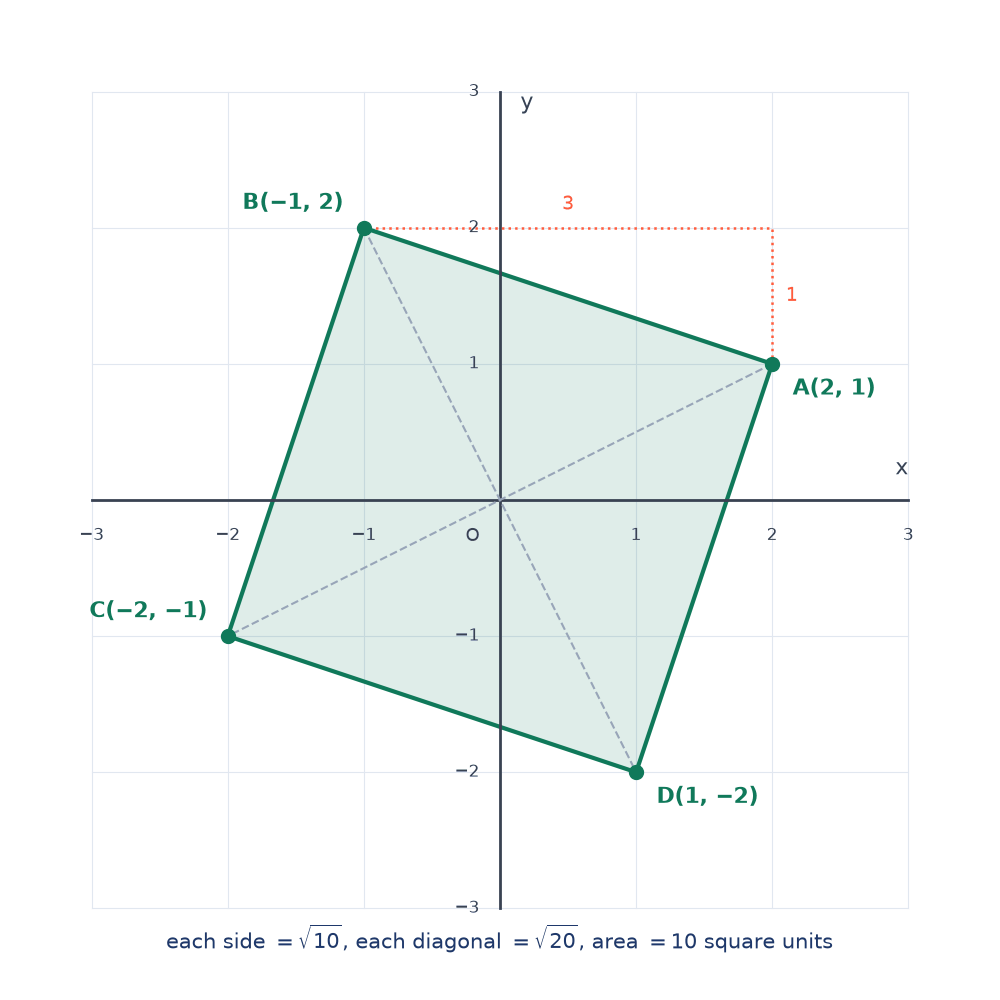
Plot A(2,1), B(−1,2), C(−2,−1) and D(1,−2). Is ABCD a square? Explain, and find its area.
All four sides are equal, so ABCD is at least a rhombus.
A right angle. The diagonal AC=(2+2)2+(1+1)2=16+4=20. In triangle ABC, AB2+BC2=10+10=20=AC2. By the converse of the Baudhāyana–Pythagoras theorem, the angle at B is a right angle. A rhombus with one right angle has all four angles right angles (neighbouring angles of a rhombus add to 180∘), so it is a square.
As a further check, the other diagonal is BD=(1+1)2+(−2−2)2=4+16=20, equal to AC, as the diagonals of a square must be. Both diagonals also have the same midpoint, the origin.
ABCD is a tilted square centred at O. Side AB is found from a step of 3 across and 1 up, so each side is √10 and the area is 10 square units.
Area. Area of a square =side2=(10)2=10 square units.
Check without the formula: the square fits inside the 4 by 4 box from −2 to 2 in each direction, whose area is 16. The four corner triangles left over are each right-angled with legs 3 and 1, of area 21×3×1=1.5. So the area is 16−4×1.5=10 square units.
Answer: Yes, ABCD is a square: all sides equal 10, the angle at B is a right angle since 10+10=20=AC2, and the diagonals are both 20. Its area is 10 square units.
Key terms
Origin
The point where the x-axis and y-axis cross, with coordinates (0,0).
Quadrant
One of the four regions into which the axes divide the plane, numbered I to IV anticlockwise from the top right.
Distance formula
(x2−x1)2+(y2−y1)2, the length of the segment joining (x1,y1) and (x2,y2).
Collinear points
Points that lie on one straight line; for three points, the two shorter distances add up to the longest.
Midpoint
The point halfway along a segment; its coordinates are the averages of the endpoints' coordinates.
Points of trisection
The two points that divide a segment into three equal parts.
Mirror image in an axis
The point obtained by reflection: (x,y) becomes (x,−y) in the x-axis and (−x,y) in the y-axis.
Circle
All the points at one fixed distance (the radius) from a fixed point (the centre).
Common questions
How do I check whether three points are on one line without drawing?
Find the three distances between them. If the two smaller ones add up exactly to the largest, the points are on one line. If the sum is larger, they form a triangle. Compare exact values, such as square roots, not rounded decimals, because the difference can be tiny.
Why is it enough to compare squares when testing a point against a circle?
Distances are never negative, and for non-negative numbers the bigger number always has the bigger square. So OD<r exactly when OD2<r2, and squares avoid square roots.
Does the order of the points matter in the distance formula?
No. Swapping the points changes the sign of each difference, but squaring removes the sign, so PQ=QP.
How do I tell whether two circles meet?
Compare the distance d between the centres with the radii r1 and r2. If d>r1+r2 they are apart; if d=r1+r2 they touch; if ∣r1−r2∣<d<r1+r2 they cross at two points; if d<∣r1−r2∣ one lies inside the other.
Is a quadrilateral with four equal sides always a square?
No. It is a rhombus, which can be squashed. You also need a right angle, or equal diagonals, before you can call it a square.
References
National Council of Educational Research and Training. Ganita Manjari: Textbook of Mathematics, Grade 9 (Part I). NCERT, New Delhi.
Sharma, R. D. Mathematics for Class 9. Dhanpat Rai Publications.
Stewart, J., Redlin, L. and Watson, S. Precalculus: Mathematics for Calculus. Cengage Learning.