Trigonometric Ratios of 0°, 30°, 45°, 60° and 90°, Class 10
Derive the exact trigonometric ratios of 0, 30, 45, 60 and 90 degrees from simple triangles, learn the full table with its not-defined entries, and use it to evaluate expressions and find unknown angles.
A handful of angles, namely 0∘, 30∘, 45∘, 60∘ and 90∘, have trigonometric ratios that can be written exactly, without a calculator. Board questions rely on them heavily: you will evaluate expressions built from them, solve simple equations such as sin(A−B)=21, and use them in every heights-and-distances problem. This lesson derives each value from a triangle, so that you can rebuild the table in the examination hall even if memory fails.
What we mean by a standard angle
For most acute angles the ratios are irrational numbers with no neat form. For the angles below, simple geometry gives exact values, because the triangles involved are half a square or half an equilateral triangle. Throughout, ∠A is an acute angle in a triangle right-angled at B, and the definitions are the ones you already know: sinA=hypotenuseopposite, cosA=hypotenuseadjacent and tanA=adjacentopposite.
Deriving the values
The ratios of 45°
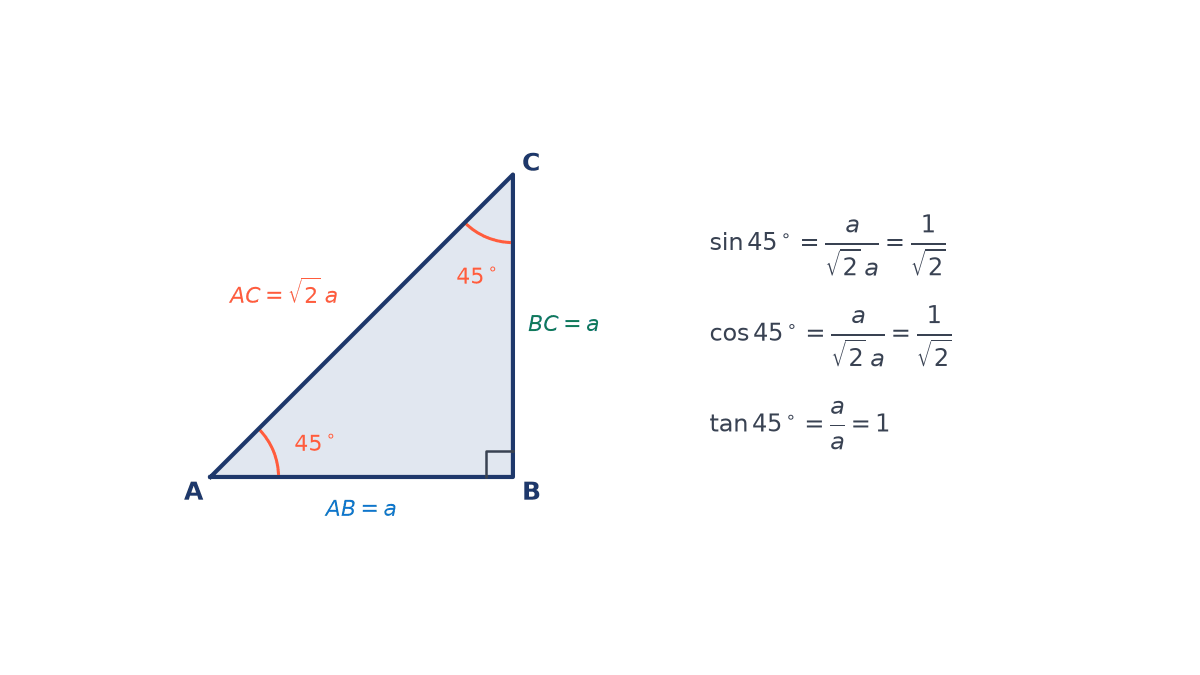
In △ABC with ∠B=90∘, suppose ∠A=45∘. The angle sum of a triangle is 180∘, so ∠C=45∘ too. Sides opposite equal angles are equal, so AB=BC. Call each of them a. By Pythagoras' theorem,
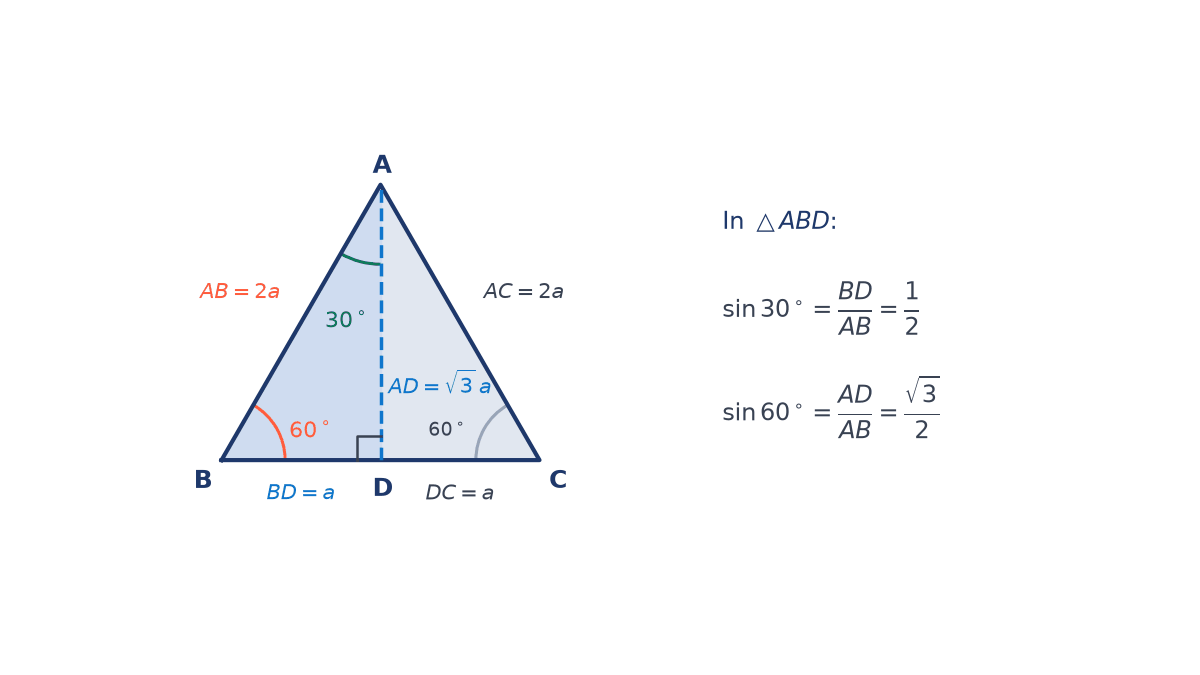
For ∠ABD=60∘ the roles swap: the opposite side is AD and the adjacent side is BD:
sin60∘=23,cos60∘=21,tan60∘=3.
The altitude of an equilateral triangle creates a 30°–60°–90° triangle with sides a, √3 a and 2a.
The ratios of 0° and 90° as limiting cases
Imagine a right triangle ABC in which ∠A keeps shrinking while the hypotenuse AC stays the same length. The opposite side BC gets shorter and shorter, and the adjacent side AB gets closer and closer to AC. As ∠A approaches 0∘, BC approaches 0 and AB approaches AC. This motivates the definitions
sin0∘=0,cos0∘=1,tan0∘=0.
Since sin0∘=0, the ratio cosec0∘=01 is not defined, and so is cot0∘. Also sec0∘=1.
Now let ∠A grow towards 90∘. Then ∠C shrinks towards 0∘, the side BC approaches AC and AB approaches 0. So
sin90∘=1,cos90∘=0,cosec90∘=1,cot90∘=0,
while tan90∘ and sec90∘ are not defined because they would need division by cos90∘=0.
The complete table
Trigonometric ratios of the standard angles
Ratio
0∘
30∘
45∘
60∘
90∘
sinA
0
21
21
23
1
cosA
1
23
21
21
0
tanA
0
31
1
3
Not defined
cosecA
Not defined
2
2
32
1
secA
1
32
2
2
Not defined
cotA
Not defined
3
1
31
0
Patterns that help you remember
The sine row can be written as 20,21,22,23,24. Note that 22=21.
The cosine row is the sine row read backwards.
Each tan entry is sine divided by cosine in the same column.
The last three rows are the reciprocals of the first three.
As A increases from 0∘ to 90∘, sinA increases from 0 to 1 and cosA decreases from 1 to 0.
Method: finding an unknown angle
Rearrange the equation so that one ratio stands alone, for example sin(A−B)=21.
Look along the correct row of the table for that value and note the angle.
Write the argument equal to that angle: A−B=30∘.
If there are two equations, solve the resulting pair of linear equations.
Check the answer against any condition given (such as A>B or A+B≤90∘) and substitute back.
If tan(A+B)=1 and tan(A−B)=31, with 0∘<A+B≤90∘ and A>B, find A and B. Answer:A=37.5∘, B=7.5∘.
Find x if cos2x=21 and 2x is acute. Answer:x=30∘.
Evaluate 1+tan230∘1−tan230∘. Answer:21.
Key terms
Standard angles
The angles 0°, 30°, 45°, 60° and 90°, whose ratios have exact values.
Isosceles right triangle
A right triangle with two equal legs; its acute angles are both 45°.
Equilateral triangle
A triangle with all sides equal and all angles 60°; its altitude splits it into two 30°–60°–90° triangles.
Not defined
A value that would require division by zero, such as tan 90° or cosec 0°.
Limiting case
The value a ratio approaches as the angle approaches 0° or 90°.
Rationalising
Multiplying numerator and denominator by a suitable surd to remove the root from the denominator.
Common questions
Do I have to derive the table in the exam?
Usually you only need the values, but a derivation for 45° or for 30° and 60° is sometimes asked as a short-answer question. Knowing the triangles also helps you recover a value you have forgotten.
Should I write 1/√2 or √2/2?
Both are correct and equal. If a question asks for a rationalised answer, use 22.
Is sin 2A equal to 2 sin A?
No. For example, sin60∘=23 but 2sin30∘=1.
Why is tan 90° not defined but sin 90° is?
sin90∘=1 is a proper number. tan90∘ would be cos90∘sin90∘=01, and division by zero has no value.
Which angle has equal sine and cosine?
Among acute angles, only 45∘, since both equal 21 there.
References
National Council of Educational Research and Training. Mathematics: Textbook for Class X. NCERT, New Delhi.
Sharma, R. D. Mathematics for Class 10. Dhanpat Rai Publications.
Loney, S. L. Plane Trigonometry. Cambridge University Press.